经济
Freakonomics
Google Books Douban
★ 7.5 13 ratings
Steven D. Levitt / Stephen J. Dubner publishing house: William Morrow 2005 - 5
Economics is not widely considered to be one of the sexier sciences. The annual Nobel Prize winner in that field never receives as much publicity as his or her compatriots in peace, literature, or physics. But if such slights are based on the notion that economics is dull, or that economists are concerned only with finance itself, Steven D. Levitt will change some minds. In Freakonomics (written with Stephen J. Dubner), Levitt argues that many apparent mysteries of everyday life don't need to be so mysterious: they could be illuminated and made even more fascinating by asking the right questions and drawing connections. For example, Levitt traces the drop in violent crime rates to a drop in violent criminals and, digging further, to the Roe v. Wade decision that preempted the existence of some people who would be born to poverty and hardship. Elsewhere, by analyzing data gathered from inner-city Chicago drug-dealing gangs, Levitt outlines a corporate structure much like McDonald's, where the top bosses make great money while scores of underlings make something below minimum wage. And in a section that may alarm or relieve worried parents, Levitt argues that parenting methods don't really matter much and that a backyard swimming pool is much more dangerous than a gun. These enlightening chapters are separated by effusive passages from Dubner's 2003 profile of Levitt in The New York Times Magazine, which led to the book being written. In a book filled with bold logic, such back-patting veers Freakonomics, however briefly, away from what Levitt actually has to say. Although maybe there's a good economic reason for that too, and we're just not getting it yet. --John Moe
Too Big to Fail
Douban Goodreads Skybridge
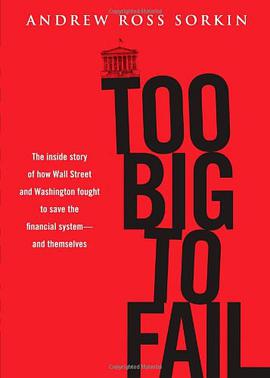
Andrew Ross Sorkin publishing house: Viking Adult 2009 - 10 other title: Too Big to Fail: The Inside Story of How Wall Street and Washington Fought to Save the Financial System from Crisis — and Themselves
Andrew Ross Sorkin delivers the first true behind-the-scenes, moment-by-moment account of how the greatest financial crisis since the Great Depression developed into a global tsunami. From inside the corner office at Lehman Brothers to secret meetings in South Korea, and the corridors of Washington, Too Big to Fail is the definitive story of the most powerful men and women in finance and politics grappling with success and failure, ego and greed, and, ultimately, the fate of the world’s economy. “We’ve got to get some foam down on the runway!” a sleepless Timothy Geithner, the then-president of the Federal Reserve of New York, would tell Henry M. Paulson, the Treasury secretary, about the catastrophic crash the world’s financial system would experience. Through unprecedented access to the players involved, Too Big to Fail re-creates all the drama and turmoil, revealing never disclosed details and elucidating how decisions made on Wall Street over the past decade sowed the seeds of the debacle. This true story is not just a look at banks that were “too big to fail,” it is a real-life thriller with a cast of bold-faced names who themselves thought they were too big to fail.
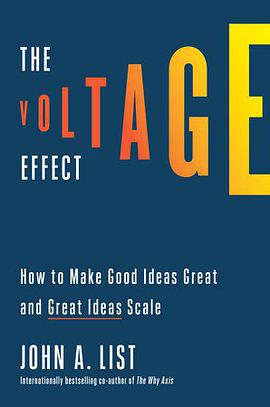
The Voltage Effect
Douban
John A. List publishing house: Currency 2022 - 2
“Scale” has become a favored buzzword in the startup world. But scale isn’t just about accumulating more users or capturing more market share. It’s about whether an idea that takes hold in a small group can do the same in a much larger one—whether you’re growing a small business, rolling out a diversity and inclusion program, or delivering billions of doses of a vaccine. Translating an idea into widespread impact, says University of Chicago economist John A. List, depends on one thing only: whether it can achieve “high voltage”—the ability to be replicated at scale. In The Voltage Effect, List explains that scalable ideas share a common set of attributes, while any number of attributes can doom an unscalable idea. Drawing on his original research, as well as fascinating examples from the realms of business, policymaking, education, and public health, he identifies five measurable vital signs that a scalable idea must possess, and offers proven strategies for avoiding voltage drops and engineering voltage gains. You’ll learn: • How celebrity chef Jamie Oliver expanded his restaurant empire by focusing on scalable “ingredients” (until it collapsed because talent doesn’t scale) • Why the failure to detect false positives early on caused the Reagan-era drug-prevention program to backfire at scale • How governments could deliver more services to more citizens if they focused on the last dollar spent • How one education center leveraged positive spillovers to narrow the achievement gap across the entire community • Why the right set of incentives, applied at scale, can boost voter turnout, increase clean energy use, encourage patients to consistently take their prescribed medication, and more. By understanding the science of scaling, we can drive change in our schools, workplaces, communities, and society at large. Because a better world can only be built at scale.
你所不知道的冰冷经济真相
Douban
袁浩 publishing house: 中国发展出版社 2012 - 4
本书从宏观经济政策解读入手,先后分析了GDP保8背后的就业压力,国进民退的结构性原因,产业空心化的形成是关键要素的非市场化等众多经济社会问题。力图为读者展现一幅中国经济的宏观画卷,希望大家能够把握时代的脉搏,找到自己的位置。