Rattle
克里斯蒂安·齐默尔曼/拉特尔:勃拉姆斯第一钢琴协奏曲
Douban Spotify
★ 9.4 10 ratings
Krystian Zimerman / Simon Rattle … genre: Classical
release date 2006-03-03 publisher: Deutsche Grammophon
齐默尔曼最新推出的这张《布拉姆斯第一钢琴协奏曲》可以说是大家期待已久的一个录音。齐默尔曼与勒图继两人与柏林爱乐乐团的精彩现场演出大获好评后,在此联手在录音室里录制了这部精彩的布拉姆斯钢琴作品。我们回头看看齐默尔曼之前推出过的唱片肖邦的作品占据了很大的数量,而对于他本人来讲演奏肖邦无疑是最得心应手,对于布拉姆斯得作品齐默尔曼则较少涉猎,而他在DG公司也只是和伯恩斯坦合作录制过一次《布拉姆斯第二钢琴协奏曲》,不过这个录音距今已经有很多年,想必齐默尔曼《布拉姆斯第一钢琴协奏曲》一定做了充分的准备和深入的研究才决定录下这个曲目。从这个曲目中我们一如以往地感受到齐默尔曼琴声中的贵气,对复杂的乐句处理轻松自如精湛的技巧可见一班,当然勒图带领下的柏林爱乐也功不可没,无论低回委婉的柔板或是气势磅礴的高潮,都能与钢琴结合得紧密和谐。可以说是一张当代大师擦出火花之力作。 (引用verycd文字)
Brahms: The Symphonies
Douban
★ 8.0 5 ratings
Simon Rattle / Berliner Philharmoniker genre: Classical
release date 2009-09-07 publisher: EMI Classics
The name of Simon Rattle had not been closely associated with the works of Johannes Brahms so it was even more rewarding when his first Brahms recording with the Berliner Philharmoniker, "Ein deutsches Requiem", won critical accolades and both Grammy and Classic FM/Gramophone awards. Now Sir Simon and the Orchestra have committed to disc the complete Brahms symphonies, recorded in concert at Berlin’s Philharmonie in the autumn of 2008. In the words of Die Zeit, "Simon Rattle has finally dared to tackle Brahms with the Berliner Philharmoniker. He combines Furtwängler’s monumentality with Karajan’s beautiful sound." The Brahms symphonies concerts drew praise from the German critics: "The fourth symphony was an ecstatic apotheosis of what current orchestral playing, quick reactions and scarcely sketched annotations can get out of this work which has long since become a classic. Especially the Passacaglia finale was a finely-dosed wonder of sound refinement and harmonic finesse. Rattle appears to have finally conquered his difficult Berliners."--Die Welt.
马勒-第九交响曲 / 拉特尔指挥柏林爱乐乐团
Douban
Simon Rattle / Berliner Philharmoniker genre: Classical
release date 2008-03-03 publisher: EMI
"The performance of Gustav Mahler’s 9th symphony was one of the most wonderful accomplishments of Simon Rattle as conductor of this orchestra." Berliner Zeitung EMI Classics are pleased to release a new recording of Gustav Mahler's Symphony No. 9 by Simon Rattle and the Berliner Philharmoniker taped live during concerts in October 2007. Sir Simon and the Orchestra subsequently performed the symphony at the Salzburg and Lucerne festivals before taking it to America in November, where they headlined Carnegie Hall's "Berlin in Lights" festival and performed it again in Boston's Symphony Hall. To coincide with the "Berlin in Lights" festival, EMI made available a digital pre-release of the album.
Bruckner: Symphony No. 4
Douban
Berliner Philharmoniker / Simon Rattle
release date 2007-05-08 publisher: EMI Classics
Following up their release of Brahm's Ein Deutsches Requiem, Sir Simon Rattle and the Berliner Philharmoniker continue to celebrate the orchestra's 125th year with an exploration of the 19th-century Germanic greats. On this recording they take on Bruckner's mighty Fourth Symphony, an uplifting spiritual journey across a huge musical landscape which commands the listener's attention and promises to remain in memory long after the final chords have died away. Speaking of the individuality and overwhelming power of Bruckner's music, Rattle had this to say: "It's as though one's caught up in a gigantic wave...which simply will not stop until the last note and in fact when the last note is sounded, very often the audience simply doesn't applaud because there's a feeling to it still going out into space..." Tracklisting: Anton Bruckner (1824-1896) Symphony No.4 in E-Flat Major "Romantic" 1. Bewegt, nicht zu schnell 2. Andante quasi allegretto 3. Scherzo- trio 4. Finale
The Essential Falla
Douban
Alicia de Larrocha / Eduardo Fernandez …
release date 1999-10-12 publisher: Decca
Disc 1: 01 El amor brujo - Introducción y escena...en la cueva 02 El amor brujo - Canción del amor dolido 03 El amor brujo - El Aparecido...Danza del Terror 04 El amor brujo - El Círculo Mágico...A media noche 05 El amor brujo - Danza ritual del fuego, para ahuyentar los malos espí- 06 El amor brujo - Escena 07 El amor brujo - Canción del fuego fátuo 08 El amor brujo - Pantomima 09 El amor brujo - Danza del juego de amor 10 El amor brujo - Final. Les campanas del amanecer 11 Concerto for Harpsichord, Flute, Oboe, Clarinet, Violin, and Cello - 1. Allegro 12 Concerto for Harpsichord, Flute, Oboe, Clarinet, Violin, and Cello - 2. Lento 13 Concerto for Harpsichord, Flute, Oboe, Clarinet, Violin, and Cello - 3. Vivace 14 Homenaje "Le tombeau de Debussy" 15 Psyche 16 Nights in the Gardens of Spain - 1. En el generalife 17 Nights in the Gardens of Spain - 2. Danza lejana 18 Nights in the Gardens of Spain - 3. En los jardines de la Sierra de Cordoba Disc 2: 01 La vida breve - Interlude - Spanish Dance No.1 02 7 Canciones populares españolas - No.1: El paño moruno 03 7 Canciones populares españolas - No.2: Seguidilla murciana 04 7 Canciones populares españolas - No.3: Asturiana 05 7 Canciones populares españolas - No.4: Jota 06 7 Canciones populares españolas - No.5: Nana 07 7 Canciones populares españolas - No.6: Canción 08 7 Canciones populares españolas - No.7: Polo 09 Cuatro piezas españolas - 1. Aragonesa 10 Cuatro piezas españolas - 2. Cubana 11 Cuatro piezas españolas - 3. Montanesa 12 Cuatro piezas españolas - 4. Andaluza 13 El sombrero de tres picos - Part 1 - Introduction 14 El sombrero de tres picos - Part 1 - Afternoon 15 El sombrero de tres picos - Part 1 - Dance of the miller's wife 16 El sombrero de tres picos - Part 1 - The grapes 17 El sombrero de tres picos - Part 2 - Dance of the neighbours 18 El sombrero de tres picos - Part 2 - The miller's dance 19 El sombrero de tres picos - Part 2 - The corregidor's dance 20 El sombrero de tres picos - Part 2 - Final dance
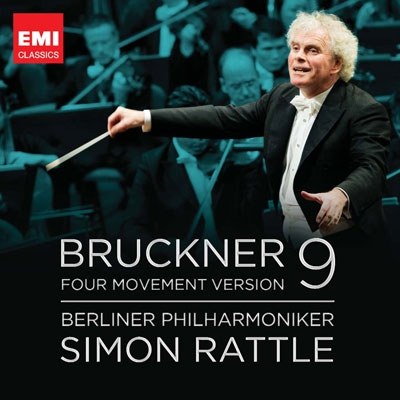
Bruckner: Symphony No. 9
Douban
Sir Simon Rattle / Berliner Philharmoniker genre: Classical
release date 2012-05-21 publisher: EMI Classics
Sir Simon Rattle conducts the Berliner Philharmoniker in Anton Bruckner’s Symphony No. 9 including the world premiere of the latest scholarly revision of the fourth movement that the composer left unfinished at his death. Sir Simon and the Orchestra unveiled the new version at Berlin’s Philharmonie in early February 2012 and at New York’s Carnegie Hall the same month. “It was fascinating to hear this monumental symphony performed with [its new] final movement. After a quizzical opening and a strong statement of the main theme there are stretches of fitful counterpoint, brass chorales and ruminative passages that take you by surprise. Overall the music pulses with a hard-wrought insistence that crests with a hallelujah coda.” (The New York Times) On 11 October 1896, the day he died, Bruckner was still desperately trying to finish the final movement of his ninth symphony. He had completed and orchestrated one third of the movement and sketched the layout for the entire finale. Unfortunately, for scholars attempting to construct the remaining two thirds of the movement, many of the manuscript pages were subsequently stolen by autograph hunters. Some of these pages have resurfaced in recent years and several attempts have been made to complete the last movement, including four prior versions by the current musicological team of Nicola Samale, Giuseppe Mazzuca, John Phillips and Benjamin-Gunnar Cohrs. “From a fresh re-examination of the manuscripts it was possible to find some convincing new solutions, binding the music even better together.” (Benjamin-Gunnar Cohrs). With the benefit of 25 years of scholarship, this latest version is arguably the most comprehensive realisation of Bruckner’s sketches. John Phillips adds, “The Finale is no musical curiosity, but an integral part of the work as its composer intended. Just as Beethoven designed his last symphony around its choral finale, Bruckner designed his Ninth around this huge, ultimately triumphant movement, synthesizing sonata form, fugue, and chorale. For the devoutly Catholic Bruckner, the symphony was to be his “homage to Divine majesty” […] The Adagio, his “Farewell to Life,” traces a gradual process of dissolution that leads us, spellbound, into the enigmatic music of the Finale [which] would end with a “song of praise to the dear Lord,” a “Hallelujah” borrowed from earlier in the work. And it is with this “Hallelujah” theme—the first entry of the trumpets in the Adagio—that the Ninth can so justly and so gloriously now conclude.” In an interview for the Berlin Philharmonic's Digital Concert Hall, Sir Simon expressed his faith in the newly assembled four-movement version and begged audiences to be receptive to the new material. “There's a kind of myth that there are only sketches left of the last movement. In fact, there was really an emerging full score, complete almost to the end,” Rattle said, adding that Bruckner was writing in his most radical, forward-looking style in the Ninth, especially in the finale. According to Gramophone, ‘to help listeners understand just how ‘complete’ the finale actually was at the time of Bruckner's death, Rattle compared the composer to an architect designing a cathedral. Indeed, Bruckner had the rather unique composition method of deciding how long his movements should be and then putting all the bars on the manuscript, numbered and with phrase lengths, even before writing the first note. “So actually, even when there are some empty pages, we know exactly how many bars there were and what kind of phrases there were,” concluded Rattle, explaining how much of the manuscript evidence was strewn throughout various collections. He also said that had the composer lived another two months, the finale would have been complete.’ For music lovers who discount the validity of any fourth movement to the Symphony No. 9, there is much to enjoy in the Berliner Philharmoniker’s performance of the first three movements: “Mr. Rattle and the Berlin players deftly balanced elements of Schubertian structure and Wagnerian turmoil in the mysterious first movement. The brutal power of the scherzo’s main theme was chilling, with the orchestra pummelling the dense, thick, dissonance-tinged chords. And Mr. Rattle laid out the threads of chromatic counterpoint in an organic, glowing and, when appropriate, gnashing account of the Adagio.” (The New York Times) For those with the intellectual curiosity to hear how accomplished Bruckner scholars have most recently realised the unfinished movement, it is performed here by the world-renowned team of Sir Simon Rattler and the Berliner Philharmoniker.
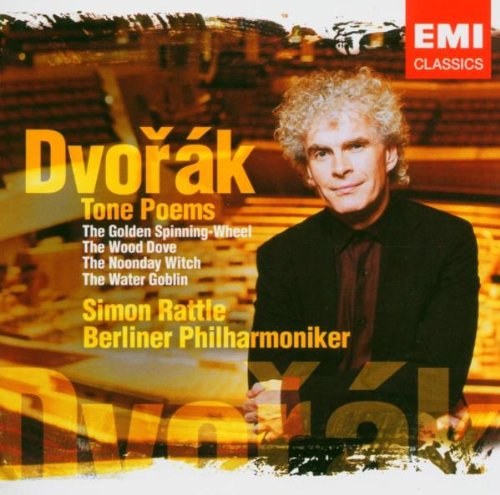
Dvorák: Tone Poems
Douban
Sir Simon Rattle
release date 2005-07-04 publisher: EMI
Disc 1 01 Golden Spinning Wheel: Allegro, ma non troppo 02 Golden Spinning Wheel: Molto vivace (Fig 9) 03 Golden Spinning Wheel: Lento (Fig 15) 04 Golden Spinning Wheel: Allegro, ma non troppo (Fig 19) 05 Wood Dove: Andante, Marcia funebre 06 Wood Dove: Allegro 07 Wood Dove: Molto vivace 08 Wood Dove: Andante Disc 2 01 Noon Witch: Allegretto 02 Noon Witch: Andante sostenuto e molto tranquillo 03 Noon Witch: Andante 04 Water Goblin: Allegro vivo 05 Water Goblin: Andante mesto come prima (Fig 13) 06 Water Goblin: Un poco piu mosso (Fig 19) 07 Water Goblin: Allegro vivace (Fig 24)
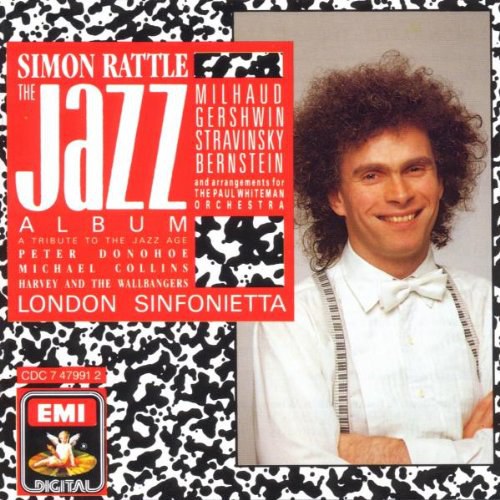
The Simon Rattle Jazz Album
Douban
Simon Rattle genre: Jazz
release date 1987-11-18 publisher: Capitol
賽門·丹尼斯·拉圖爵士,OM,CBE,FRSA,生於利物浦,英國指揮家,曾任柏林愛樂樂團首席指揮,現任倫敦交響樂團音樂總監。
Listened
Jan. 29, 2013
拉特的发型和这曲目真是相当搭~不知道的还以为这货就是搞爵士的
LSttaO Rattle 拉特尔 Jazz