智能
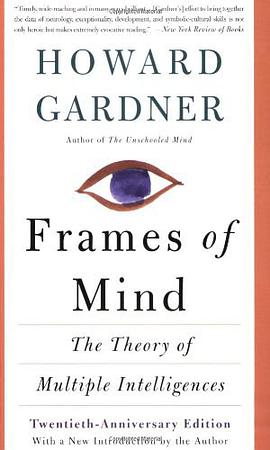
Frames Of Mind
Frames of Mind: The Theory of Multiple Intelligences Douban Goodreads
Howard E. Gardner / Howard Gardner publishing house: Basic Books 1993 - 4 other title: Frames of Mind: The Theory of Multiple Intelligences
A revolutionary challenge to the widely held notion that intelligence is a single general capacity possessed by every individual to a greater or lesser extent. Gardner's trailblazing book revolutionized the worlds of education and psychology by positing that rather than a single type of intelligence, we have several--most of which are neglected by standard testing and educational methods. More than 200,00 copies of earlier editions have been sold; this reissue includes a new introduction by the author to mark the twenty-first birthday of this remarkable book. Download PDF http://uploading.com/files/ae6de5f6/0... http://www.filesonic.com/file/1882814... http://depositfiles.com/files/vx6nj38a9

Principles of Synthetic Intelligence PSI
Douban
Bach, Joscha 2009 - 4
Although computational models of cognition have become very popular, these models are relatively limited in their coverage of cognition-- they usually only emphasize problem solving and reasoning, or treat perception and motivation as isolated modules. The first architecture to cover cognition more broadly is Psi theory, developed by Dietrich Dorner. By integrating motivation and emotion with perception and reasoning, and including grounded neuro-symbolic representations, Psi contributes significantly to an integrated understanding of the mind. It provides a conceptual framework that highlights the relationships between perception and memory, language and mental representation, reasoning and motivation, emotion and cognition, autonomy and social behavior. It is, however, unfortunate that Psi's origin in psychology, its methodology, and its lack of documentation have limited its impact. The proposed book adapts Psi theory to cognitive science and artificial intelligence, by elucidating both its theoretical and technical frameworks, and clarifying its contribution to how we have come to understand cognition.