機器人學
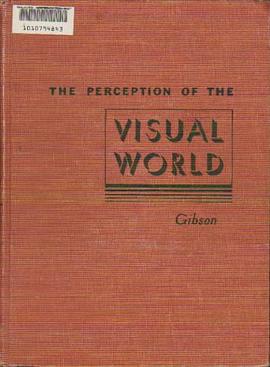
The Ecological Approach To Visual Perception
The Ecological Approach to Visual Perception Douban Goodreads
James J. Gibson publishing house: Psychology Press 1986 - 9 other title: The Ecological Approach to Visual Perception
This is a book about how we see: the environment around us (its surfaces, their layout, and their colors and textures); where we are in the environment; whether or not we are moving and, if we are, where we are going; what things are good for; how to do things (to thread a needle or drive an automobile); or why things look as they do. The basic assumption is that vision depends on the eye which is connected to the brain. The author suggests that natural vision depends on the eyes in the head on a body supported by the ground, the brain being only the central organ of a complete visual system. When no constraints are put on the visual system, people look around, walk up to something interesting and move around it so as to see it from all sides, and go from one vista to another. That is natural vision -- and what this book is about.
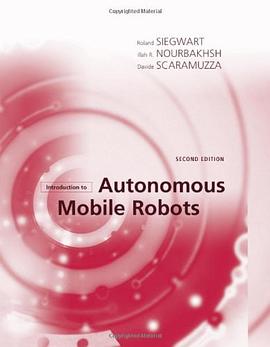
Introduction to Autonomous Mobile Robots
Douban
Siegwart, Roland; Nourbakhsh, Illah R.; Scaramuzza, Davide 2011 - 2
Mobile robots range from the Mars Pathfinder mission's teleoperated Sojourner to the cleaning robots in the Paris Metro. This text offers students and other interested readers an introduction to the fundamentals of mobile robotics, spanning the mechanical, motor, sensory, perceptual, and cognitive layers the field comprises. The text focuses on mobility itself, offering an overview of the mechanisms that allow a mobile robot to move through a real world environment to perform its tasks, including locomotion, sensing, localization, and motion planning. It synthesizes material from such fields as kinematics, control theory, signal analysis, computer vision, information theory, artificial intelligence, and probability theory. The book presents the techniques and technology that enable mobility in a series of interacting modules. Each chapter treats a different aspect of mobility, as the book moves from low-level to high-level details. It covers all aspects of mobile robotics, including software and hardware design considerations, related technologies, and algorithmic techniques.] This second edition has been revised and updated throughout, with 130 pages of new material on such topics as locomotion, perception, localization, and planning and navigation. Problem sets have been added at the end of each chapter. Bringing together all aspects of mobile robotics into one volume, Introduction to Autonomous Mobile Robots can serve as a textbook or a working tool for beginning practitioners.
The Handbook of Brain Theory and Neural Networks
The Handbook of Brain Theory and Neural Networks Goodreads Douban
Arbib, Michael A. 编 publishing house: Bradford Book 2002 - 11
Dramatically updating and extending the first edition, published in 1995, the second edition of The Handbook of Brain Theory and Neural Networks presents the enormous progress made in recent years in the many subfields related to the two great questions: How does the brain work? and, How can we build intelligent machines?Once again, the heart of the book is a set of almost 300 articles covering the whole spectrum of topics in brain theory and neural networks. The first two parts of the book, prepared by Michael Arbib, are designed to help readers orient themselves in this wealth of material. Part I provides general background on brain modeling and on both biological and artificial neural networks. Part II consists of "Road Maps" to help readers steer through articles in part III on specific topics of interest. The articles in part III are written so as to be accessible to readers of diverse backgrounds. They are cross-referenced and provide lists of pointers to Road Maps, background material, and related reading.The second edition greatly increases the coverage of models of fundamental neurobiology, cognitive neuroscience, and neural network approaches to language. It contains 287 articles, compared to the 266 in the first edition. Articles on topics from the first edition have been updated by the original authors or written anew by new authors, and there are 106 articles on new topics.
Probabilistic Robotics (Intelligent Robotics and Autonomous Agents)
Douban
Sebastian Thrun / Wolfram Burgard … publishing house: The MIT Press 2005 - 1
Probabilistic robotics is a new and growing area in robotics, concerned with perception and control in the face of uncertainty. Building on the field of mathematical statistics, probabilistic robotics endows robots with a new level of robustness in real-world situations. This book introduces the reader to a wealth of techniques and algorithms in the field. All algorithms are based on a single overarching mathematical foundation. Each chapter provides example implementations in pseudo code, detailed mathematical derivations, discussions from a practitioner's perspective, and extensive lists of exercises and class projects.
The Complexity of Robot Motion Planning
Douban
Canny, John F. 1988 - 6
The Complexity of Robot Motion Planning makes original contributions both to robotics and to the analysis of algorithms. In this groundbreaking monograph John Canny resolves long-standing problems concerning the complexity of motion planning and, for the central problem of finding a collision free path for a jointed robot in the presence of obstacles, obtains exponential speedups over existing algorithms by applying high-powered new mathematical techniques.Canny's new algorithm for this "generalized movers' problem," the most-studied and basic robot motion planning problem, has a single exponential running time, and is polynomial for any given robot. The algorithm has an optimal running time exponent and is based on the notion of roadmaps - one-dimensional subsets of the robot's configuration space. In deriving the single exponential bound, Canny introduces and reveals the power of two tools that have not been previously used in geometric algorithms: the generalized (multivariable) resultant for a system of polynomials and Whitney's notion of stratified sets. He has also developed a novel representation of object orientation based on unnormalized quaternions which reduces the complexity of the algorithms and enhances their practical applicability.After dealing with the movers' problem, the book next attacks and derives several lower bounds on extensions of the problem: finding the shortest path among polyhedral obstacles, planning with velocity limits, and compliant motion planning with uncertainty. It introduces a clever technique, "path encoding," that allows a proof of NP-hardness for the first two problems and then shows that the general form of compliant motion planning, a problem that is the focus of a great deal of recent work in robotics, is non-deterministic exponential time hard. Canny proves this result using a highly original construction.John Canny received his doctorate from MIT And is an assistant professor in the Computer Science Division at the University of California, Berkeley. The Complexity of Robot Motion Planning is the winner of the 1987 ACM Doctoral Dissertation Award.
Applied Optimal Estimation
Douban
A Gelb publishing house: MIT Press 1974 - 1
This is the first book on the optimal estimation that places its major emphasis on practical applications, treating the subject more from an engineering than a mathematical orientation. Even so, theoretical and mathematical concepts are introduced and developed sufficiently to make the book a self-contained source of instruction for readers without prior knowledge of the basic principles of the field. The work is the product of the technical staff of the The Analytic Sciences Corporation (TASC), an organization whose success has resulted largely from its applications of optimal estimation techniques to a wide variety of real situations involving large-scale systemsArthur Gelb writes in the Foreword that "It is our intent throughout to provide a simple and interesting picture of the central issues underlying modern estimation theory and practice. Heuristic, rather than theoretically elegant, arguments are used extensively, with emphasis on physical insights and key questions of practical importance."Numerous illustrative examples, many based on actual applications, have been interspersed throughout the text to lead the student to a concrete understanding of the theoretical material. The inclusion of problems with "built-in" answers at the end of each of the nine chapters further enhances the self-study potential of the text.After a brief historical prelude, the book introduces the mathematics underlying random process theory and state-space characterization of linear dynamic systems. The theory and practice of optimal estimation is them presented, including filtering, smoothing, and prediction. Both linear and non-linear systems, and continuous- and discrete-time cases, are covered in considerable detail. New results are described concerning the application of covariance analysis to non-linear systems and the connection between observers and optimal estimators. The final chapters treat such practical and often pivotal issues as suboptimal structure, and computer loading considerations.This book is an outgrowth of a course given by TASC at a number of US Government facilities. Virtually all of the members of the TASC technical staff have, at one time and in one way or another, contributed to the material contained in the work
Learning Robotics using Python
Douban
Lentin Joseph publishing house: Packt Publishing 2015 - 5
About This Book Design, simulate, build and program an interactive autonomous mobile robotProgram Robot Operating System using PythonGet a grip on the hands-on guide to robotics for learning various robotics concepts and build an advanced robot from scratch Who This Book Is For If you are an engineer, a researcher, or a hobbyist, and you are interested in robotics and want to build your own robot, this book is for you. Readers are assumed to be new to robotics but should have experience with Python. What You Will Learn Understand the core concepts and terminologies of robotics Create 2D and 3D drawings of robots using freeware such as LibreCAD and Blender Simulate your robot using ROS and Gazebo Build robot hardware from the requirements Explore a diverse range of actuators and its interfacing Interface various robotic sensors to robots Set up and program OpenCV, OpenNI, and PCL to process 2D/3D visual data Learn speech processing and synthesis using Python Apply artificial intelligence to robots using Python Build a robot control GUI using Qt and Python Calibration and testing of robot In Detail Learning about robotics will become an increasingly essential skill as it becomes a ubiquitous part of life. Even though robotics is a complex subject, several other tools along with Python can help you design a project to create an easy-to-use interface. Learning Robotics Using Python is an essential guide for creating an autonomous mobile robot using popular robotic software frameworks such as ROS using Python. It also discusses various robot software frameworks and how to go about coding the robot using Python and its framework. It concludes with creating a GUI-based application to control the robot using buttons and slides. By the end of this tutorial, you'll have a clear idea of how to integrate and assemble all things into a robot and how to bundle the software package.
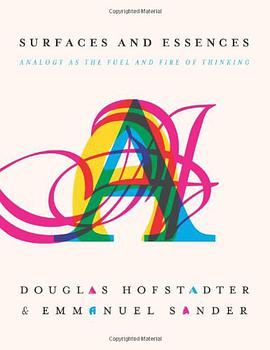
Surfaces and Essences
Douban Goodreads
Douglas Hofstadter / Emmanuel Sander publishing house: Basic Books 2013 - 4 other title: Surfaces and Essences: Analogy as the Fuel and Fire of Thinking
<b> <i>Analogy is the core of all thinking.</i> </b><br /><br />This is the simple but unorthodox premise that Pulitzer Prize–winning author Douglas Hofstadter and French psychologist Emmanuel Sander defend in their new work. Hofstadter has been grappling with the mysteries of human thought for over thirty years. Now, with his trademark wit and special talent for making complex ideas vivid, he has partnered with Sander to put forth a highly novel perspective on cognition.<br /><br />We are constantly faced with a swirling and intermingling multitude of ill-defined situations. Our brain’s job is to try to make sense of this unpredictable, swarming chaos of stimuli. How does it do so? The ceaseless hail of input triggers analogies galore, helping us to pinpoint the essence of what is going on. Often this means the spontaneous evocation of words, sometimes idioms, sometimes the triggering of nameless, long-buried memories.<br /><br />Why did two-year-old Camille proudly exclaim, “I undressed the banana!”? Why do people who hear a story often blurt out, “Exactly the same thing happened to me!” when it was a completely different event? How do we recognize an aggressive driver from a split-second glance in our rearview mirror? What in a friend’s remark triggers the offhand reply, “That’s just sour grapes”? What did Albert Einstein see that made him suspect that light consists of particles when a century of research had driven the final nail in the coffin of that long-dead idea?<br /><br />The answer to all these questions, of course, is <i>analogy-making</i>—the meat and potatoes, the heart and soul, the fuel and fire, the gist and the crux, the lifeblood and the wellsprings of thought. Analogy-making, far from happening at rare intervals, occurs at all moments, defining thinking from top to toe, from the tiniest and most fleeting thoughts to the most creative scientific insights.<br /><br />Like <i>Gödel, Escher, Bach</i> before it, <i>Surfaces and Essences</i> will profoundly enrich our understanding of our own minds. By plunging the reader into an extraordinary variety of colorful situations involving language, thought, and memory, by revealing bit by bit the constantly churning cognitive mechanisms normally completely hidden from view, and by discovering in them one central, invariant core—the incessant, unconscious quest for strong analogical links to past experiences—this book puts forth a radical and deeply surprising new vision of the act of thinking.<br />
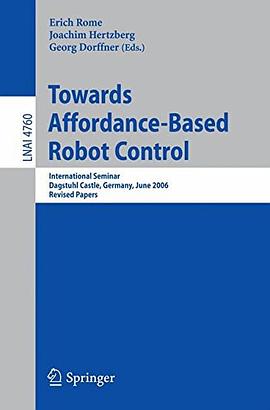
Towards Affordance-Based Robot Control
Douban
Dorffner, Georg 编 publishing house: Springer 2008 - 3
Todaya (TM)s mobile robot perception is insufficient for acting goal-directedly in unconstrained, dynamic everyday environments like a home, a factory, or a city. Subject to restrictions in bandwidth, computer power, and computation time, a robot has to react to a wealth of dynamically changing stimuli in such environments, requiring rapid, selective attention to decisive, action-relevant information of high current utility. Robust and general engineering methods for effectively and efficiently coupling perception, action and reasoning are unavailable. Interesting performance, if any, is currently only achieved by sophisticated robot programming exploiting domain features and specialties, which leaves ordinary users no chance of changing how the robot acts. The purpose of this volume - outcome of a GI-Dagstuhl Seminar held in Dagstuhl Castle in June 2006 - is to give a first overview on the concept of affordances for the design and implementation of autonomous mobile robots acting goal-directedly in a dynamic environment. The aim is to develop affordance-based control as a method for robotics. The potential of this new methodology will be shown by going beyond navigation-like tasks towards goaldirected autonomous manipulation in the project demonstrators.
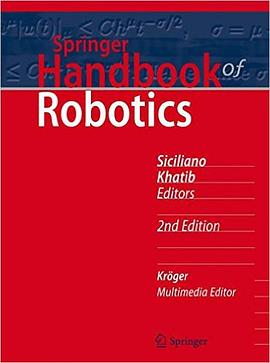
Springer Handbook of Robotics (Springer Handbooks)
Douban
Bruno Siciliano / Oussama Khatib publishing house: Springer 2016 - 6
The first edition of the handbook soon became a landmark in robotics publishing and won the American Association of Publishers PROSE Award for Excellence in Physical Sciences & Mathematics as well as the organization’s Award for Engineering & Technology. The second edition of the handbook, edited by two internationally renowned scientists with the support of an outstanding team of seven part editors and more than 200 authors, continues to be an authoritative reference for robotics researchers, newcomers to the field, and scholars from related disciplines. The contents have been restructured to achieve four main objectives: the enlargement of foundational topics for robotics, the enlightenment of design of various types of robotic systems, the extension of the treatment on robots moving in the environment, and the enrichment of advanced robotics applications. Further to an extensive update, fifteen new chapters have been introduced on emerging topics, and a new generation of authors have joined the handbook’s team. A novel addition to the second edition is a comprehensive collection of multimedia references to more than 700 videos, which bring valuable insight into the contents. The videos can be viewed directly augmented into the text with a smartphone or tablet using a unique and specially designed app.
Robotic Navigation and Mapping with Radar
Douban
Adams, Martin; Mullane, John; Jose, Ebi 2012 - 8
Focusing on autonomous robotic applications, this cutting-edge resource offers a practical treatment of short-range radar processing for reliable object detection at the ground level. This unique book demonstrates probabilistic radar models and detection algorithms specifically for robotic land vehicles. Engineers and researchers may find detailed coverage of Simultaneous Localization and Map Building (SLAM) - an area referred to as the "Holy Grail" of autonomous robotics research.
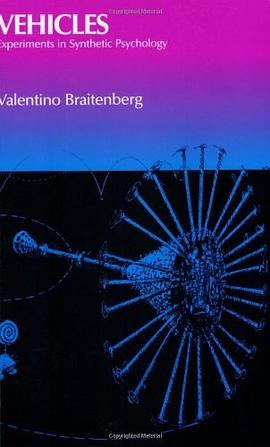
Vehicles
Douban Goodreads Skybridge
Valentino Braitenberg publishing house: A Bradford Book / MIT Press 1986 - 2 other title: Vehicles: Experiments in Synthetic Psychology
These imaginative thought experiments are the inventions of one of the world's eminent brain researchers. They are "vehicles," a series of hypothetical, self-operating machines that exhibit increasingly intricate if not always successful or civilized "behavior." Each of the vehicles in the series incorporates the essential features of all the earlier models and along the way they come to embody aggression, love, logic, manifestations of foresight, concept formation, creative thinking, personality, and free will. In a section of extensive biological notes, Braitenberg locates many elements of his fantasy in current brain research.Valentino Braitenberg is a director of the Max Planck Institute of Biological Cybernetics and Honorary Professor of Information Science at the University of TA1/4bingen, West Germany. A Bradford Book.