医疗
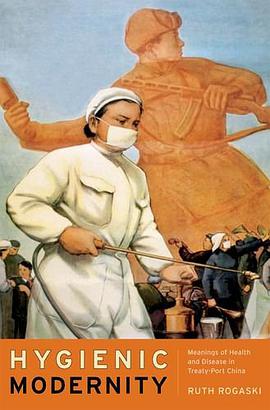
Hygienic Modernity Douban
★ 9.3 (7 ratings) author: Ruth Rogaski publishing house: University of California Press 2004 - 11
Placing meanings of health and disease at the center of modern Chinese consciousness, Ruth Rogaski reveals how hygiene became a crucial element in the formulation of Chinese modernity in the nineteenth and twentieth centuries. Rogaski focuses on multiple manifestations across time of a single Chinese concept, weisheng—which has been rendered into English as "hygiene," "sanitary," "health," or "public health"—as it emerged in the complex treaty-port environment of Tianjin. Before the late nineteenth century, weisheng was associated with diverse regimens of diet, meditation, and self-medication. Hygienic Modernity reveals how meanings of weisheng, with the arrival of violent imperialism, shifted from Chinese cosmology to encompass such ideas as national sovereignty, laboratory knowledge, the cleanliness of bodies, and the fitness of races: categories in which the Chinese were often deemed lacking by foreign observers and Chinese elites alike.
Colonizing Sex Douban
author: Sabine Frühstück publishing house: University of California Press 2003 - 10
A sweeping study of sex, power, and knowledge in modern Japan, this ambitious work provides the first full-scale, detailed history of the formation and application of a science of sex from Meiji through mid-twentieth century Japan. Tracing the different uses made of sexual knowledge, the book brings to light the complex and subtle interplay between sexuality, scientific expertise, social control, and empire building.
Drawing on a wide variety of sources, Frühstück analyzes the conflicts and negotiations that aimed at producing a normative sexuality. She shows how the "colonization" of sex was enacted through debates over several issues: the necessity of sex education; the prevention of venereal diseases; the problem of masturbation and its alleged consequences; the legalization of birth control; the fight against prostitution; the emergence of eugenics; and, eventually, the implementation of "racial hygiene" policies. In Colonizing Sex we see how these struggles were driven by rhetoric consisting of cries for defense, liberation, and truth—emphasizing in every historical moment how the sexual body has been, and is, part of much broader currents in political, cultural, and social life.
Contents
List of Illustrations
Acknowledgments
Introduction
1. Erecting a Modern Health Regime
2. Debating Sex Education
3. Sexology for the Masses
4. Claiming the Fetus
5. Breeding the Japanese "Race"
Epilogue
Notes
Bibliography
Index
Impure Science Douban
author: Steven Epstein publishing house: University of California Press 1996 - 1
In the short, turbulent history of AIDS research and treatment, the boundaries between scientist insiders and lay outsiders have been crisscrossed to a degree never before seen in medical history. Steven Epstein's astute and readable investigation focuses on the critical question of 'how certainty is constructed or deconstructed', leading us through the views of medical researchers, activists, policy makers, and others to discover how knowledge about AIDS emerges out of what he calls 'credibility struggles'. Epstein shows the extent to which AIDS research has been a social and political phenomenon and how the AIDS movement has transformed biomedical research practices through its capacity to garner credibility by novel strategies. Epstein finds that non scientist AIDS activists have gained enough of a voice in the scientific world to shape NIH-sponsored research to a remarkable extent. Because of the blurring of roles and responsibilities, the production of biomedical knowledge about AIDS does not, he says, follow the pathways common to science; indeed, AIDS research can only be understood as a field that is unusually broad, public, and contested. He concludes by analyzing recent moves to democratize biomedicine, arguing that although AIDS activists have set the stage for new challenges to scientific authority, all social movements that seek to democratize expertise face unusual difficulties. Avoiding polemics and accusations, Epstein provides a benchmark account of the AIDS epidemic to date, one that will be as useful to activists, policy makers, and general readers as to sociologists, physicians, and scientists.

Sex Cells Douban
author: Almeling, Rene publishing house: University of California Press 2011 - 9
Unimaginable until the twentieth century, the clinical practice of transferring eggs and sperm from body to body is now the basis of a bustling market. In "Sex Cells", Rene Almeling provides an inside look at how egg agencies and sperm banks do business. Although both men and women are usually drawn to donation for financial reasons, Almeling finds that clinics encourage sperm donors to think of the payments as remuneration for an easy 'job.' Women receive more money but are urged to regard egg donation in feminine terms, as the ultimate 'gift' from one woman to another. "Sex Cells" shows how the gendered framing of paid donation, as either a job or a gift, not only influences the structure of the market, but also profoundly affects the individuals whose genetic material is being purchased.
April 25, 2018 read
提了一个很有意思的经验问题(为什么捐精和捐卵的经济回报和frame不一样),和文化/医疗/经济社会学对话,讨论在特定文化和医疗领域中定价的问题。基本论点是说有同样功能的sex cells因为由不同的sexed bodies生产出来,因此也就和后者在社会中的文化意义(父/母职)勾连了起来,继而影响到了不同的组织形式、frame和定价。作者在理论中试图弥补社会学家对“sexed bodies"的忽视,听起来很棒,但是她的分析在我看来大多仍然停留在gendered bodies,并没有真正地将她一直在提的生物特性放入分析的框架。另外,她更多地视定价为结果而非过程来进行分析,导致在这一核心问题上的很多分析流于表面。
经济 医疗 社会学 美国
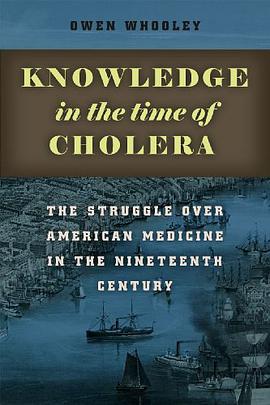
Knowledge in the Time of Cholera Douban
author: Whooley, Owen publishing house: University of Chicago Press 2013 - 4
Vomiting. Diarrhea. Dehydration. Death. Confusion. In 1832, the arrival of cholera in the United States created widespread panic throughout the country. For the rest of the century, epidemics swept through American cities and towns, killing thousands. Physicians of all stripes offered conflicting answers to the cholera puzzle, ineffectively responding with opiates, bleeding, quarantines, and all manner of remedies, before the identity of the dreaded infection was consolidated under the germ theory of disease some sixty years later. These cholera outbreaks raised fundamental questions about medical knowledge and its legitimacy, giving fuel to alternative medical sects that used the confusion of the epidemic to challenge both medical orthodoxy and the authority of the still-new American Medical Association. In "Knowledge in the Time of Cholera", Owen Whooley tells us the story of those dark days, centering his narrative on rivalries between medical and homeopathic practitioners and bringing to life the battle to control public understanding of disease, professional power, and democratic governance in nineteenth-century America.
April 11, 2018 read
Historical epistemology。政治和社会角色如何影响认识论并使特定的科学和实践得以可能。强社会建构视角并且有点过分强调关于认识论本身的政治而忽略了疾病本身,以至于很多地方看起来非常阴谋论。
医疗 知识 社会学 美国
Metrics Douban
author: Vincanne Adams publishing house: Duke University Press 2016 - 3
This volume's contributors evaluate the accomplishments, limits, and consequences of using quantitative metrics in global health. Whether analyzing maternal mortality rates, the relationships between political goals and metrics data, or the links between health outcomes and a program's fiscal support, the contributors question the ability of metrics to solve global health problems. They capture a moment when global health scholars and practitioners must evaluate the potential effectiveness and pitfalls of different metrics—even as they remain elusive and problematic.
Contributors. Vincanne Adams, Susan Erikson, Molly Hales, Pierre Minn, Adeola Oni-Orisan, Carolyn Smith-Morris, Marlee Tichenor, Lily Walkover, Claire L. Wendland
Inclusion Douban
author: Steven Epstein publishing house: University Of Chicago Press 2009 - 4
With "Inclusion", Steven Epstein argues that strategies to achieve diversity in medical research mask deeper problems, ones that might require a different approach and different solutions. Formal concern with this issue, Epstein shows, is a fairly recent phenomenon. Until the mid-1980s, scientists often studied groups of white, middle-aged men - and assumed that conclusions drawn from studying them would apply to the rest of the population. But struggles involving advocacy groups, experts, and Congress led to reforms that forced researchers to diversify the population from which they drew for clinical research. While the prominence of these inclusive practices has offered hope to traditionally undeserved groups, Epstein argues that it has drawn attention away from the tremendous inequalities in health that are rooted not in biology but in society.
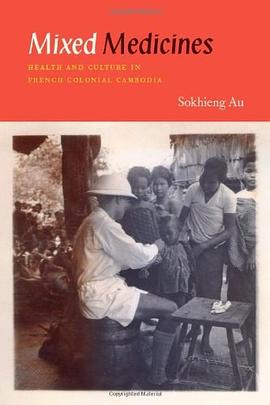
Mixed Medicines Douban
author: Sokhieng Au publishing house: University Of Chicago Press 2011 - 4
During the first half of the twentieth century, representatives of the French colonial health services actively strove to expand the practice of Western medicine in the frontier colony of Cambodia. But as the French physicians ventured beyond their colonial enclaves, they found themselves negotiating with the plurality of Cambodian cultural practices relating to health and disease. These negotiations were marked by some success, a great deal of misunderstanding, and much failure. Bringing together colorful historical vignettes, social and anthropological theory, and quantitative analyses, "Mixed Medicines" examines these interactions between the Khmer, Cham, and Vietnamese of Cambodia and the French, documenting the differences in their understandings of medicine and revealing the unexpected transformations that occurred during this period - for both the French and the indigenous population. A compelling social history, "Mixed Medicines" will be welcomed by anyone interested in the globalization of scientific and medical practices.
Feb. 23, 2018 read
殖民医疗史,草草翻过。感觉这类研究其实都差不多,殖民医学/知识/文化和本土的纠葛。作者受人类学影响很深,强调文化的不可通约性。三种关于麻风不同理解和实践的纠结挺有意思。
医疗 历史 柬埔寨 美国
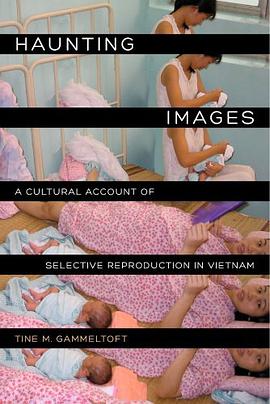
Luc Xi Douban
author: Phung, Vu Trong / VuTrong Phung … translator: Malarney, Shaun Kingsley 2011 - 4
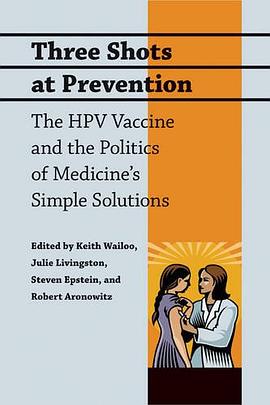
Three Shots at Prevention Douban
publishing house: Johns Hopkins University Press 2010 - 8
In 2007, Texas governor Rick Perry issued an executive order requiring that all females entering sixth grade be vaccinated against the human papillomavirus (HPV), igniting national debate that echoed arguments heard across the globe over public policy, sexual health, and the politics of vaccination. Three Shots at Prevention explores the contentious disputes surrounding the controversial vaccine intended to protect against HPV, the most common sexually transmitted infection. When the HPV vaccine first came to the market in 2006, religious conservatives decried the government's approval of the vaccine as implicitly sanctioning teen sex and encouraging promiscuity while advocates applauded its potential to prevent 4,000 cervical cancer deaths in the United States each year. Families worried that laws requiring vaccination reached too far into their private lives. Public health officials wrestled with concerns over whether the drug was too new to be required and whether opposition to it could endanger support for other, widely accepted vaccinations. Many people questioned the aggressive marketing campaigns of the vaccine's creator, Merck & Co. And, since HPV causes cancers of the cervix, vulva, vagina, penis, and anus, why was the vaccine recommended only for females? What did this reveal about gender and sexual politics in the United States? With hundreds of thousands of HPV-related cancer deaths worldwide, how did similar national debates in Europe and the developing world shape the global possibilities of cancer prevention? This volume provides insight into the deep moral, ethical, and scientific questions that must be addressed when sexual and social politics confront public health initiatives in the United States and around the world.