文化
Marketing Death Douban
author: Cheris Shun-ching Chan publishing house: Oxford University Press 2012 - 3
How do companies sell life insurance in a country where death is a taboo subject? In Marketing Death, Cheris S.C. Chan explores both how and why the life insurance industry has managed to emerge in China, a country with an entrenched cultural stigma against the very topic of death. Drawing on extensive ethnographic fieldwork and engaging with current scholarship, Chan explores the processes and micro-politics by which foreign and domestic companies have negotiated local cultural resistance and created a market in spite of it. In doing so, she asks larger questions about how different societies view and value life and death, what is meant by "cultural values," how they interact with a set of fragmented cultural tools to compellingly organize individuals' practical daily lives, and how the market is influenced by them. Chan tells a story not just of the emergence of the Chinese life insurance industry, but of the dynamic relationships between culture and markets, local norms and foreign influences in one of the world's fastest-growing economies.
Marketing Death is the first book to offer a sociological analysis of the emergence of a life insurance market outside of a European or American context. Through in-depth study of the expansion of an industry whose unique "product" - gambling on one's own sudden death - has always met with a measure of resistance, but never more so than in China, Chan provides a new lens for understanding how modern capitalist enterprises are diffused to regions with disparate cultural traditions.
May 10, 2020 read
的确是挺工整的美式论文, Fligstein + Zelizer -> China,marketing 是讲了不少,对 death 本身的探讨倒是没有怎么深究……
经济 文化 社会学 中国
On the State Douban Goodreads
author: Pierre Bourdieu publishing house: Polity 2015 - 2
What is the nature of the modern state? How did it come into being and what are the characteristics of this distinctive field of power that has come to play such a central role in the shaping of all spheres of social, political and economic life?<br /><br />In this major work the great sociologist Pierre Bourdieu addresses these fundamental questions. Modifying Max Weber’s famous definition, Bourdieu defines the state in terms of the monopoly of legitimate physical and symbolic violence, where the monopoly of symbolic violence is the condition for the possession and exercise of physical violence. The state can be reduced neither to an apparatus of power in the service of dominant groups nor to a neutral site where conflicting interests are played out: rather, it constitutes the form of collective belief that structures the whole of social life. The ‘collective fiction’ of the state Ð a fiction with very real effects - is at the same time the product of all struggles between different interests, what is at stake in these struggles, and their very foundation.<br /><br />While the question of the state runs through the whole of Bourdieu’s work, it was never the subject of a book designed to offer a unified theory. The lecture course presented here, to which Bourdieu devoted three years of his teaching at the Collège de France, fills this gap and provides the key that brings together the whole of his research in this field. This text also shows ‘another Bourdieu’, both more concrete and more pedagogic in that he presents his thinking in the process of its development. While revealing the illusions of ‘state thought’ designed to maintain belief in government being oriented in principle to the common good, he shows himself equally critical of an ‘anti-institutional mood’ that is all too ready to reduce the construction of the bureaucratic apparatus to the function of maintaining social order.<br /><br />At a time when financial crisis is facilitating the hasty dismantling of public services, with little regard for any notion of popular sovereignty, this book offers the critical instruments needed for a more lucid understanding of the wellsprings of domination.
April 14, 2019 read
下了一个很大的论断(state as monopoly of the symbolic violence)坑却没怎么填好。
法国 政治 文化 社会学
The Opera Fanatic Douban
author: Claudio Benzecry publishing house: University of Chicago Press 2011 - 8
Though some dismiss opera as old-fashioned, it shows no sign of disappearing from the world's stage. So why do audiences continue to flock to it? Given its association with wealth, one might imagine that opera tickets function as a status symbol. But while a desire to hobnob with the upper crust might motivate the occasional operagoer, for hardcore fans the real answer, according to "The Opera Fanatic", is passion - they do it for love. Opera lovers are an intense lot, Claudio E. Benzecry discovers in his look at the fanatics who haunt the legendary Colon Opera House in Buenos Aires, a key site for opera's globalization. Listening to the fans and their stories, Benzecry hears of two-hundred-mile trips for performances and nightlong camp-outs for tickets, while others testify to a particular opera's power to move them - whether to song or to tears - no matter how many times they have seen it before. Drawing on his insightful analysis of these acts of love, Benzecry proposes new ways of thinking about our relationship to art and shows how, far from merely enhancing aspects of everyday life, art allows us to transcend it.
March 3, 2019 read
不觉得这本书挑战了布迪厄的范式,relational sociology可以把这部分狂热粉丝包裹或者排除在外。
音乐 文化 社会学 美国 阿根廷
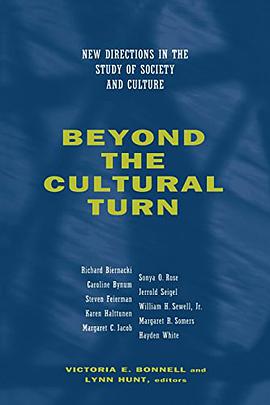
Beyond the Cultural Turn Douban
author: Bonnell, Victoria E. / Hunt, Lynn publishing house: University of California Press 1999 - 7
Nothing has generated more controversy in the social sciences than the turn toward culture, variously known as the linguistic turn, culturalism, or postmodernism. This book examines the impact of the cultural turn on two prominent social science disciplines, history and sociology, and proposes new directions in the theory and practice of historical research. The editors provide an introduction analyzing the origins and implications of the cultural turn and its postmodernist critiques of knowledge. Essays by leading historians and historical sociologists reflect on the uses of cultural theories and show both their promise and their limitations. The afterword by Hayden White provides an assessment of the trend toward culturalism by one its most influential proponents. "Beyond the Cultural Turn" offers fresh theoretical readings of the most persistent issues created by the cultural turn and provocative empirical studies focusing on diverse social practices, the uses of narrative, and the body and self as critical junctures where culture and society intersect.