知识
Economists and Societies Douban
author: Marion Fourcade publishing house: Princeton University Press 2009 - 3
"Economists and Societies" is the first book to systematically compare the profession of economics in the United States, Britain, and France, and to explain why economics, far from being a uniform science, differs in important ways among these three countries. Drawing on in-depth interviews with economists, institutional analysis, and a wealth of scholarly evidence, Marion Fourcade traces the history of economics in each country from the late nineteenth century to the present, demonstrating how each political, cultural, and institutional context gave rise to a distinct professional and disciplinary configuration. She argues that because the substance of political life varied from country to country, people's experience and understanding of the economy, and their political and intellectual battles over it, crystallized in different ways - through scientific and mercantile professionalism in the United States, public-minded elitism in Britain, and statist divisions in France. Fourcade moves past old debates about the relationship between culture and institutions in the production of expert knowledge to show that scientific and practical claims over the economy in these three societies arose from different elites with different intellectual orientations, institutional entanglements, and social purposes. Much more than a history of the economics profession, "Economists and Societies" is a revealing exploration of American, French, and British society and culture as seen through the lens of their respective economic institutions and the distinctive character of their economic experts.
May 26, 2020 read
memo写不完了略读了中间章节。虽然我对文化作为自变量还是有保留意见,但是写作极其清晰、稳扎稳打,很厉害。
知识 经济 历史 职业 社会学
Impure Science Douban
author: Steven Epstein publishing house: University of California Press 1996 - 1
In the short, turbulent history of AIDS research and treatment, the boundaries between scientist insiders and lay outsiders have been crisscrossed to a degree never before seen in medical history. Steven Epstein's astute and readable investigation focuses on the critical question of 'how certainty is constructed or deconstructed', leading us through the views of medical researchers, activists, policy makers, and others to discover how knowledge about AIDS emerges out of what he calls 'credibility struggles'. Epstein shows the extent to which AIDS research has been a social and political phenomenon and how the AIDS movement has transformed biomedical research practices through its capacity to garner credibility by novel strategies. Epstein finds that non scientist AIDS activists have gained enough of a voice in the scientific world to shape NIH-sponsored research to a remarkable extent. Because of the blurring of roles and responsibilities, the production of biomedical knowledge about AIDS does not, he says, follow the pathways common to science; indeed, AIDS research can only be understood as a field that is unusually broad, public, and contested. He concludes by analyzing recent moves to democratize biomedicine, arguing that although AIDS activists have set the stage for new challenges to scientific authority, all social movements that seek to democratize expertise face unusual difficulties. Avoiding polemics and accusations, Epstein provides a benchmark account of the AIDS epidemic to date, one that will be as useful to activists, policy makers, and general readers as to sociologists, physicians, and scientists.
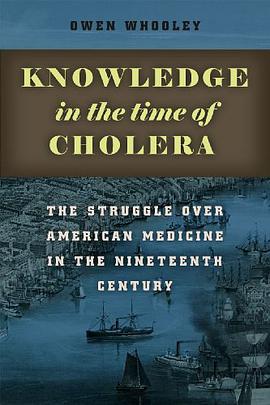
Knowledge in the Time of Cholera Douban
author: Whooley, Owen publishing house: University of Chicago Press 2013 - 4
Vomiting. Diarrhea. Dehydration. Death. Confusion. In 1832, the arrival of cholera in the United States created widespread panic throughout the country. For the rest of the century, epidemics swept through American cities and towns, killing thousands. Physicians of all stripes offered conflicting answers to the cholera puzzle, ineffectively responding with opiates, bleeding, quarantines, and all manner of remedies, before the identity of the dreaded infection was consolidated under the germ theory of disease some sixty years later. These cholera outbreaks raised fundamental questions about medical knowledge and its legitimacy, giving fuel to alternative medical sects that used the confusion of the epidemic to challenge both medical orthodoxy and the authority of the still-new American Medical Association. In "Knowledge in the Time of Cholera", Owen Whooley tells us the story of those dark days, centering his narrative on rivalries between medical and homeopathic practitioners and bringing to life the battle to control public understanding of disease, professional power, and democratic governance in nineteenth-century America.
April 11, 2018 read
Historical epistemology。政治和社会角色如何影响认识论并使特定的科学和实践得以可能。强社会建构视角并且有点过分强调关于认识论本身的政治而忽略了疾病本身,以至于很多地方看起来非常阴谋论。
医疗 知识 社会学 美国