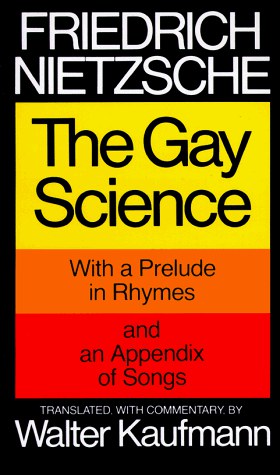
The Gay Science
Douban Goodreads Skybridge
Friedrich Nietzsche
translator:
Walter Kaufmann
publishing house:
Random House
1991
- 9
other title:
The Gay Science: With a Prelude in Rhymes and an Appendix of Songs
"[This book] mirrors all of Nietzsche's thought and could be related in hundreds of ways to his other books, his notes, and his letters. And yet it is complete in itself. For it is a work of art." —Walter Kaufmann in the Introduction
Nietzsche called The Gay Science "the most personal of all my books." It was here that he first proclaimed the death of God—to which a large part of the book is devoted—and his doctrine of the eternal recurrence.
Walter Kaufmann's commentary, with its many quotations from previously untranslated letters, brings to life Nietzsche as a human being and illuminates his philosophy. The book contains some of Nietzsche's most sustained discussions of art and morality, knowledge and truth, the intellectual conscience and the origin of logic.
Most of the book was written just before Thus Spoke Zarathustra , the last part five years later, after Beyond Good and Evil . We encounter Zarathustra in these pages as well as many of Nietzsche's most interesting philosophical ideas and the largest collection of his own poetry that he himself ever published.
Walter Kaufmann's English versions of Nietzsche represent one of the major translation enterprises of our time. He is the first philosopher to have translated Nietzsche's major works, and never before has a single translator given us so much of Nietzsche.
