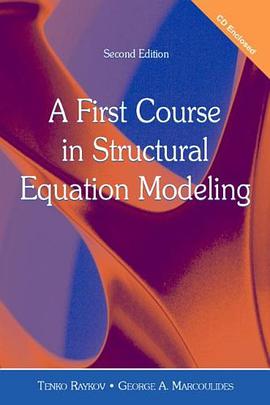
A First Course in Structural Equation Modeling
Douban
Tenko Raykov
/
George A. Marcoulides
publishing house:
Lawrence Erlbaum Associates
2006
- 4
In this book, authors Tenko Raykov and George A. Marcoulides introduce students to the basics of structural equation modeling (SEM) through a conceptual, nonmathematical approach. For ease of understanding, the few mathematical formulas presented are used in a conceptual or illustrative nature, rather than a computational one. Featuring examples from EQS, LISREL, and Mplus, A First Course in Structural Equation Modeling is an excellent beginner's guide to learning how to set up input files to fit the most commonly used types of structural equation models with these programs. The basic ideas and methods for conducting SEM are independent of any particular software. Highlights of the Second Edition include: * Review of latent change (growth) analysis models at an introductory level * Coverage of the popular Mplus program * Updated examples of LISREL and EQS * A CD that contains all of the text's LISREL, EQS, and Mplus examples. A First Course in Structural Equation Modeling is intended as an introductory book for students and researchers in psychology, education, business, medicine, and other applied social, behavioral, and health sciences with limited or no previous exposure to SEM. A prerequisite of basic statistics through regression analysis is recommended. The book frequently draws parallels between SEM and regression, making this prior knowledge helpful.