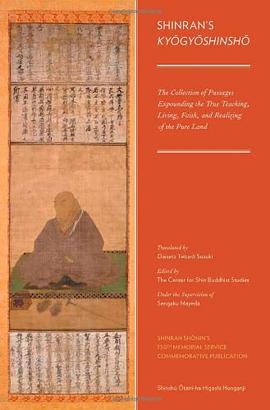
Shinran's Kyogyoshinsho
Douban
translator:
Suzuki, Daisetz Teitaro
2012
- 10
This annotated translation by Daisetz Suzuki (1870-1966) comprises the first four of six chapters of the Kyogyoshinsho, the definitive doctrinal work of Shinran (1173-1262). Shinran founded the Jodo Shin sect of Pure Land Buddhism, now the largest religious organization in Japan. Writing in Classical Chinese, Shinran began this, his magnum opus, while in exile and spent the better part of thirty years after his return to Kyoto revising the text. Although unfinished, Suzuki's translation conveys the text's core religious message, showing how Shinran offered a new understanding of faith through studying teachings before engaging in praxis, rather than the more common and far more limited view of faith in Buddhism as relevant to one just beginning their pursuit of Buddhist truth. Although Suzuki is best known for his scholarship on Zen Buddhism, he took a lifelong interest in Pure Land Buddhism. Suzuki's own religious perspective is evident in his translation of gyo as "True Living" rather than the expected "Practice," and of sho as "True Realizing of the Pure Land" rather than the expected "Enlightenment" or "Confirmation." This book contains the second edition of Suzuki's translation. It includes a number of corrections to the original 1973 edition, long out of print, as well as Suzuki's unfinished preface in its original form for the first time.