Abbott
Time Matters
Douban
Andrew Abbott publishing house: University of Chicago Press 2001 - 7
What do variables really tell us? When exactly do inventions occur? Why do we always miss turning points as they transpire? When does what doesn't happen mean as much, if not more, than what does? Andrew Abbott considers these fascinating questions in Time Matters, a diverse series of essays that constitutes the most extensive analysis of temporality in social science today. Ranging from abstract theoretical reflection to pointed methodological critique, Abbott demonstrates the inevitably theoretical character of any methodology. Time Matters focuses particularly on questions of time, events, and causality. Abbott grounds each essay in straightforward examinations of actual social scientific analyses. Throughout, he demonstrates the crucial assumptions we make about causes and events, about actors and interaction and about time and meaning every time we employ methods of social analysis, whether in academic disciplines, market research, public opinion polling, or even evaluation research. Turning current assumptions on their heads, Abbott not only outlines the theoretical orthodoxies of empirical social science, he sketches new alternatives, laying down foundations for a new body of social theory.
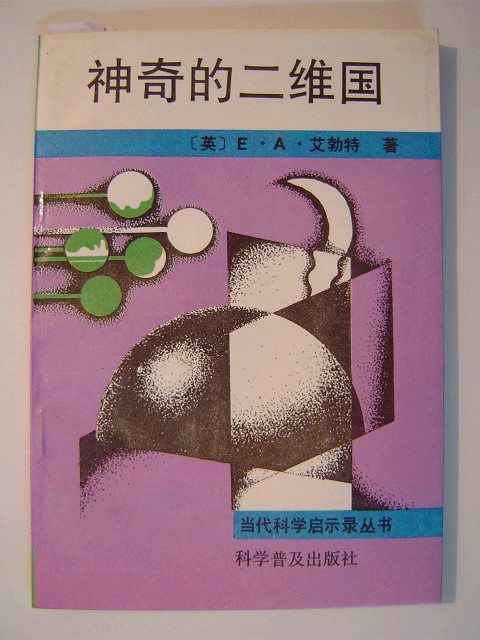
神奇的二维国
Douban
[英]艾勃特 translator: 陈忱 publishing house: 科学普及出版社 1991 - 2
这是历史上第一本讨论非三维世界的科普作品。它以通俗的语言,丰富的想象和生动的叙述,展示了具有各种维数的世界的有趣特点,并通过不同维数的智慧生物彼此间难以互相沟通的巧妙情节,揭示出只能靠推理和类比来摹想高维世界的存在。这在一个世纪之后的今天看来是很有现实意义和启示作用的。
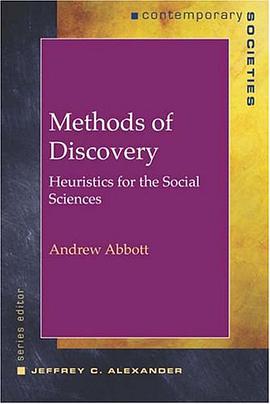
Methods of Discovery
Douban
Andrew Abbott publishing house: W. W. Norton & Company 2004 - 2
Methods of Discovery is organized around strategies for deepening arguments in order to find the best ways to study social phenomena. This exciting book is not about the mechanics of doing social science research, but about habits of thinking that enable students to use those mechanics in new ways, by coming up with new ideas and combining them more effectively with old ones. Examples from throughout the social sciences help show how these moves can open new lines of thinking. Each chapter covers several moves and their reverses (if these exist), discussing particular examples of the move as well as its logical and theoretical structure. This book offers readers a new way of thinking about directions for their research and new ways to imagine information relevant to their research problems.
Chaos of Disciplines
Douban
Andrew Abbott publishing house: University Of Chicago Press 2001 - 2
In this new study, Andrew Abbott presents a fresh and daring analysis of the evolution and development of the social sciences. "Chaos of Disciplines" reconsiders how knowledge actually changes and advances. Challenging the accepted belief that social sciences are in a perpetual state of progress, Abbott contends that disciplines instead cycle around an inevitable pattern of core principles. New schools of thought, then, are less a reaction to an established order than they are a reinvention of fundamental concepts. "Chaos of Disciplines" uses fractals to explain the patterns of disciplines, and then applies them to key debates that surround the social sciences. Abbott argues that knowledge in different disciplines is organized by common oppositions that function at any level of theoretical or methodological scale. Opposing perspectives of thought and method, then, in fields ranging from history, sociology and literature, become radically similar, much like fractals, they are each mutual reflections of their own distinctions.
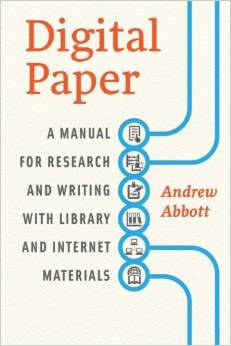
Digital Paper
Douban
★ 10.0 7 ratings
Andrew Abbott publishing house: University Of Chicago Press 2014 - 8
Today’s researchers have access to more information than ever before. Yet the new material is both overwhelming in quantity and variable in quality. How can scholars survive these twin problems and produce groundbreaking research using the physical and electronic resources available in the modern university research library? In Digital Paper, Andrew Abbott provides some much-needed answers to that question. Abbott tells what every senior researcher knows: that research is not a mechanical, linear process, but a thoughtful and adventurous journey through a nonlinear world. He breaks library research down into seven basic and simultaneous tasks: design, search, scanning/browsing, reading, analyzing, filing, and writing. He moves the reader through the phases of research, from confusion to organization, from vague idea to polished result. He teaches how to evaluate data and prior research; how to follow a trail to elusive treasures; how to organize a project; when to start over; when to ask for help. He shows how an understanding of scholarly values, a commitment to hard work, and the flexibility to change direction combine to enable the researcher to turn a daunting mass of found material into an effective paper or thesis. More than a mere how-to manual, Abbott’s guidebook helps teach good habits for acquiring knowledge, the foundation of knowledge worth knowing. Those looking for ten easy steps to a perfect paper may want to look elsewhere. But serious scholars, who want their work to stand the test of time, will appreciate Abbott’s unique, forthright approach and relish every page of Digital Paper.