Appadurai
The Future as Cultural Fact
Douban
Arjun Appadurai publishing house: Verso 2013 - 3
This major collection of essays, a sequel to Modernity at Large (1996), is the product of ten years' research and writing, constituting an important contribution to globalization studies. Appadurai takes a broad analytical look at the genealogies of the present era of globalization through essays on violence, commodification, nationalism, terror and materiality. Alongside a discussion of these wider debates, Appadurai situates India at the heart of his work, offering writing based on first-hand research among urban slum-dwellers in Mumbai, in which he examines their struggle to achieve equity, recognition and self-governance in conditions of extreme inequality. Finally, in his work on design, planning, finance and poverty, Appadurai embraces the "politics of hope" and lays the foundations for a revitalized, and urgent, anthropology of the future.
The Social Life of Things
Douban
Arjun Appadurai publishing house: 劍橋大學出版社 1988 - 1
The meaning that people attribute to things necessarily derives from human transactions and motivations, particularly from how those things are used and circulated. The contributors to this volume examine how things are sold and traded in a variety of social and cultural settings, both present and past. Focusing on culturally defined aspects of exchange and socially regulated processes of circulation, the essays illuminate the ways in which people find value in things and things give value to social relations. By looking at things as if they lead social lives, the authors provide a new way to understand how value is externalized and sought after. They discuss a wide range of goods - from oriental carpets to human relics - to reveal both that the underlying logic of everyday economic life is not so far removed from that which explains the circulation of exotica, and that the distinction between contemporary economies and simpler, more distant ones is less obvious than has been thought. As the editor argues in his introduction, beneath the seeming infinitude of human wants, and the apparent multiplicity of material forms, there in fact lie complex, but specific, social and political mechanisms that regulate taste, trade, and desire. Containing contributions from American and British social anthropologists and historians, the volume bridges the disciplines of social history, cultural anthropology, and economics, and marks a major step in our understanding of the cultural basis of economic life and the sociology of culture. It will appeal to anthropologists, social historians, economists. archaeologists, and historians of art.
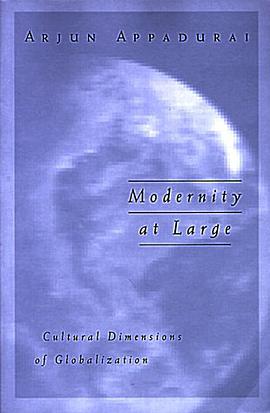
Modernity at Large
Douban
Arjun Appadurai publishing house: University of Minnesota Press 1996 - 11
The world is growing smaller. Every day we hear this idea expressed and witness its reality in our lives-through the people we meet, the products we buy, the foods we eat, and the movies we watch. In this bold look at the cultural effects of a shrinking world, leading cultural theorist Arjun Appadurai places these challenges and pleasures of contemporary life in a broad global perspective. Offering a new framework for the cultural study of globalization, Modernity at Large shows how the imagination works as a social force in today's world, providing new resources for identity and energies for creating alternatives to the nation-state, whose era some see as coming to an end. Appadurai examines the current epoch of globalization, which is characterized by the twin forces of mass migration and electronic mediation, and provides fresh ways of looking at popular consumption patterns, debates about multiculturalism, and ethnic violence. He considers the way images-of lifestyles, popular culture, and self-representation-circulate internationally through the media and are often borrowed in surprising (to their originators) and inventive fashions. Appadurai simultaneously explores and explodes boundaries-between how we imagine the world and how that imagination influences our self-understanding, between social institutions and their effects on the people who participate in them, between nations and peoples that seem to be ever more homogeneous and yet ever more filled with differences. Modernity at Large offers a path to move beyond traditional oppositions between culture and power, tradition and modernity, global and local, pointing out the vital role imagination plays in our construction of the world of today-and tomorrow.