Bandyopadhyay_Sekhar
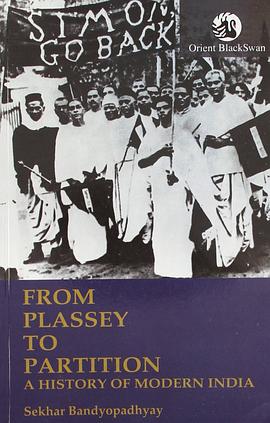
From Plassey to Partition
Douban
Sekhar Bandyopadhyay 2004
From Plassey To Partition: A History of Modern India begins with the disintegration and downfall of the Mughal Empire and the parallel rise of the British Empire in the Indian subcontinent. The book offers an insight into the minds of the Indians under the British rule and their struggle for freedom as it gained ground after the Rising of 1857. The book is unique in its approach towards presenting the problems of Indians under the British rule. It gives a detailed account of their conflicts, cultural and social changes, their fight for freedom and the acceptance and adaptation to modernism brought in by the foreign rulers. From Plassey to Partition: A History of Modern India presents the entire history of the British dominion over India through the various struggles and rebellions of the Indians, the rise of Indian leaders and politics, the Partition that led to the creation of Pakistan and finally, Independent India. The entire account has been presented in a unique way by Sekhar Bandyopadhyay, who has provided the readers with different perspectives and sides to the entire struggle for Indian freedom. The book is divided into eight parts, which are British Empire in India, Emergence of Indian Nationalism, Transition of the Eighteenth Century, Early Indian Responses, Early Nationalism, Many Voices of a Nation, The Age of Gandhian Politics, and Freedom with Partition. The book also provides 5 maps of India at various times to offer a better understanding of the geography of the time. From Plassey To Partition: A History Of Modern India is suitable for both history students and interested readers, owing to its detailed presentation of the historical facts and events of that time period.
Read
Nov. 11, 2019
2015.2.6, Boi Mela | 150203 | 一部周详的围绕着民族主义发展演变的政治史叙事,除了18世纪的上限和1947的下限以外基本打破了关于殖民时期内部的时间分段论
Bandyopadhyay_Sekhar
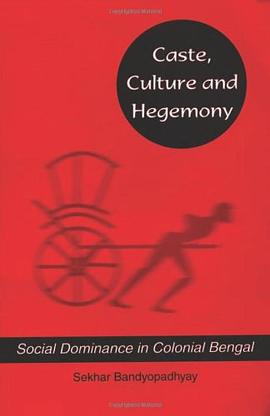
Caste, Culture and Hegemony
Douban
Sekhar Bandyopadhyay publishing house: SAGE Publications Pvt. Ltd 2004 - 8
It is widely believed that, because of its exceptional social development, the caste system in colonial Bengal differed considerably from the rest of India. Through a study of the complex interplay between caste, culture and power, this book convincingly demonstrates that Bengali Hindu society preserved the essentials of caste discrimination in colonial times, even while giving the outward appearance of having changed. Using empirical data combined with an impressive array of secondary sources, Dr Bandyopadhyay delineates the manner in which Hindu caste society maintained its cultural hegemony and structural cohesion. Starting with an examination of the relationship between caste and power, the book examines early cultural encounters between 'high' Brahmanical tradition and the more egalitarian 'popular' religious cults of the lower castes. It moves on to take a close look at the relationship between caste and gender showing the reasons why the reform movement for widow remarriage failed. It ends with an examination of the Hindu 'partition' campaign, which appropriated dalit autonomous politics and made Hinduism the foundation of an emergent Indian national identity. Sekhar Bandyopadhyay breaks with many of the assumptions of two important schools of thought-the Dumontian and the subaltern-and takes instead a more nuanced approach to show how high caste hegemony has been able to perpetuate itself. He thus takes up issues which go to the heart of contemporary problems in India's social and political fabric.
Read
Feb. 28, 2014
Hatcher | The dialectic relationship between subaltern agency and structural hegemony. Good reminder of how caste disappeared in the late colonial Hindu-Muslim divide leading up to Partition.
Bandyopadhyay_Sekhar