Brown_Kate
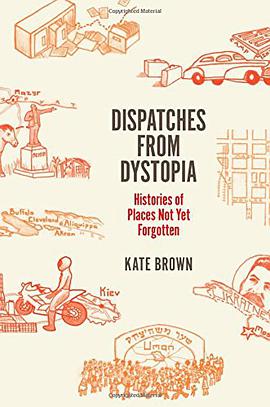
Dispatches from Dystopia
Douban
Kate Brown publishing house: University Of Chicago Press 2015 - 5
“Why are Kazakhstan and Montana the same place?” asks one chapter of Kate Brown’s surprising and unusual journey into the histories of places on the margins, overlooked or erased. It turns out that a ruined mining town in Kazakhstan and Butte, Montana—America’s largest environmental Superfund site—have much more in common than one would think thanks to similarities in climate, hucksterism, and the perseverance of their few hardy inhabitants. Taking readers to these and other unlikely locales, Dispatches from Dystopia delves into the very human and sometimes very fraught ways we come to understand a particular place, its people, and its history. In Dispatches from Dystopia, Brown wanders the Chernobyl Zone of Alienation, first on the Internet and then in person, to figure out which version—the real or the virtual—is the actual forgery. She also takes us to the basement of a hotel in Seattle to examine the personal possessions left in storage by Japanese-Americans on their way to internment camps in 1942. In Uman, Ukraine, we hide with Brown in a tree in order to witness the annual male-only Rosh Hashanah celebration of Hasidic Jews. In the Russian southern Urals, she speaks with the citizens of the small city of Kyshtym, where invisible radioactive pollutants have mysteriously blighted lives. Finally, Brown returns home to Elgin, Illinois, in the midwestern industrial rust belt to investigate the rise of “rustalgia” and the ways her formative experiences have inspired her obsession with modernist wastelands. Dispatches from Dystopia powerfully and movingly narrates the histories of locales that have been silenced, broken, or contaminated. In telling these previously unknown stories, Brown examines the making and unmaking of place, and the lives of the people who remain in the fragile landscapes that are left behind.
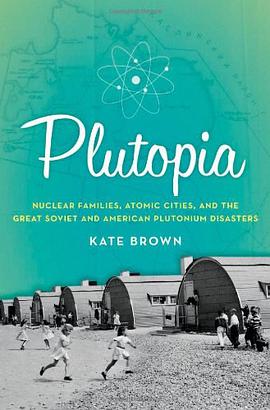
Plutopia
Douban
Kate Brown publishing house: Oxford University Press 2013 - 4
While many transnational histories of the nuclear arms race have been written, Kate Brown provides the first definitive account of the great plutonium disasters of the United States and the Soviet Union. In Plutopia, Brown draws on official records and dozens of interviews to tell the extraordinary stories of Richland, Washington and Ozersk, Russia-the first two cities in the world to produce plutonium. To contain secrets, American and Soviet leaders created plutopias--communities of nuclear families living in highly-subsidized, limited-access atomic cities. Fully employed and medically monitored, the residents of Richland and Ozersk enjoyed all the pleasures of consumer society, while nearby, migrants, prisoners, and soldiers were banned from plutopia--they lived in temporary "staging grounds" and often performed the most dangerous work at the plant. Brown shows that the plants' segregation of permanent and temporary workers and of nuclear and non-nuclear zones created a bubble of immunity, where dumps and accidents were glossed over and plant managers freely embezzled and polluted. In four decades, the Hanford plant near Richland and the Maiak plant near Ozersk each issued at least 200 million curies of radioactive isotopes into the surrounding environment--equaling four Chernobyls--laying waste to hundreds of square miles and contaminating rivers, fields, forests, and food supplies. Because of the decades of secrecy, downwind and downriver neighbors of the plutonium plants had difficulty proving what they suspected, that the rash of illnesses, cancers, and birth defects in their communities were caused by the plants' radioactive emissions. Plutopia was successful because in its zoned-off isolation it appeared to deliver the promises of the American dream and Soviet communism; in reality, it concealed disasters that remain highly unstable and threatening today. An untold and profoundly important piece of Cold War history, Plutopia invites readers to consider the nuclear footprint left by the arms race and the enormous price of paying for it.
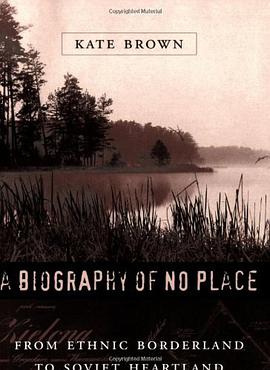
A Biography of No Place
Douban
Kate Brown publishing house: Harvard University Press 2005 - 9
This is a biography of a borderland between Russia and Poland, a region where, in 1925, people identified as Poles, Germans, Jews, Ukrainians, and Russians lived side by side. Over the next three decades, this mosaic of cultures was modernized and homogenized out of existence by the ruling might of the Soviet Union, then Nazi Germany, and finally, Polish and Ukrainian nationalism. By the 1950s, this “no place” emerged as a Ukrainian heartland, and the fertile mix of peoples that defined the region was destroyed. Kate Brown’s study is grounded in the life of the village and shtetl, in the personalities and small histories of everyday life in this area. In impressive detail, she documents how these regimes, bureaucratically and then violently, separated, named, and regimented this intricate community into distinct ethnic groups. Drawing on recently opened archives, ethnography, and oral interviews that were unavailable a decade ago, A Biography of No Place reveals Stalinist and Nazi history from the perspective of the remote borderlands, thus bringing the periphery to the center of history. We are given, in short, an intimate portrait of the ethnic purification that has marked all of Europe, as well as a glimpse at the margins of twentieth-century “progress.”