Butler_Judith
Bodies That Matter
Douban Goodreads
Judith Butler publishing house: Routledge 1993 - 9
In "Bodies That Matter," Judith Butler further develops her distinctive theory of gender by examining the workings of power at the most "material" dimensions of sex and sexuality. Deepening the inquiries she began in "Gender" "Trouble," Butler offers an original reformulation of the materiality of bodies, examining how the power of heterosexual hegemony forms the "matter" of bodies, sex, and gender. Butler argues that power operates to constrain "sex" from the start, delimiting what counts as a viable sex. She offers a clarification of the notion of "performativity" introduced in "Gender Trouble" and explores the meaning of a citational politics. The text includes readings of Plato, Irigaray, Lacan, and Freud on the formation of materiality and bodily boundaries; "Paris is Burning," Nella Larsen's "Passing," and short stories by Willa Cather; along with a reconsideration of "performativity" and politics in feminist, queer, and radical democratic theory.

Gender Trouble
Douban
Judith Butler publishing house: Routledge 1999 - 9
"For the most part, feminist theory has assumed that there is some existing identity, understood through the category of women, who not only initiates feminist interests and goals within discourse, but constitutes the subject for whom political representation is pursued."
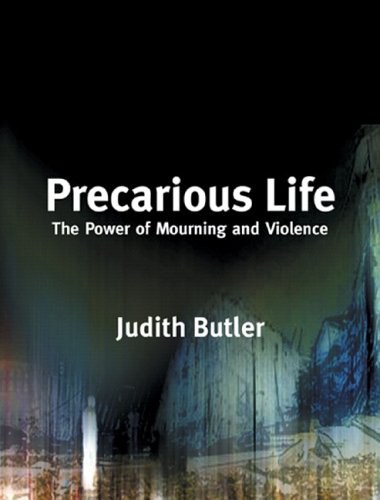
Precarious Life
Google Books Douban Goodreads
Judith Butler publishing house: Verso 2006 - 7 other title: Precarious Life: The Powers of Mourning and Violence
This profound appraisal of post-9/11 America considers the conditions of heightened vulnerability and aggression that followed from the attack on the US, and US retaliation. Judith Butler critiques the use of violence that has emerged as a response to loss, and argues that the dislocation of first-world privilege offers instead a chance to imagine a world in which that violence might be minimized and in which interdependency becomes acknowledged as the basis for a global political community. Butler considers the means by which some lives become grief-worthy, while others are perceived as undeserving of grief or even incomprehensible as lives. She discusses the political implications of sovereignty in light of the prisoners in Guantánamo Bay. She argues against the anti-intellectual current of contemporary US patriotism and the power of censorship during times of war. Finally, she takes on the question of when and why anti-semitism is leveled as a charge against those who voice criticisms of the Israeli state. She counters that we have a responsibility to speak out against both Israeli injustices and anti-semitism, and argues against the rhetorical use of the charge of anti-semitism to quell public debate.