Chatterjee_Partha
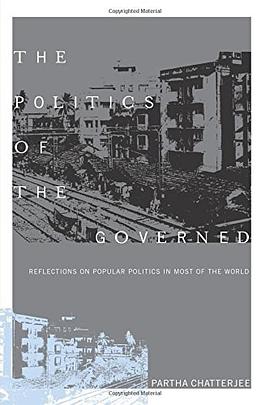
The Politics of the Governed
Douban
Partha Chatterjee
publishing house:
Columbia University Press
2006
Often dismissed as the rumblings of "the street," popular politics is where political modernity is being formed today, according to Partha Chatterjee. The rise of mass politics all over the world in the twentieth century led to the development of new techniques of governing population groups. On the one hand, the idea of popular sovereignty has gained wide acceptance. On the other hand, the proliferation of security and welfare technologies has created modern governmental bodies that administer populations, but do not provide citizens with an arena for democratic deliberation. Under these conditions, democracy is no longer government of, by, and for the people. Rather, it has become a world of power whose startling dimensions and unwritten rules of engagement Chatterjee provocatively lays bare. This book argues that the rise of ethnic or identity politics-particularly in the postcolonial world-is a consequence of new techniques of governmental administration. Using contemporary examples from India, the book examines the different forms taken by the politics of the governed.
Many of these operate outside of the traditionally defined arena of civil society and the formal legal institutions of the state. This book considers the global conditions within which such local forms of popular politics have appeared and shows us how both community and global society have been transformed. Chatterjee's analysis explores the strategic as well as the ethical dimensions of the new democratic politics of rights, claims, and entitlements of population groups and permits a new understanding of the dynamics of world politics both before and after the events of September 11, 2001. The Politics of the Governed consists of three essays, originally given as the Leonard Hastings Schoff Lectures at Columbia University in November 2001, and four additional essays that complement and extend the analyses presented there. By combining these essays between the covers of a single volume, Chatterjee has given us a major and urgent work that provides a full perspective on the possibilities and limits of democracy in the postcolonial world.
The Nation and Its Fragments
Douban
Partha Chatterjee
publishing house:
Princeton University Press
1993
In this book, the prominent theorist Partha Chatterjee looks at the creative and powerful results of the nationalist imagination in Asia and Africa that are posited not on identity but on difference with the nationalism propagated by the West. Arguing that scholars have been mistaken in equating political nationalism with nationalism as such, he shows how anticolonialist nationalists produced their own domain of sovereignty within colonial society well before beginning their political battle with the imperial power. These nationalists divided their culture into material and spiritual domains, and staked an early claim to the spiritual sphere, represented by religion, caste, women and the family, and peasants. Chatterjee shows how middle- class elites first imagined the nation into being in this spiritual dimension and then readied it for political contest, all the while "normalizing" the aspirations of the various marginal groups that typify the spiritual sphere.While Chatterjee's specific examples are drawn from Indian sources, with a copious use of Bengali language materials, the book is a contribution to the general theoretical discussion on nationalism and the modern state. Examining the paradoxes involved with creating first a uniquely non- Western nation in the spiritual sphere and then a universalist nation-state in the material sphere, the author finds that the search for a postcolonial modernity is necessarily linked with past struggles against modernity.
民族主义思想与殖民地世界
Douban
[印度]帕尔塔·查特吉
translator:
范慕尤
/
杨曦
publishing house:
译林出版社
2007
- 10
历史话语中占统治地位的“人”或者“公民”指的只是“精英”,只有当底层造反时,主子们才意识到仆从们也有意识。
——帕尔塔·查特吉
查特吉为我们阐明了,理论如何能够动摇并且彻底改变我们看待世界的框架。如果我们乐意去挑战一些人类赖以生活的基本假设,那么这种理论恰恰开启了新的可能性。
——菲利普·霍尔登
前 言
布莱希特的剧作《伽利略传》的最后一幕,引用了伽利略曾说过的一句话,“如果有障碍物存在,两点之间最短的线有可能是曲线。”由于经典力学假定两点之间在理论上是无阻碍的,因而这个论断有反讽的意味。可在秩序混乱的政治领域中,这却可以被看作真理。
很明显政治理论家们并不重视这个事实,即政治必然在一个话语意义不甚确切的意识形态领域内运作。在政治家那里,概念是不明确的,这样概念就有了政治价值,因为不明确所以有一系列可能的解释;在那里目的自相矛盾,而结果则不可预料;行动变幻莫测;选择都是战略性的,相对的而不是单义和绝对的。然而,这个充斥着模糊和虚假、操纵和欺骗、梦幻的世界并不完全是虚构的,因为在这里,明确了目的,建立了规则,确立了价值,完成了革命并建立了国家。
这本书是有关政治革命的,但其过程不能通过这种方式来描述,即从历史中选取起因和高潮两点,两点之间以一条直线贯穿。有论点指出,革命从根本上说并不只是革命。在转变、动摇、中断以及无法预测的变化中,被支持的和受到压制的东西一样多,从中你会意识到在这一复杂运动的进程中历史的合理性要多于那些偶然的或干扰性的因素。通过研究形式不一的转折点,我们可以找到线索,理解民族主义思想史在今天所具有的政治意义。
我本想将这本书命名为《曲线》,但比我精通出版业务的朋友劝我说,这不是一个挖掘潜在读者的好办法,我接受了他的建议。
我于1981—1982年在牛津大学圣安东尼学院期间动笔写作本书,我非常感谢Nuffield基金会给我的出国奖学金。1982—1983年我在澳大利亚国立大学太平洋研究学院做短期访问学者期间,继续写作本书,回到加尔各答时已完稿。对于牛津大学Bodlian图书馆,堪培拉ANU图书馆,加尔各答国立图书馆,加尔各答大学历史图书馆,加尔各答社会科学研究中心图书馆职员的帮助,我万分感激。
曾看过及评论过本书初稿的有安瓦尔·阿卜杜勒—马利克, 沙希德·阿明, 贾苏特罗·伯格奇, 迪拜什·哲格罗伯蒂, 约翰·达恩, 欧姆卡罗·古斯瓦米,拉那吉特·古哈,德伯蒂·古哈·塔古达, 苏迪伯达·卡维拉吉,鲁德罗·穆凯吉,哥耶·班代,阿毗吉特·森,阿肖克·森。对他们的批评和建议谨此致谢。
我在阿尔及尔、牛津、堪培拉、巴罗达、巴黎和加尔各答的研讨会上发表并讨论过本书的不同章节,在此向所有与会者致以谢意。
我还要感谢联合国大学的金海德·穆会古吉,安瓦尔·阿卜杜勒—马利克,Zed Books的罗伯特·摩太诺和安娜·格沃丽,牛津大学出版社的拉维·达耶勒,鲁古·俄德弗尼,在本书出版方面给予的帮助。同时谢谢梅·迈肯思和玛格丽特·豪准备打印稿。
最后借此机会感谢卡马丽的支持和理解。
帕尔塔·查特吉
1985年12月于加尔各答
译 后 记
本书由范慕尤和杨曦合作翻译,范慕尤负责前三章的正文,杨曦承担了后三章、全书尾注和索引的翻译。北大英语系的张琪校对了全文。在此过程中,北大东语系印地语专业毕业的周陈校对了后三章的正文并提出了不少修改意见,北大印地语专业的王静老师帮助译出了一些印地专名,此外印度语言文化专业的张幸帮忙解决了大部分的孟加拉语专名翻译。北大东语系段晴教授也不时给予点拨,对他们的大力帮助我们一并致以谢意。
由于译者水平所限,书中错误和疏漏在所难免,还望读者不吝赐教,批评指证。
范慕尤 杨曦
2007年4月20日
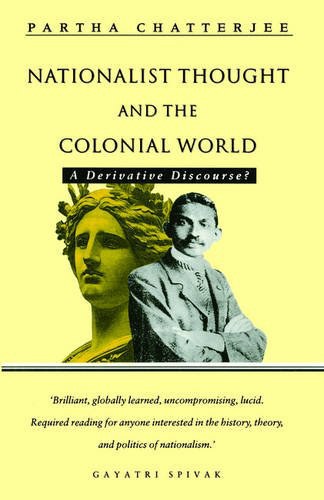
Nationalist Thought and the Colonial World
Douban
Partha Chatterjee
publishing house:
Zed Books
1986
- 5
Nationalist Thought and the Colonial World
Douban
Partha Chatterjee
publishing house:
University Of Minnesota Press
1993
- 2
"If it isn't obvious from the title of this book that this is going to be full of postmodern jargon, it becomes clear quite quickly that Chaterjee prefers difficult terms like 'problematic', 'thematic' and 'discourse' without always defining them - he even admits his admiration for Rorty, Barthes, Foucault and Derrida. Nonetheless, underneath all of this verbiage is a strong and convincing argument about the three stages of nationalism in India: the moment of departure (epitomized by Bankimchandra Chatttopadhyay), the moment of manoeuvre (Gandhi) and the moment of arrival (Nehru). Chatterjee clearly shows how nationalism in India was akin to Gramsci's concept of the 'passive revolution' - i.e. merely a drive towards independence, not towards transforming or breaking up colonial institutions. He argues that, instead of supporting nationalism, we should instead challenge the marriage between reason and capital. From the title of this book one might expect Chatterjee to draw links to other anti-colonial nationalisms but he doesn't; rather he only discusses India (not even other parts of South Asia). While this approach doesn't really make this book too useful for examining anti-colonial nationalisms in general, for someone like me who has never read a book on Indian nationalism this is a good introduction."
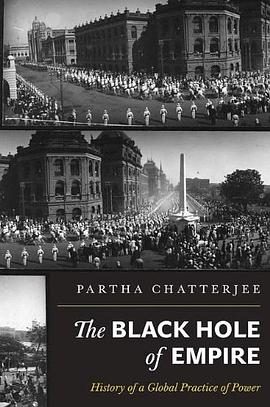
The Black Hole of Empire
Douban
Partha Chatterjee
publishing house:
Princeton University Press
2012
- 4
When Siraj, the ruler of Bengal, overran the British settlement of Calcutta in 1756, he allegedly jailed 146 European prisoners overnight in a cramped prison. Of the group, 123 died of suffocation. While this episode was never independently confirmed, the story of "The black hole of Calcutta' was widely circulated and seen by the British public as an atrocity committed by savage colonial subjects. "The Black Hole of Empire" follows the ever-changing representations of this historical event and founding myth of the British Empire in India, from the eighteenth century to the present. Partha Chatterjee explores how a supposed tragedy paved the ideological foundations for the civilizing force of British imperial rule and territorial control in India. Chatterjee takes a close look at the justifications of modern empire by liberal thinkers, international lawyers, and conservative traditionalists, and examines the intellectual and political responses of the colonized, including those of Bengali nationalists. The two sides of empire's entwined history are brought together in the story of the Black Hole memorial: set up in Calcutta in 1760, demolished in 1821, restored by Lord Curzon in 1902, and removed in 1940 to a neglected churchyard. Challenging conventional truisms of imperial history, nationalist scholarship, and liberal visions of globalization, Chatterjee argues that empire is a necessary and continuing part of the history of the modern state.
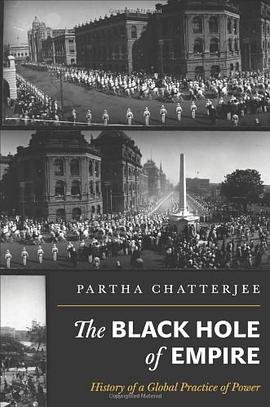
The Black Hole of Empire
Douban
Partha Chatterjee
publishing house:
Princeton University Press
2012
- 4
When Siraj, the ruler of Bengal, overran the British settlement of Calcutta in 1756, he allegedly jailed 146 European prisoners overnight in a cramped prison. Of the group, 123 died of suffocation. While this episode was never independently confirmed, the story of "The black hole of Calcutta' was widely circulated and seen by the British public as an atrocity committed by savage colonial subjects. "The Black Hole of Empire" follows the ever-changing representations of this historical event and founding myth of the British Empire in India, from the eighteenth century to the present. Partha Chatterjee explores how a supposed tragedy paved the ideological foundations for the civilizing force of British imperial rule and territorial control in India. Chatterjee takes a close look at the justifications of modern empire by liberal thinkers, international lawyers, and conservative traditionalists, and examines the intellectual and political responses of the colonized, including those of Bengali nationalists. The two sides of empire's entwined history are brought together in the story of the Black Hole memorial: set up in Calcutta in 1760, demolished in 1821, restored by Lord Curzon in 1902, and removed in 1940 to a neglected churchyard. Challenging conventional truisms of imperial history, nationalist scholarship, and liberal visions of globalization, Chatterjee argues that empire is a necessary and continuing part of the history of the modern state.
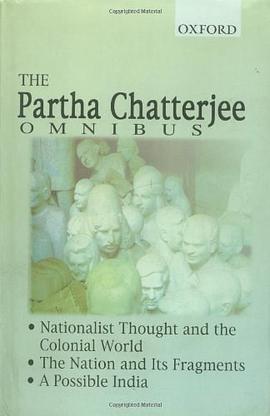
The Partha Chatterjee Omnibus
Douban
Partha Chatterjee
publishing house:
Oxford University Press
2007
- 1

The Nation and Its Fragments
Douban
Partha Chatterjee
publishing house:
Princeton University Press
1993
- 10
In this book, the prominent theorist Partha Chatterjee looks at the creative and powerful results of the nationalist imagination in Asia and Africa that are posited not on identity but on difference with the nationalism propagated by the West. Arguing that scholars have been mistaken in equating political nationalism with nationalism as such, he shows how anticolonialist nationalists produced their own domain of sovereignty within colonial society well before beginning their political battle with the imperial power. These nationalists divided their culture into material and spiritual domains, and staked an early claim to the spiritual sphere, represented by religion, caste, women and the family, and peasants.Chatterjee shows how middle-class elites first imagined the nation into being in this spiritual dimension and then readied it for political contest, all the while "normalizing" the aspirations of the various marginal groups that typify the spiritual sphere. While Chatterjee's specific examples are drawn from Indian sources, with a copious use of Bengali language materials, the book is a contribution to the general theoretical discussion on nationalism and the modern state. Examining the paradoxes involved with creating first a uniquely non-Western nation in the spiritual sphere and then a universalist nation-state in the material sphere, the author finds that the search for a postcolonial modernity is necessarily linked with past struggles against modernity.