Cooper_Frederick
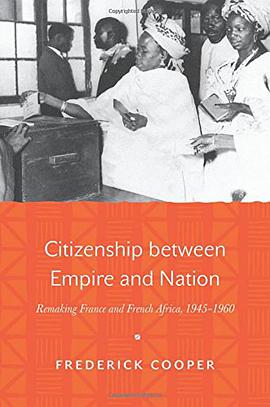
Citizenship between Empire and Nation
Douban
Frederick Cooper publishing house: Princeton University Press 2014 - 7
As the French public debates its present diversity and its colonial past, few remember that between 1946 and 1960 the inhabitants of French colonies possessed the rights of French citizens. Moreover, they did not have to conform to the French civil code that regulated marriage and inheritance. One could, in principle, be a citizen and different too. Citizenship between Empire and Nation examines momentous changes in notions of citizenship, sovereignty, nation, state, and empire in a time of acute uncertainty about the future of a world that had earlier been divided into colonial empires. Frederick Cooper explains how African political leaders at the end of World War II strove to abolish the entrenched distinction between colonial "subject" and "citizen." They then used their new status to claim social, economic, and political equality with other French citizens, in the face of resistance from defenders of a colonial order. Africans balanced their quest for equality with a desire to express an African political personality. They hoped to combine a degree of autonomy with participation in a larger, Franco-African ensemble. French leaders, trying to hold on to a large French polity, debated how much autonomy and how much equality they could concede. Both sides looked to versions of federalism as alternatives to empire and the nation-state. The French government had to confront the high costs of an empire of citizens, while Africans could not agree with French leaders or among themselves on how to balance their contradictory imperatives. Cooper shows how both France and its former colonies backed into more "national" conceptions of the state than either had sought.
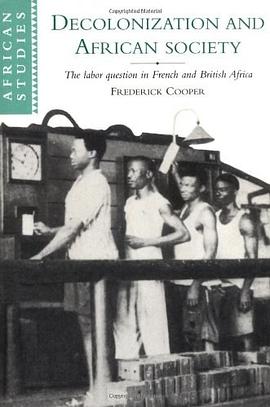
Decolonization and African Society
Douban
Cooper, Frederick publishing house: 劍橋大學出版社 1996 - 8
This detailed and authoritative volume changes our conceptions of 'imperial' and 'African' history. Frederick Cooper gathers a vast range of archival sources in French and English to achieve a truly comparative study of colonial policy toward the recruitment, control, and institutionalization of African labor forces from the mid 1930s, when the labor question was first posed, to the late 1950s, when decolonization was well under way. Professor Cooper explores colonial conceptions of the African worker and shows how African trade union and political leaders used the new language of social change to claim equality and a share of power. This helped to persuade European officials that the 'modern' Africa they imagined was unaffordable. Britain and France could not reshape African society. As they left the continent, the question was how they had affected the ways in which Africans could reorganize society themselves.
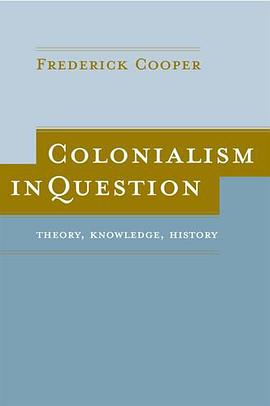
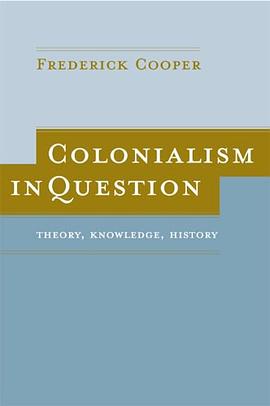
Colonialism in Question
Douban Open Library
Frederick Cooper publishing house: University of California Press 2005 - 6
In this closely integrated collection of essays on colonialism in world history, Frederick Cooper raises crucial questions about concepts relevant to a wide range of issues in the social sciences and humanities, including identity, globalization, and modernity. Rather than portray the past two centuries as the inevitable movement from empire to nation-state, Cooper places nationalism within a much wider range of imperial and diasporic imaginations, of rulers and ruled alike, well into the twentieth century. He addresses both the insights and the blind spots of colonial studies in an effort to get beyond the tendency in the field to focus on a generic colonialism located sometime between 1492 and the 1960s and somewhere in the "West." Broad-ranging, cogently argued, and with a historical focus that moves from Africa to South Asia to Europe, these essays, most published here for the first time, propose a fuller engagement in the give-and-take of history, not least in the ways in which concepts usually attributed to Western universalism―including citizenship and equality―were defined and reconfigured by political mobilizations in colonial contexts.
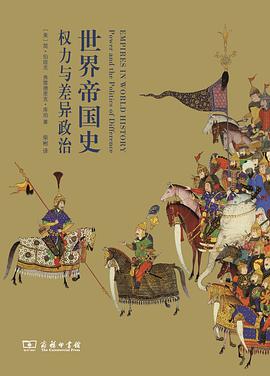
世界帝国史
Empires in world history: Power and the politics of difference Douban
[美] 简·伯班克 / [美] 弗雷德里克·库珀 translator: 柴彬 publishing house: 商务印书馆 2017 - 8
本书是一部波澜壮阔的帝国统治史,始于公元前3世纪,绵延至20世纪中期。幅员广袤的世界诸帝国在这一时期纷纷登上历史舞台。影响深远的罗马帝国,勇武虔诚的拜占庭帝国和阿拉伯帝国,年寿不永的加洛林帝国,灵活务实的蒙古帝国、奥斯曼帝国、俄罗斯帝国,自成一体的中华帝国以及彻底开启全球化进程的西方诸帝国……它们各不相同的统治策略深刻影响了世界历史的发展轨迹。作者不仅关注它们如何崛起、竞争并形成其独特制度与统治实践,而且超越对历史细节的泛泛叙述,将帝国作为一种统治形式加以分析考察。同时本书借助对各个帝国统治策略、施政传统的一系列对比,充分展示其内部的差异性、丰富性和复杂性,从而加深了我们对帝国统治史的理解。本书曾获2011年世界史学会年度图书奖。
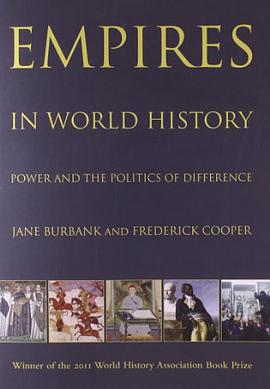
Empires in World History
Douban
Jane Burbank / Frederick Cooper publishing house: Princeton University Press 2011 - 7
Empires - vast states of territories and people united by force and ambition - have dominated the political landscape for more than two millennia. "Empires in World History" departs from conventional European and nation-centered perspectives to take a remarkable look at how empires relied on diversity to shape the global order. Beginning with ancient Rome and China and continuing across Asia, Europe, the Americas, and Africa, Jane Burbank and Frederick Cooper examine empires' conquests, rivalries, and strategies of domination - with an emphasis on how empires accommodated, created, and manipulated differences among populations. Burbank and Cooper examine Rome and China from the third century BCE, empires that sustained state power for centuries. They delve into the militant monotheism of Byzantium, the Islamic Caliphates, and the short-lived Carolingians, as well as the pragmatically tolerant rule of the Mongols and Ottomans, who combined religious protection with the politics of loyalty. Burbank and Cooper discuss the influence of empire on capitalism and popular sovereignty, the limitations and instability of Europe's colonial projects, Russia's repertoire of exploitation and differentiation, as well as the "empire of liberty" - devised by American revolutionaries and later extended across a continent and beyond. With its investigation into the relationship between diversity and imperial states, "Empires in World History" offers a fresh approach to understanding the impact of empires on the past and present.
Colonialism in Question
Douban
Frederick Cooper publishing house: University of California Press 2005 - 6
In this closely integrated collection of essays on colonialism in world history, Frederick Cooper raises crucial questions about concepts relevant to a wide range of issues in the social sciences and humanities, including identity, globalization, and modernity. Rather than portray the past two centuries as the inevitable movement from empire to nation-state. Cooper places nationalism within a much wider range of imperial and diasporic imaginations, of rulers and ruled alike, well into the twentieth century. He addresses both the insights and the blind spots of colonial studies in an effort to get beyond the tendency in the field to focus on a generic colonialism located sometime between 1492 and the 1960s and somewhere in the "West." Broad-ranging, cogently argued, and with a historical focus that moves from Africa to South Asia to Europe, these essays, most published here for the first time, propose a fuller engagement in the give-and-take of history, not least in the ways in which concepts usually attributed to Western universalism - including citizenship and equality - were defined and reconfigured by political mobilizations in colonial contexts.