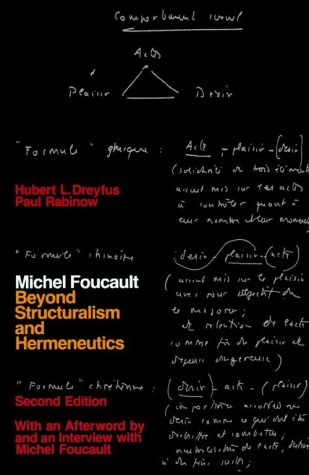
Dreyfus
Michel Foucault
Douban
Hubert L. Dreyfus / Paul Rabinow publishing house: University Of Chicago Press 1983
This book, which Foucault himself has judged accurate, is the first to provide a sustained, coherent analysis of Foucault's work as a whole. . To demonstrate the sense in which Foucault's work is beyond structuralism and hermeneutics, the authors unfold a careful, analytical exposition of his oeuvre. They argue that during the of Foucault's work became a sustained and largely successful effort to develop a new method—"interpretative analytics"—capable fo explaining both the logic of structuralism's claim to be an objective science and the apparent validity of the hermeneutical counterclaim that the human sciences can proceed only by understanding the deepest meaning of the subject and his tradition. . "There are many new secondary sources [on Foucault]. None surpass the book by Hubert Dreyfus and Paul Rabinow. . . . The American paperback edition contains Foucault's 'On the Genealogy of Ethics,' a lucid interview that is now our best source for seeing how he construed the whole project of the history of sexuality."—David Hoy, London Review of Books
Being-in-the-World
Douban
Hubert L. Dreyfus publishing house: The MIT Press 1990
Being-in-the-World is a guide to one of the most influential philosophical works of this century: Division I of Part One of Being and Time, where Martin Heidegger works out an original and powerful account of being-in-the-world which he then uses to ground a profound critique of traditional ontology and epistemology. Hubert Dreyfus's commentary opens the way for a new appreciation of this difficult philosopher, revealing a rigorous and illuminating vocabulary that is indispensable for talking about the phenomenon of world.The publication of Being and Time in 1927 turned the academic world on its head. Since then it has become a touchstone for philosophers as diverse as Marcuse, Sartre, Foucault, and Derrida who seek an alternative to the rationalist Cartesian tradition of western philosophy. But Heidegger's text is notoriously dense, and his language seems to consist of unnecessarily barbaric neologisms; to the neophyte and even to those schooled in Heidegger thought, the result is often incomprehensible.Dreyfus's approach to this daunting book is straightforward and pragmatic. He explains the text by frequent examples drawn from everyday life, and he skillfully relates Heidegger's ideas to the questions about being and mind that have preoccupied a generation of cognitive scientists and philosophers of mind.Hubert L. Dreyfus is Professor of Philosophy at the University of California, Berkeley.