Duara
全球现代性的危机
The Crisis of Global Modernity: Asian Traditions and a Sustainable Future Douban
[美国] 杜赞奇 translator: 黄彦杰 publishing house: 商务印书馆 2017 - 5
这本《全球现代性危机》是杜赞奇教授学术著作中主旨最为宏大的一部。杜赞奇教授称之为一种“历史社会学”,但这本书的范围远远超出了一般的历史社会学的专题研究。除了围绕“超越”和“流转历史”的历史叙述与讨论之外,这本书还涵盖了关于亚洲政治文化、环保运动、宗教传统、道德实践、国家建构以及区域形成等诸多重要的历史和当代课题。值得一提的是,一直隐含在杜赞奇教授早期作品中的印度主题也全面登场,成为与中国同等重要的历史和理论讨论的对象。透过中国、印度以及亚洲其他国家和地方的大量历史经验,杜赞奇教授对源自西方宗教改革的民族国家模式提出了尖锐的批评。他认为,正是竞争性的民族国家建构导致了全球资源与环境危机,而只有建立在对话式超越理念上的天、地、人关系才能在根本上解决全球现代性危机。他注意到,最后的解决之道或许还需要向亚洲的历史经验和当代实践取经,比如“对话式”超越传统以及东盟这样区域整合尝试。
Read
Aug. 10, 2017
南亚后殖民知识精英的短板暴露无遗。
Duara
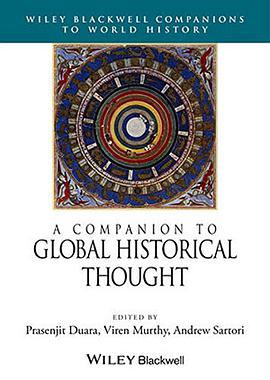
A Companion to Global Historical Thought
Douban
Prasenjit Duara / Viren Murthy … publishing house: Wiley-Blackwell 2014 - 3
A Companion to Global Historical Thought provides an overview of the development of historical thinking from the earliest times to the present, directly addressing issues of historiography in a globalized context. Questions concerning the global dissemination of historical writing and the relationship between historiography and other ways of representing the past have become important not only in the academic study of history, but also in public arenas in many countries. With contributions from leading international scholars, the book considers the problem of "the global" – in the multiplicity of traditions of narrating the past; in the global dissemination of modern historical writing; and of "the global" as a concept animating historical imaginations. It explores the different intellectual approaches that have shaped the discipline of history, and the challenges posed by modernity and globalization, while illustrating the shifts in thinking about time and the emergence of historical thought. Complementing the Companion to Western Historical Thought, this book places non-Western perspectives on historiography at the center of discussion, helping scholars and students alike make sense of the discipline at the start of the twenty-first century.
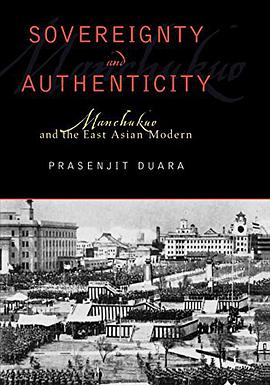
Sovereignty and Authenticity
Douban
Prasenjit Duara publishing house: Rowman & Littlefield Publishers 2004 - 1
In this powerful and provocative book, Prasenjit Duara uses the case of Manchukuo, the Japanese puppet state in northeast China from 1932-1945, to explore how such antinomies as imperialism and nationalism, modernity and tradition, and governmentality and exploitation interacted in the post-World War I period. His study of Manchukuo, which had a population of 40 million and was three times the area of Japan, catalyzes a broader understanding of new global trends that characterized much of the twentieth century. Asking why Manchukuo so desperately sought to appear sovereign, Duara examines the cultural and political resources it mobilized to make claims of sovereignty. He argues that Manchukuo, as a transparently constructed "nation-state," offers a unique historical laboratory for examining the utilization and transformation of circulating global forces mediated by the "East Asian modern." Sovereignty and AUthenticity not only shows how Manchukuo drew technologies of modern nationbuilding from China and Japan, but it provides a window into how some of these techniques and processes were obscured or naturalized in the more successful East Asian nation-states. With its sweepingly original theoretical and comparative perspectives on nationalism and imperialism, this book will be essential reading for all those interested in contemporary history.
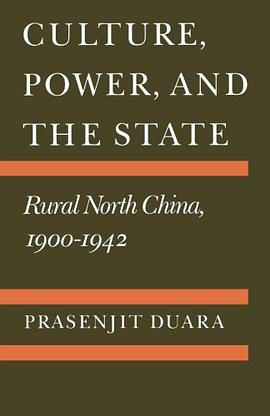
Culture, Power, and the State
Douban
Prasenjit Duara publishing house: Stanford University Press 1991 - 4
In the early twentieth century, the Chinese state made strenuous efforts to broaden and deepen its authority over rural society. This book is an ambitious attempt to offer both a method and a framework for analyzing Chinese social history in the state-making era.The author constructs a prismatic view of village-level society that shows how marketing, kinship, water control, temple patronage, and other structures of human interaction overlapped to form what he calls the cultural nexus of power in local society. The author's concept of the cultural nexus and his tracing of how it was altered enables us for the first time to grapple with change at the village level in all its complexity.The author asserts that the growth of the state transformed and delegitimized the traditional cultural nexus during the Republican era, particularly in the realm of village leadership and finances. Thus, the expansion of state power was ultimately and paradoxically responsible for the revolution in China as it eroded the foundations of village life, leaving nothing in its place.The problems of state-making in China were different from those of eighteenth- and nineteenth-century Europe; the Chinese experience heralds the process that would become increasingly common in the emergent states of the developing world under the very different circumstances of the twentieth century.
To read April 29, 2009
Duara
Rescuing History from the Nation
Douban
Prasenjit Duara publishing house: University Of Chicago Press 1997 - 1
Prasenjit Duara offers the first systematic account of the relationship between the nation-state, nationalism, and the concept of linear history. Focusing primarily on China and including discussion of India, Duara argues that many historians of postcolonial nation-states have adopted a linear, evolutionary history of the Enlightenment/colonial model. As a result, they have written repressive, exclusionary, and incomplete accounts. The backlash against such histories has resulted in a tendency to view the past as largely constructed, imagined, or invented. In this book, Duara offers a way out of the impasse between constructionism and the evolving nation; he redefines history as a series of multiple, often conflicting narratives produced simultaneously at national, local, and transnational levels. In a series of closely linked case studies, he considers such examples as the very different histories produced by Chinese nationalist reformers and partisans of popular religions, the conflicting narratives of statist nationalists and of advocates of federalism in early twentieth-century China. He demonstrates the necessity of incorporating contestation, appropriation, repression, and the return of the repressed subject into any account of the past that will be meaningful to the present. Duara demonstrates how to write histories that resist being pressed into the service of the national subject in its progress—or stalled progress—toward modernity.
To read April 29, 2009
Duara