Dutt_Michael_Madhusudan
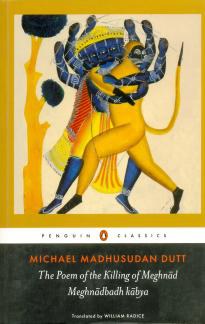
The Poem of the Killing of Meghnād
Meghnādbadh kābya Douban
Michael Madhusudan Dutt translator: William Radice publishing house: Penguin Classics 2010 - 11
'Meghnad instantly seized the divine sword but he could not lift it. He pulled atthe bow It remained in Lakshman s hand. He angrily grasped the shield, but his efforts were useless. . . .' First published in Bengali in 1861, The Poem of the Killing of Meghnad (Meghnadbadh kabya) by Michael Madhusudan Dutt is an epic in blank verse that has Indrajit (Meghnad), Ravan s warrior son who is slain by Lakshman in the Ramayana, as its protagonist. But the manner in which Meghnad is killed by Lakshman in a temple, where he has come to carry out a puja to Agni and has no means of defending himself is a departure from the Kshatriya warrior-code. This is the most subversive and original feature of Madhusudan s epic, and a daring way of turning Meghnad into a tragic hero. Something of an Indian equivalent to Milton s Paradise Lost, this magnificent work is an expression of Madhusudan s mind, of the Bengal Renaissance, and even of the wider Indian modernity that has emerged from that era. Imbued with irrepressible enthusiasm, youthful exuberance and rebellious flamboyance, Madhusudan s voice was compellingly new and inventive. This lyrical and vigorous translation by William Radice is accompanied by an extensive introduction, detailed footnotes and a comprehensive survey of Madhusudan s use of Indian and Western sources.
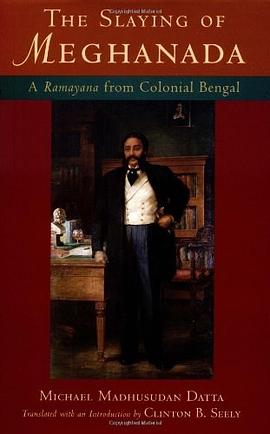
The Slaying of Meghanada
Douban
Datta, Michael Madhusudan translator: Seely, Clinton B. 2004 - 2
"The poem is rising into splendid popularity. Some say it is better than Milton-but that is all bosh-nothing can be better than Milton; many say it licks Kalidasa; I have no objection to that. I don't think it impossible to equal Virgil, Kalidasa, and Tasso." Michael Madhusudan Datta wrote this in a letter to a friend about his verse narrative, The Slaying of Meghanada (1861). The epic, a Bengali version of the Ramayana story in which Ravana, not Rama, is the hero, has become a classic of Indian literature. Datta lived in Bengal at the height of what is frequently called the Bengal Renaissance, a time so labeled for its reinvigoration and reconfiguration of the Hindu past and for the florescence of the literary arts. It was also a period when the Bengali city of Kolkata was a center of world trade-the second city of the British empire-and thus a site of cultural exchange between India and the West. Datta was the perfect embodiment of this time and place. The Slaying of Meghanada is deeply influenced by western epic tradition, and is sprinkled with nods to Homer, Milton, and Dante. Datta's deft intermingling of western and eastern literary traditions brought about a sea change in South Asian literature, and is generally considered to mark the dividing line between pre-modern and modern Bengali literature. Datta's masterpiece is now accessible to readers of English in Clinton Seely's elegant translation, which captures both the sense and the spirit of the original. The poem is supplemented by an extensive introduction, notes, and a glossary.