Elman
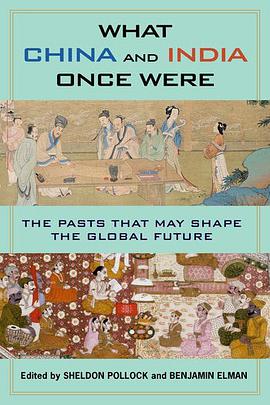
What China and India Once Were
Douban
Benjamin Elman (ed.) / Sheldon Pollock (ed.) publishing house: Columbia University Press 2018 - 10
In the early years of the twenty-first century, China and India have emerged as world powers. In many respects, this is a return to the historical norm for both countries. For much of the early modern period, China and India were global leaders in a variety of ways. In this book, prominent scholars seek to understand modern China and India through an unprecedented comparative analysis of their long histories. Using new sources, making new connections, and reexamining old assumptions, noted scholars of China and India pair up in each chapter to tackle major questions by combining their expertise. What China and India Once Were details how these two cultural giants arrived at their present state, considers their commonalities and divergences, assesses what is at stake in their comparison, and, more widely, questions whether European modernity provides useful contrasts. In jointly composed chapters, contributors explore ecology, polity, gender relations, religion, literature, science and technology, and more, to provide the richest comparative account ever offered of China and India before the modern era. What China and India Once Were establishes innovative frameworks for understanding the historical and cultural roots of East and South Asia in global context, drawing on the variety of Asian pasts to offer new ways of thinking about Asian presents.
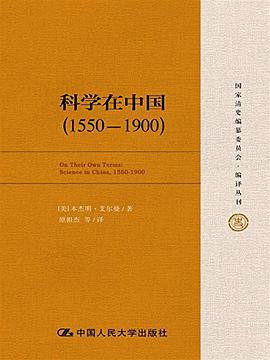
科学在中国 (1550-1900)
On Their Own Terms: Science in China 1550-1900 Douban
[美] 艾尔曼 translator: 原祖杰 等 publishing house: 中国人民大学出版社 2016 - 5
《科学在中国 (1550-1900)》是美国普林斯顿大学教授本杰明·艾尔曼在对中国学术思想多年研究的基础上,对中国1550至1900年科技发展史的一次重要探讨。17世纪初,欧洲人在钟表、杠杆和滑轮等重要机械制作上已经领先于中国了,但同时他们也在向中国人学习丝绸和瓷器 的制作技术。基督教传教士对于科学知识在中国的传播与发展无疑发挥了关键作用,无论是耶稣会科学知识与中国古代科学的嫁接,还是新教徒影响下欧洲现代科学在中国的传播,都为后来晚清改革者和国共两党精英所一致倡导的科学进步奠定了基础。与许多学者贬抑中西接触之前乃至甲午战争之前中国科技发展水平不同,艾尔曼从中国人的自然史观和学科分类等角度论证说,中国人对科学从来不乏兴趣,这也正是传教士介绍的欧洲科学能够在明、清朝野得到重视的根本原因。艾尔曼在本书中重新审视了一个被学术界一直视为当然的观点,即科学在明、清时期的中国是失败的,而在欧洲、日本是成功的。为了剥离甲午战争以来尤其是五四运动以来形成的明、清中国科学失败论的外壳,艾尔曼以惊人的耐心和毅力考察了与中国科学以及中国人科学思维相关的各个领域,向读者展示了中国人“以他们自己的方式”重构现代科学的努力。
To read March 18, 2017
Elman
World Philology
Douban
Sheldon Pollock / Benjamin A. Elman … publishing house: Harvard University Press 2015 - 1
Philology-the discipline of making sense of texts-is enjoying a renaissance within academia after decades of neglect. World Philology charts the evolution of philology across the many cultures and historical time periods in which it has been practiced, and demonstrates how this branch of knowledge, like philosophy and mathematics, is an essential component of human understanding. Every civilization has developed ways of interpreting the texts that it produces, and differences of philological practice are as instructive as the similarities. We owe our idea of a textual edition for example, to the third-century BCE scholars of the Alexandrian Library. Rabbinical philology created an innovation in hermeneutics by shifting focus from how the Bible commands to what it commands. Philologists in Song China and Tokugawa Japan produced startling insights into the nature of linguistic signs. In the early modern period, new kinds of philology arose in Europe but also among Indian, Chinese, and Japanese commentators, Persian editors, and Ottoman educationalists who began to interpret texts in ways that had little historical precedent. They made judgments about the integrity and consistency of texts, decided how to create critical editions, and determined what it actually means to read. Covering a wide range of cultures-Greek, Roman, Hebrew, Arabic, Sanskrit, Chinese, Indo-Persian, Japanese, Ottoman, and modern European-World Philology lays the groundwork for a new scholarly discipline.
A Cultural History of Civil Examinations in Late Imperial China
Douban
Benjamin A. Elman publishing house: University of California Press 2000 - 3
In this multidimensional analysis, Benjamin A. Elman uses over a thousand newly available examination records from the Yuan, Ming, and Ch'ing dynasties, 1315-1904, to explore the social, political, and cultural dimensions of the civil examination system, one of the most important institutions in Chinese history. For over five hundred years, the most important positions within the dynastic government were usually filled through these difficult examinations, and every other year some one to two million people from all levels of society attempted them. Covering the late imperial system from its inception to its demise, Elman revises our previous understanding of how the system actually worked, including its political and cultural machinery, the unforeseen consequences when it was unceremoniously scrapped by modernist reformers, and its long-term historical legacy. He argues that the Ming-Ch'ing civil examinations from 1370 to 1904 represented a substantial break with T'ang-Sung dynasty literary examinations from 650 to 1250. Late imperial examinations also made "Tao Learning," Neo-Confucian learning, the dynastic orthodoxy in official life and in literati culture. The intersections between elite social life, popular culture, and religion that are also considered reveal the full scope of the examination process throughout the late empire.
To read June 2, 2010
Elman真是……居然900页
Elman
From Philosophy to Philology
Douban
Benjamin A. Elman publishing house: Univ of California Los Angeles 2001 - 9
From Philosophy to Philology is an indispensable work on the intellectual life of China’s literati in the seventeenth and eighteenth centuries. While there was not a scientific revolution in China, there was an intellectual one. The shock of the Manchu conquest and the collapse of the Ming dynasty in 1644 led to a rejection of the moral self-cultivation that dominated intellectual life under the Ming. China’s scholars, particularly in the Yangzi River Basin, sought to restore China’s greatness by recapturing the wisdom of the ancients from the Warring States period (403–221 B.C.) and the Former Han dynasty (202 B.C.–9 A.D.), much as Renaissance Europe rediscovered the Greeks and Romans. But in China scholars faced the daunting task of determining which of many editions of the Classics were the true originals and which were forged additions of later centuries. The ensuing search for authentic texts led to the founding of academies and libraries, the compiling of bibliographies, the rise of printing of editions of the Classics and Histories and commentaries on their components, the study of ancient inscriptions, and a two-hundred-year effort to discover and discard forged texts. In the process rigorous standards of scholarly training were adopted, and scholarship became a full-time profession distinct from gentry farmers or imperial officials.