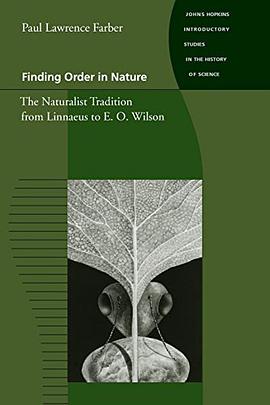
Since emerging as a discipline in the middle of the eighteenth century, natural history has been at the heart of the life sciences. It gave rise to the major organizing theory of life-evolution-and continues to be a vital science with impressive practical value. Central to advanced work in ecology, agriculture, medicine, and environmental science, natural history also attracts enormous popular interest. In Finding Order in Nature Paul Farber traces the development of the naturalist tradition since the Enlightenment and considers its relationship to other research areas in the life sciences. Written for the general reader and student alike, the volume explores the adventures of early naturalists, the ideas that lay behind classification systems, the development of museums and zoos, and the range of motives that led collectors to collect. Farber also explores the importance of sociocultural contexts, institutional settings, and government funding in the story of this durable discipline. "The quest for insight into the order of nature leads naturalists beyond classification to the creation of general theories that explain the living world. Those naturalists who focus on the order of nature inquire about the ecological relationships among organisms and also among organisms and their surrounding environments. They ask fundamental questions of evolution, about how change actually occurs over short and long periods of time. Many naturalists are drawn, consequently, to deeper philosophical and ethical issues: What is the extent of our ability to understand nature? And, understanding nature, will we be able to preserve it? Naturalists question the meaning of the order they discover and ponder our moral responsibility for it."-from the Introduction