Faure
浮生
The Fisher Folk of Late Imperial and Modern China : An Historical Anthropology of Boat-and-Shed Living Douban
贺喜
/
科大卫 主编
publishing house:
中西书局
2021
- 6
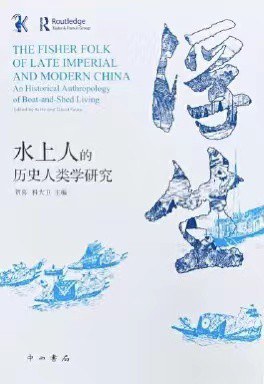
在很长的历史时期内,中国的沿海、沿江、沿湖生活着大量的水上人。这些人或被称为“疍”,或被称为“九姓渔户”,等等。这些称呼的背后往往交织着陆上人与水上人之间的权力关系。历史上,水上人往往不被允许上岸建屋居住,他们也很少掌握文字,因此撰写水上人历史的,几乎都是陆上人,采取的是陆上人的眼光。本书即试图去理解这样一个文字记录很不全面的社会历史,解读其与“陆上人”的联系与交流。
Colonialism and the Hong Kong Mentality
DoubanAcknowledgements iii
Introduction 1
Pt.I An overview
Ch.1 Is there a colonial mentality? 9
Ch.2 In Britain's footsteps: the colonial heritage 25
Ch.3 Hong Kong's lost generation 47
Ch.4 Beyond colonialism: the shift in 1967 69
Pt.II Documentary appendix
Ch.5 Social welfare, including housing, 1949-50 87
Ch.6 British government thinking on Hong Kong, 1956-1964 127
Ch.7 Sir David Trench and Constitutional reforms in Hong Kong 195
皇帝和祖宗
Douban
科大卫
translator:
卜永坚
publishing house:
江苏人民出版社
2009
- 11
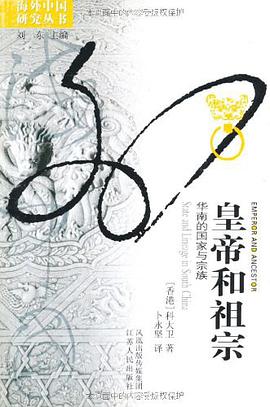
《皇帝和祖宗·华南的国家与宗族》所要回答和解决的问题是:朝廷的法典条文,民间的礼仪习俗,二者如何交织在一起,指导着“华南”这个有意识的、历时数百年的地域建构进程?《皇帝和祖宗·华南的国家与宗族》显示:历代王朝都致力于华南的政治整合,要培养出敬畏官府、纳粮当差、安分守己的良民。随着王朝在华南的军事征讨、行政规划,一套关于权力的文化语言也渗透华南。这套语言有两个互相发明的关键词:“皇帝”、“宗族”。它们渗透到一切礼节、身份、地位、财产权、商业习惯、社会流动、社区构建之中。华南与王朝中央之间的正统纽带,不仅建立于里甲与祀典之上,也建立在“宗族”这套语言之上。
The Fisher Folk of Late Imperial and Modern China
Douban
He Xi
/
David Faure (Editors)
publishing house:
Routledge
2015
The Historical Anthropology of Chinese Society Series
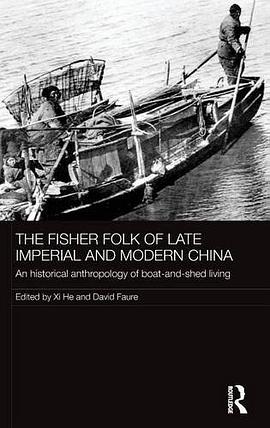
Although most studies of rural society in China deal with land villages, in fact very substantial numbers of Chinese people lived by the sea, on the rivers and the lakes. In land villages, mostly given to farming, people lived in permanent houses, whereas on the margins of the waterways many people lived in boats and sheds, and developed their own marked features, often being viewed as pariahs by the rest of Chinese society. This book examines these boat and shed living people. It takes an "historical anthropological" approach, combining research in official records with investigations among surviving boat and shed living people, their oral traditions and their personal records. Besides outlining the special features of the boat and shed living people, the book considers why pressures over time drove many to move to land villages, and how boat and shed living people were gradually marginalised, often losing their fishing rights to those who claimed imperial connections. The book covers the subject from Ming and Qing times up to the present.

近代中国商业的发展
China and Capitalism Douban此书为中国经济史与商业史研究领域的一位杰出学者所著,也是中国商业史研究的代表性著作。全书着重探讨了明清时期的私人契约、宗族、近代商号、工厂制的引进以及商业诉讼等在中国商业发展中的演变脉络、效用及影响。其中科大卫教授主要介绍了从16世纪到20世纪中国商业发展的两个阶段:在16世纪至18世纪的传统阶段,中国商业依合同和礼仪而立;自19世纪下半叶开始的近代化阶段,中国商业不得不因公司法和会计标准的引入而进行调整。
本书所收录的论文始终贯穿着作者独特的研究旨趣:即从16至20世纪政治与社会变迁的主要趋势中观察中国的商业实践。无论是追溯传统还是观察现代,无论是研究制度还是探讨现实,作者始终把中国社会固有的观念、习俗和行为方式视为一种具有坚韧的生命力的存在:它可能受到冲击,却从来不曾被置换;它可能与西方的经验大相径庭,却实实在在地影响着中国社会的过去和现在。那么,我们又将面对一个怎样的未来呢?这本书中的思考或许会在不经意间点亮我们的灵感。因为正如作者所说:“我们读历史的目的就是为了更好的生活。”

中国乡村与墟镇神圣空间的建构
Douban
(法) 劳格文
/
(英) 科大卫 编
publishing house:
社会科学文献出版社
2014
- 11
本书为2011年11月举行的“中国乡村与墟镇的建构空间——神圣之角色”研讨会的论文选集,内容涉及山东、山西、江西、安徽、广东、广西和湖南,文章所展示的不同地区的礼仪空间,有着极大的相似性,即当地宗族都有一套说辞,作为它们控制当地神龛和庙宇的理由;虽然不是每篇文章都描述宗教仪式,但从中可以看出,乡村都有交给仪式专家承办的宗教仪式;佛寺在礼仪空间内扮演重要角色,与祖先祠堂和庙宇呈三分天下之势。
Chieftains into Ancestors
Douban Open Library
David Faure
/
Ts'ui-p'ing Ho
publishing house:
UBC Press
2013
- 3
other title:
Chieftains Into Ancestors Imperial Expansion And Indigenous Society In Southwest China
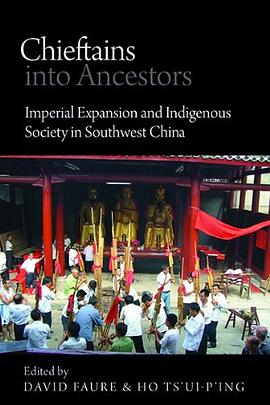
Chinese history has always been written from a centrist viewpoint. Telling the story of a quintessential Chinese culture that spread uniformly from the administrative heartland to the previously untamed periphery, official records have largely ignored the local histories of the country conquered peoples, preserved for generations in the form of oral tradition through myths, legends, and religious rituals. The history of southwestern China, a region known today for its minority character, is the subject of this volume.
In Chieftains into Ancestors, the authors describe the intersection of imperial administration and chieftain-dominated local culture. Since the acceptance of a new socio-political structure never happens overnight, they observe local rituals against the backdrop of extant written records, focusing on examples from the southwestern Hunan, Guangxi, Yunnan, and southwestern Guangdong provinces. The authors contemplate the crucial question of how one can begin to write the history of a conquered people whose past has been largely wiped out. Combining anthropological fieldwork with historical textual analysis, they dig deep for the indigenous voice as they build a new history of China southwestern region -- one that recognizes the ethnic, religious, and gendered transformations that took place in China nation-building process.
Unity and Diversity
Douban
Tao Tao Liu
/
David Faure eds.
publishing house:
Hong Kong University Press
1996
- 4
This book examines the evolution of the local identity in China from historical times to the present day. It traces the expression of local identity in religion and myth, in the construction of the provincial character, in the growth of cities, in literature, in economic development and in the expansion of the Chinese state. It argues that the growth of a local identity was part and parcel of the evolution of a national character. But, it notes also that the transforming of the local identity with the extension of the state has often come with a sense of nostalgia, a yearning for a world that has perhaps never been.
Down to Earth
DoubanBringing local history to bear on major questions in Chinese social history and anthropology, this volume comprises a series of historical and ethnographic studies of the Pearl River Delta from late imperial times through the 1940's. The delta is a rich and socially complex area of south China, and the contributors - scholars from the People's Republic of China, Hong Kong, the United Kingdom, and the United States - have long-standing ties to the region.
The contributors argue that local society in the Delta was integrated into the Chinese state through a series of changes that involved constant redefinition of lineages, territories, and ethnic identities. The emergence of lineages in the Ming and Qing dynasties, the deployment of deities in local alliances, and the shrewd use of ethnic labels provided terms for a discourse that reified the criteria for membership in Chinese local society. The ideology produced by these developments continued to serve as the norm for the legitimization of power in local society through the Republican period.
In reconstructing the 'civilizing process' in the Delta, whereby local inhabitants, both elites and commoners, used symbolic and instrumental means to become part of Chinese culture and polity, the book confronts a central question in history and anthropology: How do we conceptualize the historical development of a state agrarian society with hierarchies of power and authority, attachment to which is both unifying and diversifying?
Society
DoubanThis book puts together historical documents that illustrate the lives and concerns of Hong Kong people through a century and a half of colonial rule. It describes not only the ideals of the elite, but also the harsh realities of life faced by the majority, who until recent years lived under considerable poverty. It documents changes in standards of living, housing conditions, family life, communal organization and political aspirations. This vivid account of Hong Kong’s social history as Hong Kong people lived it summarizes the predicaments of people who chose to live in Hong Kong.

Emperor and Ancestor
DoubanThis book summarizes twenty years of the author's work in historical anthropology and documents his argument that in China, ritual provided the social glue that law provided in the West. The book offers a readable history of the special lineage institutions for which south China has been noted and argues that these institutions fostered the mechanisms that enabled south China to be absorbed into the imperial Chinese state—first, by introducing rituals that were acceptable to the state, and second, by providing mechanisms that made group ownership of property feasible and hence made it possible to pool capital for land reclamation projects important to the state. Just as taxation, defense, and recognition came together with the emergence of powerful lineages in the sixteenth century, their disintegration in the late nineteenth century signaled the beginnings of a new Chinese state.
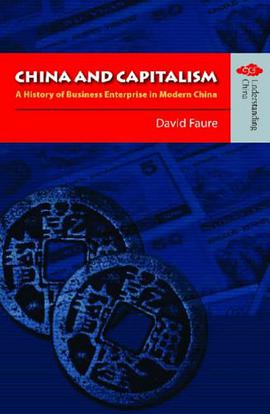
China and Capitalism
DoubanWritten by one of the most distinguished experts on China’s economic and business history, China and Capitalism provides a highly original and at the same time clear and readable approach to understanding the development of business in China from 1500 to the 1990s. David Faure then uses the picture he has assembled to shed new light on the strengths and weaknesses of Chinese business today. The book is written to be accessible to people with little background in China or Chinese business practice.
Dr Faure describes three phases in the development of Chinese business from the sixteenth to the twentieth century. In the traditional phase, from the sixteenth to the eighteenth century, Chinese business relied on contracts as well as on ritual propriety. In the modernizing phase, from the second half of the nineteenth century to the first half of the twentieth century, Chinese business had to adapt to the introduction of company law and legal standards of accounting. In the contemporary phase, from the middle of the twentieth century to the present day, China emerged from a control economy to a vibrant market by embracing once again the changes introduced in the modernizing phase.
General readers, including students and teachers in courses touching on but not primarily devoted to the Chinese experience, will find in this book the most comprehensive account of China’s business development in the last five centuries and many insights into the workings of China’s modern business scene. Specialist readers will find a highly original approach to the history of business in China.