Hatcher
Idioms of Improvement
Douban
Brian A. Hatcher publishing house: Oxford University Press, USA 2001 - 1
Read
May 18, 2020
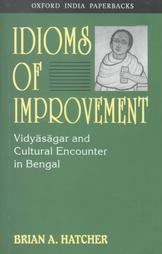
20130117 | "Vernacular convergence": "triveni" of Western, traditional, and vernacular; "yatna" and "dharma" as examples of vernacularization; the vernacular not only about cultural domain untapped by colonialism, but new possibilities for vernacular meaning-making; indigenous initiative to take on the possibility in this convergence process
Hatcher
Vidyasagar
Douban
Brian A. Hatcher publishing house: Routledge India 2014 - 3
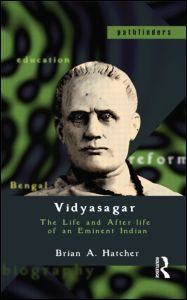
This book offers a new interpretation of the life and legacy of the Indian reformer and intellectual, Ishvarchandra Vidyasagar (1820–91). Drawing upon autobiography, biography, secondary criticism and a range of Vidyasagar’s original writings in Bengali, the book interrogates the role of history, memory and controversy, and emphasises the key challenge of pinning down the identity of an enigmatic and multi-faceted figure. By examining lesser-known works of Vidyasagar (including several pseudonymous and posthumous works) alongside the evidence of his public career, the author calls attention to the colonial transformation of intellectual and social life, the nature of life writing, the limits of standard biographies and the problem of modern Indian identity as such. Based on decades of research and an original perspective, this book will be especially useful to scholars of modern Indian history, biographical studies, comparative literature and those interested in Bengal. Review ‘In this innovative work, Hatcher attempts not so much a biography of Vidyasagar as an insightful reading of extant biographies.’ — Amiya P. Sen, Head, Department of History and Culture, Jamia Millia Islamia, New Delhi ‘Hatcher’s stunning exploration makes this important monograph both biographical and historiographical.’ — A. R. Venkatachalapathy, Madras Institute of Development Studies, Chennai
Read
Oct. 25, 2014
Thoughtful attempt to offer a critical reading of mythical anecdotes and hagiographical writings to see through the "after-life", but the excessive detail still occasionally takes on a somewhat celebratory tone. A more comprehensive "Historical worlds of Vidyasagar", which will bridge the early colonial and late colonial periods, is still awaiting.
Hatcher
Hindu Widow Marriage
Douban
Vidyasagar, Ishvarchandra translator: Hatcher, Brian A. 2011 - 11
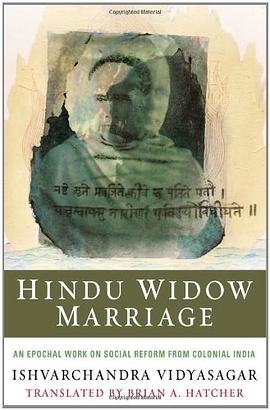
Before the passage of the Hindu Widow's Re-marriage Act of 1856, Hindu tradition required a woman to live as a virtual outcast after her husband's death. Widows were expected to shave their heads, discard their jewelry, live in seclusion, and undergo regular acts of penance. Ishvarchandra Vidyasagar was the first Indian intellectual to successfully argue against these strictures. A Sanskrit scholar and passionate social reformer, Vidyasagar was a leading proponent of widow marriage in colonial India, urging his contemporaries to reject a ban that caused countless women to suffer needlessly. Vidyasagar's brilliant strategy paired a rereading of Hindu scripture with an emotional plea on behalf of the widow, resulting in an organic reimagining of Hindu law and custom. Vidyasagar made his case through the two-part publication Hindu Widow Marriage, a tour de force of logic, erudition, and humanitarian rhetoric. In this new translation, Brian A. Hatcher makes available in English for the first time the entire text of one of the most important nineteenth-century treatises on Indian social reform. An expert on Vidyasagar, Hinduism, and colonial Bengal, Hatcher enhances the original treatise with a substantial introduction describing Vidyasagar's multifaceted career, as well as the history of colonial debates on widow marriage. He innovatively interprets the significance of Hindu Widow Marriage within modern Indian intellectual history by situating the text in relation to indigenous commentarial practices. Finally, Hatcher increases the accessibility of the text by providing an overview of basic Hindu categories for first-time readers, a glossary of technical vocabulary, and an extensive bibliography.