Kaufmann
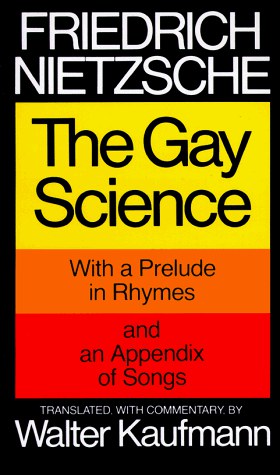
The Gay Science
Douban Goodreads Skybridge
Friedrich Nietzsche translator: Walter Kaufmann publishing house: Random House 1991 - 9 other title: The Gay Science: With a Prelude in Rhymes and an Appendix of Songs
"[This book] mirrors all of Nietzsche's thought and could be related in hundreds of ways to his other books, his notes, and his letters. And yet it is complete in itself. For it is a work of art." —Walter Kaufmann in the Introduction Nietzsche called The Gay Science "the most personal of all my books." It was here that he first proclaimed the death of God—to which a large part of the book is devoted—and his doctrine of the eternal recurrence. Walter Kaufmann's commentary, with its many quotations from previously untranslated letters, brings to life Nietzsche as a human being and illuminates his philosophy. The book contains some of Nietzsche's most sustained discussions of art and morality, knowledge and truth, the intellectual conscience and the origin of logic. Most of the book was written just before Thus Spoke Zarathustra , the last part five years later, after Beyond Good and Evil . We encounter Zarathustra in these pages as well as many of Nietzsche's most interesting philosophical ideas and the largest collection of his own poetry that he himself ever published. Walter Kaufmann's English versions of Nietzsche represent one of the major translation enterprises of our time. He is the first philosopher to have translated Nietzsche's major works, and never before has a single translator given us so much of Nietzsche.
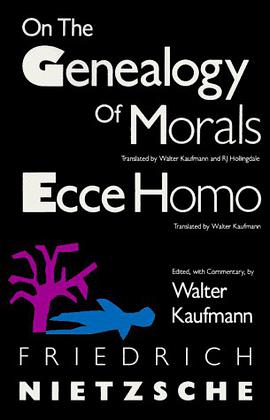
On the Genealogy of Morals/Ecce Homo
Zur Genealogie der Moral Douban
Friedrich Nietzsche translator: Walter Kaufmann publishing house: Vintage 1989
The great philosopher's major work on ethics, along with ECCE HOMO, Nietzche's remarkable review of his life and works. Translated by Walter Kaufmann.
Nietzsche
Douban
Walter A. Kaufmann publishing house: Princeton University Press 1975 - 2
This classic is the benchmark against which all modern books about Nietzsche are measured. When Walter Kaufmann wrote it in the immediate aftermath of World War II, most scholars outside Germany viewed Nietzsche as part madman, part proto-Nazi, and almost wholly unphilosophical. Kaufmann rehabilitated Nietzsche nearly single-handedly, presenting his works as one of the great achievements of Western philosophy. Responding to the powerful myths and countermyths that had sprung up around Nietzsche, Kaufmann offered a patient, evenhanded account of his life and works, and of the uses and abuses to which subsequent generations had put his ideas.Without ignoring or downplaying the ugliness of many of Nietzsche's proclamations, he set them in the context of his work as a whole and of the counterexamples yielded by a responsible reading of his books. More positively, he presented Nietzsche's ideas about power as one of the great accomplishments of modern philosophy, arguing that his conception of the "will to power" was not a crude apology for ruthless self-assertion but must be linked to Nietzsche's equally profound ideas about sublimation.He also presented Nietzsche as a pioneer of modern psychology and argued that a key to understanding his overall philosophy is to see it as a reaction against Christianity. Many scholars in the past half century have taken issue with some of Kaufmann's interpretations, but the book ranks as one of the most influential accounts ever written of any major Western thinker.
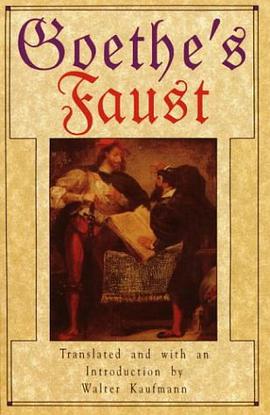
Goethe's Faust
Douban Goodreads Skybridge
Johann Wolfgang von Goethe translator: Walter Kaufmann publishing house: Anchor 1963 other title: Faust
The best translation of Faust available, this volume provides the original German text and its English counterpart on facing pages. Walter Kaufmann's translation conveys the poetic beauty and rhythm as well as the complex depth of Goethe's language. Includes Part One and selections from Part Two.
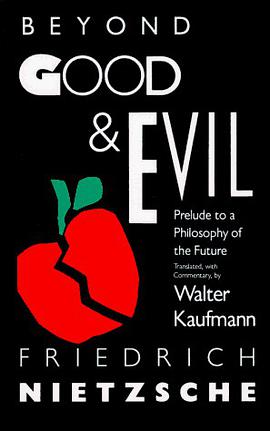
Beyond Good & Evil
Google Books Douban
Friedrich Wilhelm Nietzsche translator: Walter Kaufmann publishing house: Vintage 1989 - 12
Nietzsche proposes in "Beyond Good and Evil" a system of inquiry and analysis known by the phrase 'history as critique.' This straightforward manner of investigation leads Nietzsche to question all of culture's most venerated conventions: science, religion, politics, decency and linguistic stock. He begins this process by overriding tradition when he says "only that which has no history can be defined." An explanation of virtue, for example, can only be written when the defintion eludes all possible requisites of custom and habit. We cannot properly administer the philosophical aspects of morality except through divine direction, suspicion, or an unexamined dependence on tradition. Because of this, Nietzsche calls to question the foundational premise that it is best for human beings to seek the truth. How do we know that mendacity isn't better? What is truth, anyway? He disputes the intention of the traditional esoteric venture. He unburdens all sources of cultural incontestability and claims to fixed truth which empties them of their value: "...we modern men, like semi-barbarians...reach 'our' bliss only when we are most in danger." Since we are in a process of perpetual adaptation we cannot be defined by any indigenous quality. Instead of adopting a class consciousness for purposes of easy identification Nietzsche asks that we establish an amplified sense of responsibility to our own luxurious creativity. He declares there is a higher calling: an unassisted life of intense but private joy, anguish, fortitude, perception, and constructive preparation.