Koselleck
Critique and Crisis
Douban
Reinhart Koselleck publishing house: The MIT Press 1998 - 1
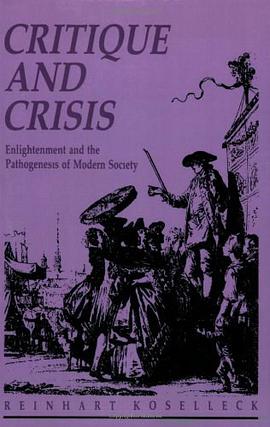
Critique and Crisis established Reinhart Koselleck's reputation as the most important German intellectual historian of the postwar period. This first English translation of Koselleck's tour de force demonstrates a chronological breadth, a philosophical depth, and an originality which are hardly equalled in any scholarly domain. It is a history of the Enlightenment in miniature, fundamental to our understanding of that period and its consequences.Like Tocqueville, Koselleck views Enlightenment intellectuals as an uprooted, unrealistic group of onlookers who sowed the seeds of the modern political tensions that first flowered in the French Revolution. He argues that it was the split that developed between state and society during the Enlightenment that fostered the emergence of this intellectual elite divorced from the realities of politics.Koselleck describes how this disjunction between political authority proper and its subjects led to private spheres that later became centers of moral authority and, eventually, models for political society that took little or no notice of the constraints under which politicians must inevitably work. In this way progressive bourgeois philosophy, which seemed to offer the promise of a unified and peaceful world, in fact produced just the opposite.The book provides a wealth of examples drawn from all of Europe to illustrate the still relevant message that we evade the constraints and the necessities of the political realm at our own risk.Reinhart Koselleck is Professor of the Theory of History at the University of Bielefeld and author of Futures Past: On the Semantics of Historical Time. Critique and Crisis is included in the series Studies in Contemporary German Social Thought, edited by Thomas McCarthy.
Futures Past
Douban Goodreads
Koselleck, Reinhart/ Tribe, Keith (TRN) translator: Keith Tribe publishing house: Columbia University Press 2004 - 6
Widely considered to be the most important German intellectual historian of the postwar period, Reinhart Koselleck has had a profound influence on contemporary historiography. With a new, interpretive introduction by the translator, this revised and corrected edition of Koselleck's most acclaimed work is once again available in English.With the advent of modernity in the late eighteenth-century every aspect of human life was radically transformed, including the experience of time. As the ever-accelerating pace of the modern world left people with briefer intervals of time in which to gather new experiences and adapt to social and technological changes, the demands that were placed on the future correspondingly increased. The promises of modernity -- freedom, progress, opportunity -- began to produce expectations and hopes that broke free of the present and projected utopian visions of unbounded possibility onto the future. In this provocative and erudite book, Koselleck explores the shifting perceptions and conceptions of historical time that have emerged over the past two centuries. Relying on an extraordinary array of witnesses and texts -- from politicians, philosophers, theologians, and poets to proverbs, lexica, Renaissance paintings, and the dreams of German citizens during the Third Reich -- Koselleck argues that the past and the future have become "relocated" in relation to each other, and that "history" has emerged as a new kind of temporality with distinct characteristics and ways of assimilating experience.Chronological time is generally tied to social and political actions, to the concrete experiences of human beings. Yet in reality historical events and epochsintermingle and overlap, transcending strict temporal distinctions that can be derived from physical or astronomical phenomena. In the present context of globalization -- where many cultures and perceptions become superimposed upon one another -- the modern world faces not only temporal acceleration but also historical disorientation. Koselleck believes that any given present is simultaneously a "former future" that was once defined by specific terms and ideas. By analyzing the semantics of historical time, Koselleck brings into focus the far-reaching impact that conceptions of time have on social organization, revealing that human history results as much from structure of temporal experience as from the contingencies of uncontrollable events.