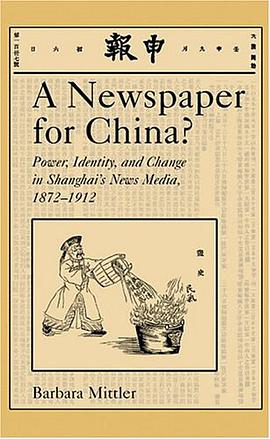
A Newspaper for China?
Douban
Barbara Mittler
publishing house:
Harvard University Asia Center
2004
- 5
In 1872 in the treaty port of Shanghai, British merchant Ernest Major founded one of the longest-lived and most successful of modern Chinese-language newspapers, the Shenbao. His publication quickly became a leading newspaper in China and won praise as a "department store of news," a "forum for intellectual discussion and moral challenge," and an "independent mouthpiece of the public voice." Located in the International Settlement of Shanghai, it was free of government regulation. Paradoxically, in a country where the government monopolized the public sphere, it became one of the world's most independent newspapers.
As a private venture, the Shenbao was free of the ideologies that constrained missionary papers published in China during the nineteenth century. But it also lacked the subsidies that allowed these papers to survive without a large readership. As a purely commercial venture, the foreign-managed Shenbao depended on the acceptance of educated Chinese, who would write for it, read it, and buy it. This book sets out to analyze how the managers of the Shenbao made their alien product acceptable to Chinese readers and how foreign-style newspapers became alternative modes of communication acknowledged as a powerful part of the Chinese public sphere within a few years. In short, it describes how the foreign Shenbao became a "newspaper for China."