Roy_Tirthankar
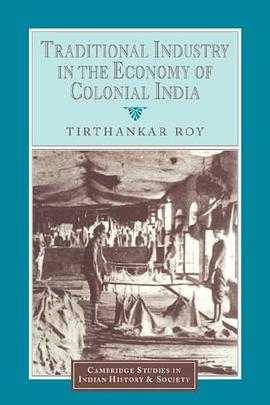
Traditional Industry in the Economy of Colonial India
Douban
Tirthankar Roy publishing house: 劍橋大學出版社 2007 - 2
The majority of workers in South Asia are employed in industries that rely on manual labour and craft skills. Some of these industries have existed for centuries and survived great changes in consumption and technology over the last 150 years. In earlier studies, historians of the region focused on mechanized rather than craft industries, arguing that traditional manufacturing was destroyed or devitalized during the colonial period, and that 'modern' industry is substantially different. Exploring new material from research into five traditional industries, Tirthankar Roy's book contests these notions, demonstrating that while traditional industry did evolve during the Industrial Revolution, these transformations had a positive rather than destructive effect on manufacturing generally. In fact, the book suggests, the major industries in post-independence India were shaped by such transformations. Tirthankar Roy's book offers penetrating insights into India's economic and social history.
Read
Jan. 29, 2020
Traditional industries drastically reorganized during colonial period, playing a creative role in India's industrialization; Challenging the "de-industrialization" thesis; destructive impact aside, focusing on the the creative impact
Roy_Tirthankar
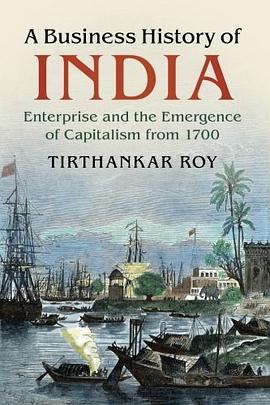
A Business History of India
Douban
Tirthankar Roy publishing house: 劍橋大學出版社
In recent decades, private investment has led to an economic resurgence in India. But this is not the first time the region has witnessed impressive business growth. There have been many similar stories over the past 300 years. India's economic history shows that capital was relatively expensive. How, then, did capitalism flourish in the region? How did companies and entrepreneurs deal with the shortage of key resources? Has there been a common pattern in responses to these issues over the centuries? Through detailed case studies of firms, entrepreneurs, and business commodities, Tirthankar Roy answers these questions. Roy bridges the approaches of business and economic history, illustrating the development of a distinctive regional capitalism. On each occasion of growth, connections with the global economy helped firms and entrepreneurs better manage risks. Making these deep connections between India's economic past and present shows why history matters in its remaking of capitalism today.
Natural Disasters and Indian History
Douban
Tirthankar Roy publishing house: Oxford University Press 2012 - 9
This short and exploratory study is the first to engage with a social and economic history of natural disasters in India. Based on the study of a number of events that occurred in colonial India between 1770 and 1935, the author argues that the impact of natural disasters requires a graded sense of time. The book draws on three themes-market, politics, and knowledge, roughly corresponding to three time scales-the short, the medium, and the long run, respectively. These frame the case studies of famines, earthquakes, and storms covered in the book. These studies illustrate that disasters become devastating events by impairing the capacity of the state and civil society; they create gainers and losers; and they destroy cooperation. Yet, as the author points out, disasters have also enabled new understandings of nature, state, and society, on the basis of which useful new knowledge could grow.
Company of Kinsmen
Douban
Tirthankar Roy publishing house: Oxford University Press 2010 - 4
This volume examines the history of enterprise and entrepreneurial communities from the beginning of the eighteenth to mid nineteenth century. Roy examines how enterprise and entrepreneurial communities adapted to globalization and colonial law. He analyses forms of merchant organization in pre-colonial and colonial India; impact of commercialism on artisans collectives; linkages between institutional change and peasant lineage; interplay between new work opportunities, managerial paradigms, and organized labour supply; relationship between state, economic order, and business organizations.
Traditional Industry in the Economy of Colonial India
Douban
Tirthankar Roy publishing house: 劍橋大學出版社 1999 - 11
The majority of workers in South Asia are employed in industries that rely on manual labour and craft skills. Some of these industries have existed for centuries and survived great changes in consumption and technology over the last 150 years. In earlier studies, historians of the region focused on mechanized rather than craft industries, arguing that traditional manufacturing was destroyed or devitalized during the colonial period, and that 'modern' industry is substantially different. Exploring new material from research into five traditional industries, Tirthankar Roy's book contests these notions, demonstrating that while traditional industry did evolve during the Industrial Revolution, these transformations had a positive rather than destructive effect on manufacturing generally. In fact, the book suggests, the major industries in post-independence India were shaped by such transformations. Tirthankar Roy's book offers penetrating insights into India's economic and social history.
India in the World Economy
Douban
Tirthankar Roy publishing house: 劍橋大學出版社 2012 - 6
Cross-cultural exchange has characterized the economic life of India since antiquity. Its long coastline has afforded convenient access to Asia and Africa as well as trading partnerships formed in the exchange of commodities ranging from textiles to military technology and from opium to indigo. In a journey across two thousand years, this enthralling book, written by a leading South Asian historian, describes the ties of trade, migration, and investment between India and the rest of the world and shows how changing patterns of globalization have reverberated in economic policy, politics, and political ideology within India. Along the way, the book asks three major questions: Is this a particularly Indian story? When did the big turning points happen? And is it possible to distinguish the modern from the pre-modern pattern of exchange? These questions invite a new approach to the study of Indian history by placing the region at the center of the narrative. This is global history written on India's terms, and, as such, the book invites Indian, South Asian, and global historians to rethink both their history and their methodologies.