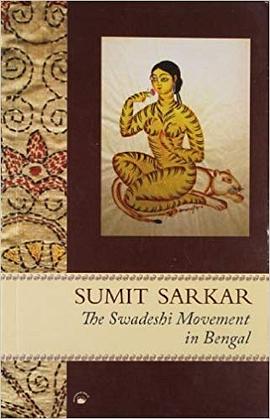
The Swadeshi Movement in Bengal, 1903-1908
Douban
Sumit Sarkar
publishing house:
Orient BlackSwan
2011
- 5
This classic work of scholarship, first published in 1973, has long been out of print. It is reprinted now with a new preface by the author and critical essays by Neeladri Bhattacharya and Dipesh Chakrabarty.
From the moment of its first printing about thirty-five years ago, The Swadeshi Movement in Bengal has always held a special place in the historiography of modern India. Very few monographs, if any, have ever rivalled the meticulous research and the thick description that characterized this book, or the lucidity of its exposition and the persuasive power of its overall argument ... Sarkar s research improved on existing historiography in a major way by bringing out many unknown or hitherto neglected aspects of the history of the Swadeshi movement: the complex divisions that marked its different trends, the labour movement and mass mobilization of the period that few knew about in our time, Swadeshi anticipation of many of the Gandhian techniques of protest ... this book, which should have enjoyed a steady and buoyant market over the years, has strangely remained out of print for about fifteen successive years. Its republication by Permanent Black is truly a cause for celebration. --Dipesh Chakrabarty, University of Chicago
Sumit Sarkar s story of Swadeshi brings out in fascinating detail, with a wealth of sources, all that he sees as heroic and tragic, sublime and quixotic, in those dramatic and eventful years in Bengal. We have here no simple story of success or failure, no celebratory account of great deeds and noble figures, no linear unfolding of events that lead step by step to a final climax. What we have instead is a picture painted in shades of grey in which black and white merge and separate in that in-between zone where the blackness of black comes under question as much as the whiteness of white. --Neeladri Bhattacharya, Jawaharlal Nehru University