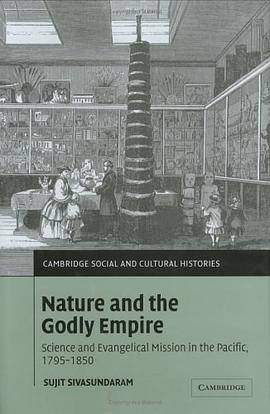
Sivasundaram
Nature and the Godly Empire
Douban
Sujit Sivasundaram publishing house: 劍橋大學出版社 2005 - 11
Nineteenth-century historians have described how science became secular and how scientific theories such as evolution justified colonialism. This 2005 book explores the relationship between nineteenth-century science and Christianity outside the Western world. At focus are the intrepid missionaries of the London Missionary Society who reverently surveyed the oceans and islands of the Pacific and instructed converts to observe nature in order to interpret God's designs. Sujit Sivasundaram argues that the knowledge that these missionaries practised functioned as a popular science that was inextricably linked with religious expansion. He shows how Britain's providential empire found support from popular views of nature as much as elite science and how science and religion came together in communities far from the metropolis even as disputes raged in Europe. This will be essential reading for historians of empire, science and religion, cultural historians, environmental historians and anthropologists.
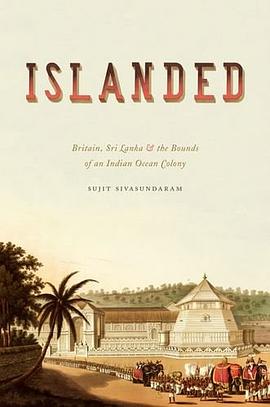
Islanded
Douban
Sivasundaram, Sujit publishing house: University Of Chicago Press 2013 - 8
How did the British come to conquer South Asia in the late eighteenth and early nineteenth centuries? Answers to this question usually start in northern India, neglecting the dramatic events that marked Britain’s contemporaneous taking of the island of Sri Lanka. In Islanded, Sujit Sivasundaram reconsiders the arrival of British rule in South Asia as a dynamic and unfinished process of territorialisation and state building, revealing that the British rule in South Asia as a dynamic and unfinished process of territorialisation and state building, revealing that the British colonial project was framed by Sri Lanka’s traditions and maritime placement and built in part on the model they provided. Using palm-leaf manuscripts alongside the colonial archive, Sivasundaram tells the story of two sets of islanders in combat and collaboration. He explores how the British organized the process of ‘islanding’ and ‘partitioning’: they aimed to create a separable unit of colonial governace and trade in keeping with conceptions of ethnology, culture, and geography. The advent of British rule in South Asia was thus a critical point in the fragmentation of the mainland from the island. But rather than serving as a radical rupture, he reveals how the colonists recycled and constantly redefined traditions that they learned from Kandy, a kingdom in the Sri Lankan highlands whose customs—from the strategies of war to views of nature—fascinated them. Picking up a range of unusual themes, from migration, orientalism, and ethnography to botany, medicine, and education, Islanded is an engaging retelling of the advent of British rule and a theory of colonial impact that speaks to other places that have been lost from dominant histories.