Stoler
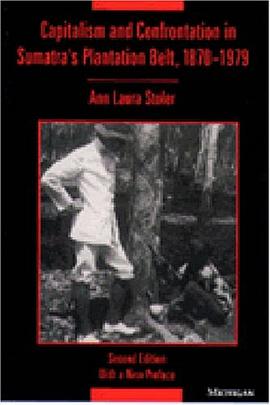
Capitalism and Confrontation in Sumatra's Plantation Belt, 1870-1979
Douban
Stoler, Ann Laura publishing house: University of Michigan Press 1995
Over the last century, North Sumatra has been the site of one of the most intensive and successful pursuits of foreign agricultural enterprise of any developing country. Colonial expansion by Europeans resulted in overt--sometimes violent-- conflict between capital and labor, as workers resisted plantation interests. "Capitalism and Confrontation in Sumatra's Plantation Belt, 1870-1979" is a fascinating ethnographic history that analyzes how popular resistance actively molded both the form of colonialism and the social, economic, and political experience of the Javanese laboring communities on Sumatra's plantation borders. "A well-crafted and expertly researched history . . . exhibits a brand of intellectual integrity that is rare in a work so critical and this makes it a major contribution to the literature of the impact of imperialism and capitalism on the traditional populations of the Third World." --Peasant Studies "From written historical records, as well as from very broad and intensive field work, Ann Laura Stoler has pieced together an eminently rich and meaningful episode of Indonesian history . . . . What makes for its quality is the remarkable balance, maintained throughout the study, between description, analysis and interpretation."--Pacific Affairs Ann Laura Stoler is Professor of Anthropology and History and Women's Studies, University of Michigan, and the author of "Race and the Education of Desire: A Colonial Reading of Foucault's The History of Sexuality." She is the recipient of the 1992 Harry J. Benda Prize in Southeast Asian Studies from the Association of Asian Studies.
Race and the Education of Desire
Douban
Ann Laura Stoler publishing house: Duke University Press Books 1995 - 10
Michel Foucault’s History of Sexuality has been one of the most influential books of the last two decades. It has had an enormous impact on cultural studies and work across many disciplines on gender, sexuality, and the body. Bringing a new set of questions to this key work, Ann Laura Stoler examines volume one of History of Sexuality in an unexplored light. She asks why there has been such a muted engagement with this work among students of colonialism for whom issues of sexuality and power are so essential. Why is the colonial context absent from Foucault’s history of a European sexual discourse that for him defined the bourgeois self? In Race and the Education of Desire, Stoler challenges Foucault’s tunnel vision of the West and his marginalization of empire. She also argues that this first volume of History of Sexuality contains a suggestive if not studied treatment of race. . Drawing on Foucault’s little-known 1976 College de France lectures, Stoler addresses his treatment of the relationship between biopower, bourgeois sexuality, and what he identified as “racisms of the state.” In this critical and historically grounded analysis based on cultural theory and her own extensive research in Dutch and French colonial archives, Stoler suggests how Foucault’s insights have in the past constrained—and in the future may help shape—the ways we trace the genealogies of race. . Race and the Education of Desire will revise current notions of the connections between European and colonial historiography and between the European bourgeois order and the colonial treatment of sexuality. Arguing that a history of European nineteenth-century sexuality must also be a history of race, it will change the way we think about Foucault.
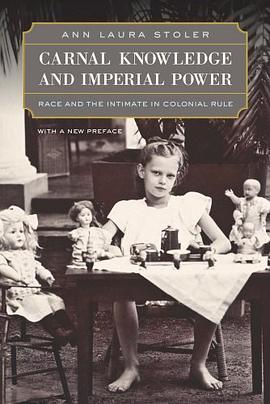
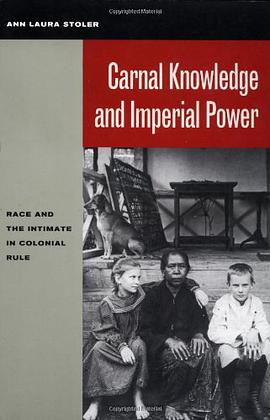
Carnal Knowledge and Imperial Power
Douban
Ann Laura Stoler publishing house: University of California Press 2010 - 2
This landmark book tracks matters of intimacy to investigate matters of state in late nineteenth and early twentieth century Indonesia, particularly the critical role played by sexual arrangements and affective attachments in creating colonial categories and distinguishing the ruler from the ruled. Arguing that social classification is not a benign cultural act but a potent political one, Ann Laura Stoler's essays focus on parents and parenting, nursing mothers, servants, orphanages, and abandoned children to reveal why they were understood as so essential to imperial governance and why they have been so consistently absent from its historiography. In a new preface, Stoler takes up a broad range of problematics raised in the first edition, including the analytics of comparison, the treatment of the intimate, and more.
Along the Archival Grain
Douban
Ann Laura Stoler publishing house: Princeton University Press 2008 - 11
"Along the Archival Grain" offers a unique methodological and analytic opening to the affective registers of imperial governance and the political content of archival forms. In a series of nuanced mediations on the nature of colonial documents from the nineteenth-century Netherlands Indies, Ann Laura Stoler identifies the social epistemologies that guided perception and practice, revealing the problematic racial ontologies of that confused epistemic space. Navigating familiar and extraordinary paths through the lettered lives of those who ruled, she seizes on moments when common sense failed and prevailing categories no longer seemed to work. She asks not what colonial agents knew, but what happened when what they thought they knew they found they did not. Rejecting the notion that archival labor be approached as an extractive enterprise, Stoler sets her sights on archival production as a consequential act of governance, as a field of force with violent effect, and not least as a vivid space to do ethnography.