Strauss
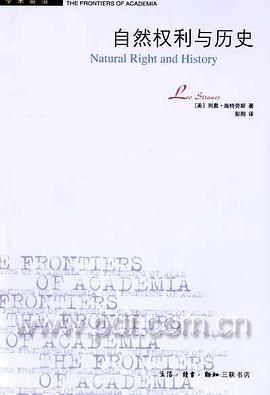
自然权利与历史
Natural Right and History Douban
[美国] 列奥·施特劳斯 translator: 彭刚 publishing house: 生活·读书·新知三联书店 2006 - 7
自然权利问题乃是当代政治与社会哲学中首要的议题之一,本书对这一主题进行了极其细致入微的探究;作者尤其从古典的柏拉图、亚里士多德入手,揭示出现代自然权利理论前提下所导致的自然权利的危机。 像许多伟大的思想家一样,列奥•施特劳斯致力于一些根本的思想问题凸显出西方文明中深刻的精神紧张。他对于当代思想中的实证主义、历史主义以及自由主义的批判,使他更加深入地投身于古典政治哲学的研究。
What is Political Philosophy? And Other Studies
Douban
Leo Strauss publishing house: University Of Chicago Press 1988 - 10
"All political action has . . . in itself a directedness towards knowledge of the good: of the good life, or of the good society. For the good society is the complete political good. If this directedness becomes explicit, if men make it their explicit goal to acquire knowledge of the good life and of the good society, political philosophy emerges. . . . The theme of political philosophy is mankind's great objectives, freedom and government or empire—objectives which are capable of lifting all men beyond their poor selves. Political philosophy is that branch of philosophy which is closest to political life, to non-philosophic life, to human life."—From "What Is Political Philosophy?" What Is Political Philosophy?—a collection of ten essays and lectures and sixteen book reviews written between 1943 and 1957—contains some of Leo Strauss's most famous writings and some of his most explicit statements of the themes that made him famous. The title essay records Strauss's sole extended articulation of the meaning of political philosophy itself. Other essays discuss the relation of political philosophy to history, give an account of the political philosophy of the non-Christian Middle Ages and of classic European modernity, and present his theory of esoteric writing.
Natural Right and History
Douban
Leo Strauss publishing house: University Of Chicago Press 1965
In this classic work, Leo Strauss examines the problem of natural right and argues that there is a firm foundation in reality for the distinction between right and wrong in ethics and politics. On the centenary of Strauss's birth, and the fiftieth anniversary of the Walgreen Lectures which spawned the work, Natural Right and History remains as controversial and essential as ever. "Strauss ...makes a significant contribution towards an understanding of the intellectual crisis in which we find ourselves ...[and] brings to his task an admirable scholarship and a brilliant, incisive mind."--John H. Hallowell, American Political Science Review Leo Strauss (1899-1973) was the Robert Maynard Hutchins Distinguished Service Professor Emeritus in Political Science at the University of Chicago.
The City and Man
Douban
Leo Strauss publishing house: University Of Chicago Press 1978 - 11
"The City and Man" consists of provocative essays by the late Leo Strauss on Aristotle's "Politics, " Plato's "Republic," and Thucydides' "Peloponnesian Wars." Together, the essays constitute a brilliant attempt to use classical political philosophy as a means of liberating modern political philosophy from the strangehold of ideology. The essays are based on a long and intimate familiarity with the works, but the essay on Aristotle is especially important as one of Strauss's few writings on the philosopher who largely shaped Strauss's conception of antiquity. The essay on Plato is a full-scale discussion of Platonic political philosophy, wide in scope yet compact in execution. When discussing Thucydides, Strauss scceeds not only in presenting the historian as a moral thinker of high rank, but in drawing his thought into the orbit of philosophy, and thus indicating a relation of history and philosophy that does not presuppose the absorption of philosphy by history.
Leo Strauss On Plato's Symposium
Douban Goodreads
Leo Strauss publishing house: University Of Chicago Press 2003 - 5
From Library Journal In fall 1959, Strauss offered a course at the University of Chicago titled "Plato's Political Philosophy," during which he lectured on the Symposium. It was suggested shortly after that the lectures be reworked and published, and Strauss agreed. Benardete (classics, New York Univ.) worked on the manuscript, but Strauss was not satisfied with the results, and the project languished until 1999, when Benardete picked it up again and completed it. The resulting publication is not only an excellent analysis of, and introduction to, the Symposium but a text that mirrors the mind and skills of a renowned teacher. Strauss provides a detailed and careful reading of the dialog, together with a cogent analysis of its place in Plato's work, the nature of Eros, the tension between philosophy and poetry, and other related topics. This is a valuable addition to libraries that support programs in philosophy and/or political studies. Terry Skeats, Bishop's Univ. Lib., Lennoxville, Quebec Copyright 2001 Reed Business Information, Inc. --This text refers to the Hardcover edition. Product Description The first major piece of unpublished work by Leo Strauss to appear in more than thirty years, this volume offers the public the unprecedented experience of encountering this renowned scholar as his students did. Given as a course in autumn 1959 under the title "Plato's Political Philosophy," these provocative lectures—until now, never published, but instead passed down from one generation of students to the next—show Strauss at his subtle and insightful best.
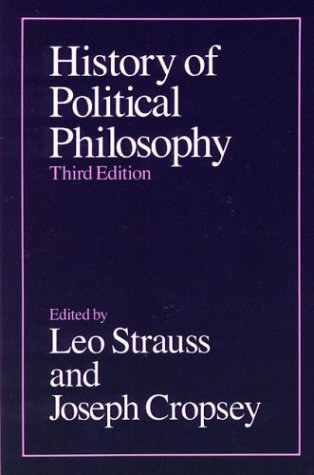
History of Political Philosophy
Douban Goodreads
Leo Strauss / Joseph Cropsey publishing house: University Of Chicago Press 1987 - 11
This volume provides an unequaled introduction to the thought of chief contributors to the Western tradition of political philosophy from classical Greek antiquity to the twentieth century. Written by specialists on the various philosophers, this third edition has been expanded significantly to include both new and revised essays.
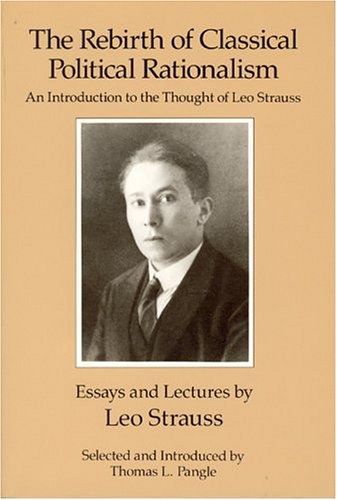
The Rebirth of Classical Political Rationalism
Douban
Leo Strauss publishing house: University Of Chicago Press 1989 - 1
This concise and accessible introduction to Strauss's thought provides, for wider audience, a bridge to his more complex theoretical work. Editor Pangle has gathered five of Strauss's previously unpublished lectures and five hard-to-find published writings and has arranged them so as to demonstrate the systematic progression of the major themes that underlay Strauss's mature work. "[These essays] display the incomparable insight and remarkable range of knowledge that set Strauss's works apart from any other twentieth-century philosopher's."--Charles R. Kesler, National Review