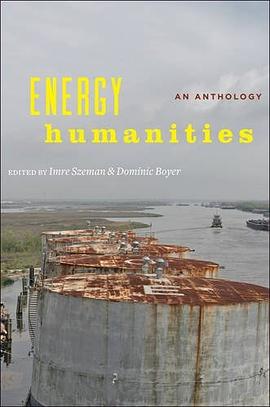
Energy Humanities
Douban
Imre Szeman (Editor)
/
Dominic Boyer (Editor)
publishing house:
Johns Hopkins University Press
2017
- 6
Energy humanities is a field of scholarship that, like medical and digital humanities before it, aims to overcome traditional boundaries between the disciplines and between academic and applied research. Responding to growing public concern about anthropogenic climate change and the unsustainability of the fuels we use to power our modern society, energy humanists highlight the essential contribution that humanistic insights and methods can make to areas of analysis once thought best left to the natural sciences.
In this groundbreaking anthology, Imre Szeman and Dominic Boyer have brought together a carefully curated selection of the best and most influential work in energy humanities. Arguing that today’s energy and environmental dilemmas are fundamentally problems of ethics, habits, imagination, values, institutions, belief, and power―all traditional areas of expertise of the humanities and humanistic social sciences―the essays and other pieces featured here demonstrate the scale and complexity of the issues the world faces. Their authors offer compelling possibilities for finding our way beyond our current energy dependencies toward a sustainable future.
Contributors include: Margaret Atwood, Paolo Bacigalupi, Lesley Battler, Ursula Biemann, Dominic Boyer, Italo Calvino, Warren Cariou, Dipesh Chakrabarty, Una Chaudhuri, Claire Colebrook, Stephen Collis, Erik M. Conway, Amy De’Ath, Adam Dickinson, Fritz Ertl, Pope Francis, Amitav Ghosh, Gökçe Günel, Gabrielle Hecht, Cymene Howe, Dale Jamieson, Julia Kasdorf, Oliver Kellhammer, Stephanie LeMenager, Barry Lord, Graeme Macdonald, Joseph Masco, John McGrath, Martin McQuillan, Timothy Mitchell, Timothy Morton, Jean-François Mouhot, Abdul Rahman Munif, Judy Natal, Reza Negarestani, Pablo Neruda, David Nye, Naomi Oreskes, Andrew Pendakis, Karen Pinkus, Ken Saro-Wiwa, Hermann Scheer, Roy Scranton, Allan Stoekl, Imre Szeman, Laura Watts, Michael Watts, Jennifer Wenzel, Sheena Wilson, Patricia Yaeger, and Marina Zurkow