hatcher
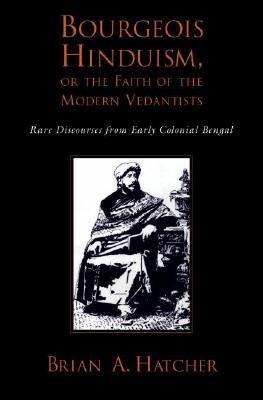
Bourgeois Hinduism, or Faith of the Modern Vedantists: Rare Discourses from Early Colonial Bengal
Bourgeois Hinduism, or Faith of the Modern Vedantists: Rare Discourses from Early Colonial Bengal Goodreads
Brian A. Hatcher publishing house: Oxford University Press, USA 2007 - 10
In 1839 a diverse group of Hindu leaders began gathering in Calcutta to share and propagate their faith in a non-idolatrous form of worship. The group, known as the Tattvabodhini Sabha, met weekly to worship and hear discourses from members on the virtues of a rational and morally responsible mode of worship. They called upon ancient sources of Hindu spirituality to guide them in developing a form of modern theism they referred to as Vedanta. In this book, Brian Hatcher translates these hitherto unknown discourses and situates them against the backdrop of religious and social change in early colonial Calcutta. Apart from bringing to light the theology and moral vision of an association that was to have a profound influence on religious and intellectual life in nineteenth-century Bengal, Hatcher's analysis promotes reflection on a variety of topics central to understanding the development of modern forms of Hindu belief and practice.
Hinduism Before Reform
Google Books
Brian A. Hatcher publishing house: Harvard University Press 2020 - 3
A bold retelling of the origins of contemporary Hinduism, and an argument against the long-established notion of religious reform. By the early eighteenth century, the Mughal Empire was in decline, and the East India Company was making inroads into the subcontinent. A century later Christian missionaries, Hindu teachers, Muslim saints, and Sikh rebels formed the colorful religious fabric of colonial India. Focusing on two early nineteenth-century Hindu communities, the Brahmo Samaj and the Swaminarayan Sampraday, and their charismatic figureheads—the “cosmopolitan” Rammohun Roy and the “parochial” Swami Narayan—Brian Hatcher explores how urban and rural people thought about faith, ritual, and gods. Along the way he sketches a radical new view of the origins of contemporary Hinduism and overturns the idea of religious reform. Hinduism Before Reform challenges the rigid structure of revelation-schism-reform-sect prevalent in much history of religion. Reform, in particular, plays an important role in how we think about influential Hindu movements and religious history at large. Through the lens of reform, one doctrine is inevitably backward-looking while another represents modernity. From this comparison flows a host of simplistic conclusions. Instead of presuming a clear dichotomy between backward and modern, Hatcher is interested in how religious authority is acquired and projected. Hinduism Before Reform asks how religious history would look if we eschewed the obfuscating binary of progress and tradition. There is another way to conceptualize the origins and significance of these two Hindu movements, one that does not trap them within the teleology of a predetermined modernity.