feminism/feminist
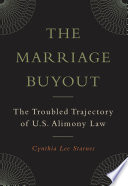
The Marriage Buyout
Google Books
Cynthia Starnes publishing house: NYU Press 2014 - 5
From divorce court to popular culture, alimony is a dirty word. Unpopular and rarely ordered, the awards are frequently inconsistent and unpredictable. The institution itself is often viewed as an historical relic that harkens back to a gendered past in which women lacked the economic independence to free themselves from economic support by their spouses. In short, critics of alimony claim it has no place in contemporary visions of marriage as a partnership of equals. But as Cynthia Lee Starnes argues in The Marriage Buyout, alimony is often the only practical tool for ensuring that divorce does not treat today’s primary caregivers as if they were suckers. Her solution is to radically reconceptualize alimony as a marriage buyout. Starnes’s buyouts draw on a partnership model of marriage that reinforces communal norms of marriage, providing a gender-neutral alternative to alimony that assumes equality in spousal contribution, responsibility, and right. Her quantification formulae support new default rules that make buyouts more certain and predictable than their current alimony counterparts. Looking beyond alimony, Starnes outlines a new vision of marriages with children, describing a co-parenting partnership between committed couples, and the conceptual basis for income sharing between divorced parents of minor children. Ultimately, under a partnership model, the focus of alimony is on gain rather than loss and equality rather than power: a spouse with disparately low earnings isn’t a sucker or a victim dependent on a fixed alimony payment, but rather an equal stakeholder in marriage who is entitled at divorce to share any gains the marriage produced.
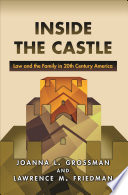
Inside the Castle
Google Books
Joanna L. Grossman / Lawrence M. Friedman publishing house: Princeton University Press 2011 - 7
A comprehensive social history of families and family law in twentieth-century America Inside the Castle is a comprehensive social history of twentieth-century family law in the United States. Joanna Grossman and Lawrence Friedman show how vast, oceanic changes in society have reshaped and reconstituted the American family. Women and children have gained rights and powers, and novel forms of family life have emerged. The family has more or less dissolved into a collection of independent individuals with their own wants, desires, and goals. Modern family law, as always, reflects the brute social and cultural facts of family life. The story of family law in the twentieth century is complex. This was the century that said goodbye to common-law marriage and breach-of-promise lawsuits. This was the century, too, of the sexual revolution and women's liberation, of gay rights and cohabitation. Marriage lost its powerful monopoly over legitimate sexual behavior. Couples who lived together without marriage now had certain rights. Gay marriage became legal in a handful of jurisdictions. By the end of the century, no state still prohibited same-sex behavior. Children in many states could legally have two mothers or two fathers. No-fault divorce became cheap and easy. And illegitimacy lost most of its social and legal stigma. These changes were not smooth or linear—all met with resistance and provoked a certain amount of backlash. Families took many forms, some of them new and different, and though buffeted by the winds of change, the family persisted as a central institution in society. Inside the Castle tells the story of that institution, exploring the ways in which law tried to penetrate and control this most mysterious realm of personal life.