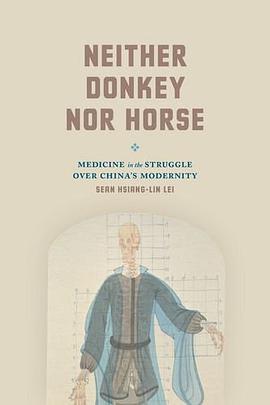
Neither Donkey nor Horse tells the story of how Chinese medicine was transformed from the antithesis of modernity in the early twentieth century into a potent symbol of and vehicle for China’s exploration of its own modernity half a century later. Instead of viewing this transition as derivative of the political history of modern China, Sean Hsiang-lin Lei argues that China’s medical history had a life of its own, one that at times directly influenced the ideological struggle over the meaning of China’s modernity and the Chinese state.
Far from being a remnant of China’s premodern past, Chinese medicine in the twentieth century coevolved with Western medicine and the Nationalist state, undergoing a profound transformation—institutionally, epistemologically, and materially—that resulted in the creation of a modern Chinese medicine. This new medicine was derided as “neither donkey nor horse” because it necessarily betrayed both of the parental traditions and therefore was doomed to fail. Yet this hybrid medicine survived, through self-innovation and negotiation, thus challenging the conception of modernity that rejected the possibility of productive crossbreeding between the modern and the traditional.
By exploring the production of modern Chinese medicine and China’s modernity in tandem, Lei offers both a political history of medicine and a medical history of the Chinese state.
Review
“In this insightful and provocative book, Lei shows us what it meant to practice ‘modern’ medicine in Mao Zedong’s semicolonial and semifeudal society. Drawing on rich historical sources, Neither Donkey nor Horse reveals that modern medicine will always be mongrel medicine. Importantly, Lei gives us the critical postcolonial genealogy for ‘Traditional Chinese Medicine,’ the epitome of Chinese modernity, now a global phenomenon.”
(Warwick Anderson, University of Sydney)
“Reaching far beyond the history of modern China, Neither Donkey nor Horse challenges conventional understanding of modernity, science, and state power through an intellectual and social history of medical debate and development in East Asia from the late nineteenth century forward. This is a thoughtful and meticulously researched investigation of transnational modernizing processes in the twentieth century as they touched down and transformed worlds in China. The book demonstrates that medical knowledge and practice, whether ‘modern’ or ‘traditional,’ historicized or fixed as policy, are nowhere innocent of politics, culture, and social hierarchy. It offers surprising historical lessons for everyone interested in science and local knowledge, socialism and capitalism, institutions and ideas about nature as they weave together in modern regimes of health and population governance.”
(Judith Farquhar, University of Chicago)
“Neither Donkey nor Horse is a tour de force of how both Western and Chinese medicine played central roles not only in Chinese modernity but also the formation of the state in Republican China. Lei thus adroitly relates the politics of medicine and debates over making Chinese medicine more scientific to the big themes of nationalism, the state, and modernity that dominated the political struggles of early twentieth-century China.”
(Marta Hanson, Johns Hopkins University)
“Neither Donkey nor Horse is a major work by the leading scholar in the field of modern Chinese medical history. Lei argues that what we now know as traditional Chinese medicine as it emerged as a discourse in the early twentieth century was fundamentally shaped by the encounter with Western medicine and the relationship with the state that this dictated. Chinese medicine was something new that was created during this period in response to themes with Western biomedicine as traditional practitioners sought social mobility through participation in the state. Lei’s argument is backed up by research of the highest standard: his knowledge of the historical sources is outstanding, and he is impressively familiar with the secondary and theoretical literature in both English and Chinese. His book will be of interest not only to historians of Republican China but also to those interested in the history of science more widely.”
(Henrietta Harrison, University of Oxford)
“If you are going to read just one book on the modern history of Chinese medicine, this is the work to read. Lei’s analysis of the entwinement of medicine, science, modernity, and the state is brilliantly original and persuasive, and argued with admirable clarity. Neither Donkey nor Horse is a major contribution to science studies and the history of global health, as well as to the study of twentieth-century China.”
(Shigehisa Kuriyama, Harvard University)