在线阅读本书
Book Description
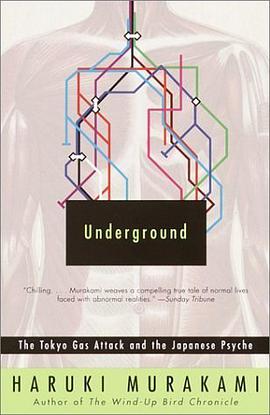
From Haruki Murakami, internationally acclaimed author of The Wind-Up Bird Chronicle and Norwegian Wood, a work of literary journalism that is as fascinating as it is necessary, as provocative as it is profound.
In March of 1995, agents of a Japanese religious cult attacked the Tokyo subway system with sarin, a gas twenty-six times as deadly as cyanide. Attempting to discover why, Murakami conducted hundreds of interviews with the people involved, from the survivors to the perpetrators to the relatives of those who died, and Underground is their story in their own voices. Concerned with the fundamental issues that led to the attack as well as these personal accounts, Underground is a document of what happened in Tokyo as well as a warning of what could happen anywhere. This is an enthralling and unique work of nonfiction that is timely and vital and as wonderfully executed as Murakami’s brilliant novels.
From Publishers Weekly
On March 20, 1995, followers of the religious cult Aum Shinrikyo unleashed lethal sarin gas into cars of the Tokyo subway system. Many died, many more were injured. This is acclaimed Japanese novelist Murakami's (The Wind-Up Bird Chronicle, etc.) nonfiction account of this episode. It is riveting. What he mostly does here, however, is listen to and record, in separate sections, the words of both victims, people who "just happened to be gassed on the way to work," and attackers. The victims are ordinary people bankers, businessmen, office workers, subway workers who reflect upon what happened to them, how they reacted at the time and how they have lived since. Some continue to suffer great physical disabilities, nearly all still suffer great psychic trauma. There is a Rashomon-like quality to some of the tales, as victims recount the same episodes in slightly different variations. Cumulatively, their tales fascinate, as small details weave together to create a complex narrative. The attackers are of less interest, for what they say is often similar, and most remain, or at least do not regret having been, members of Aum. As with the work of Studs Terkel, which Murakami acknowledges is a model for this present work, the author's voice, outside of a few prefatory comments, is seldom heard. He offers no grand explanation, no existential answer to what happened, and the book is better for it. This is, then, a compelling tale of how capriciously and easily tragedy can destroy the ordinary, and how we try to make sense of it all. (May 1)Forecast: Publication coincides with the release of a new novel by Murakami (Sputnik Sweetheart, Forecasts, Mar. 19), and several national magazines, including Newsweek and GQ, will be featuring this fine writer. This attention should help Murakami's growing literary reputation.
From Library Journal
The deadly Tokyo subway poison gas attack, perpetrated by members of the Aum Shinrikyo cult on March 20, 1995, was the fulfillment of every urban straphanger's nightmare. Through interviews with several dozen survivors and former members of Aum, novelist Murakami (The Wind-Up Bird Chronicle) presents an utterly compelling work of reportage that lays bare the soul of contemporary Japan in all its contradictions. The sarin attack exposed Tokyo authorities' total lack of preparation to cope with such fiendish urban terrorism. More interesting, however, is the variety of reactions among the survivors, a cross-section of Japanese citizens. Their individual voices remind us of the great diversity within what is too often viewed from afar as a homogeneous society. What binds most of them is their curious lack of anger at Aum. Chilling, too, is the realization that so many Aum members were intelligent, well-educated persons who tried to fill voids in their lives by following Shoko Asahara, a mad guru who promised salvation through total subordination to his will. For all public and academic libraries. Steven I. Levine, Univ. of Montana, Missoula
From Booklist
After living abroad for eight years, novelist Murakami returned to Japan intent on gaining a deeper understanding of his homeland, a mission that took on an unexpected urgency in the aftermath of the Tokyo poison-gas attack in March 1995. Inspired by a letter to the editor from a woman whose husband survived the subway attack but suffered terrible aftereffects, Murakami set out to interview as many survivors as he could find who were capable of overcoming the Japanese reluctance to complain or criticize. With great sensitivity, insight, and respect, Murakami coaxed a remarkable group of people into describing their harrowing experiences aboard the five morning rush-hour trains on which members of the Aum Shinrikyo cult released deadly sarin gas. Unlike a journalist, Murakami doesn't force these searing narratives into tidy equations of cause and effect, good and evil, but rather allows contradictions and ambiguity to stand, thus presenting unadorned the shocking truth of the diabolical and brutal manner in which ordinary lives were derailed or destroyed. The most haunting aspect of these accounts is the eerie passivity of the passengers both during and after the assault, a phenomena echoed in Murakami's courageous interviews with Aum members, frank conversations that reveal the depth of these individuals' spiritual longings and the horror of their betrayal at the hands of their corrupt and insane leader. Shaped by his fascination with alternative worlds and humanity's capacity for both compassion and abomination, Murakami's masterful and empathic chronicle vividly articulates the lessons that should be learned from this tragic foray into chaos.
Donna Seaman
Book Dimension :
length: (cm)20.3 width:(cm)13.3