进化

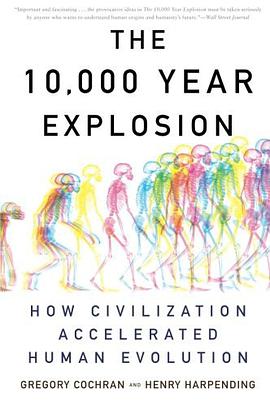
The 10,000 Year Explosion
Douban
Gregory Cochran
/
Henry Harpending
publishing house:
Basic Books
2010
- 10
A manifesto for and an example of a new kind of history, a biological history, and not just of the prehistoric era Scientists have long believed that the 'great leap forward' that occurred some 40,000 to 50,000 years ago in Europe marked the end of significant biological evolution in humans. In this stunning account of our evolutionary history, top scholars Gregory Cochran and Henry Harpending reject this conventional wisdom and reveal that the human species has undergone a storm of genetic change much more recently. Human evolution in fact accelerated after civilisation arose, they contend, and these ongoing changes have played a pivotal role in human history. They argue that biology explains the expansion of the Indo-Europeans, the European conquest of the Americas, and European Jews' rise to intellectual prominence. In each of these cases, the key was recent genetic change: adult milk tolerance in the early Indo-Europeans that allowed for a new way of life, increased disease resistance among the Europeans settling America, and new versions of neurological genes among European Jews. Ranging across subjects as diverse as human domestication, Neanderthal hybridization, and IQ tests, Cochran and Harpending's analysis demonstrates convincingly that human genetics have changed and can continue to change much more rapidly than scientists have previously believed. A provocative and fascinating look at human evolution, "The 10,000 Year Explosion" reveals the ongoing interplay between culture and biology in the making of the human race.
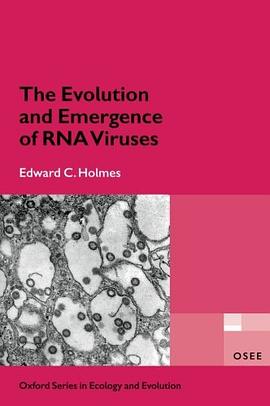
The Evolution and Emergence of RNA Viruses
Douban
Edward C. Holmes
publishing house:
Oxford University Press
2009
- 8
RNA viruses provide unique insights into the patterns and processes of evolutionary change in real time. The study of viral evolution is especially topical given the growing awareness that emerging and re-emerging diseases (most of which are caused by RNA viruses) represent a major threat to public health. However, while the study of viral evolution has developed rapidly in the last 30 years, relatively little attention has been directed toward linking work on the mechanisms of viral evolution within cells or individual hosts, to the epidemiological outcomes of these processes. This novel book fills this gap by considering the patterns and processes of viral evolution across their entire range of spatial and temporal scales.
The Evolution and Emergence of RNA Viruses provides a comprehensive overview of RNA virus evolution. This is the first book to link mechanisms of viral evolution to epidemiological outcomes, incorporating case studies in RNA virus emergence and evolution using topical examples such as influenza, HIV, dengue fever, and rabies. It reveals the underlying evolutionary processes by which emerging viruses cross species boundaries and spread in new hosts.
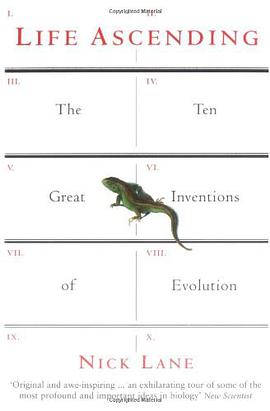
Life Ascending
Douban
Nick Lane
publishing house:
Profile Books
2010
- 1
How did life invent itself? Where did DNA come from? How did consciousness develop? Powerful new research methods are providing vivid insights into the makeup of life. Comparing gene sequences, examining atomic structures of proteins, and looking into the geochemistry of rocks have helped explain evolution in more detail than ever before. Nick Lane expertly reconstructs the history of life by describing the ten greatest inventions of evolution (including DNA, photosynthesis, sex, and sight), based on their historical impact, role in organisms today, and relevance to current controversies. Who would have guessed that eyes started off as light-sensitive spots used to calibrate photosynthesis in algae? Or that DNA’s building blocks form spontaneously in hydrothermal vents? Lane gives a gripping, lucid account of nature’s ingenuity, and the result is a work of essential reading for anyone who has ever pondered or questioned the science underlying evolution’s greatest gifts to man.
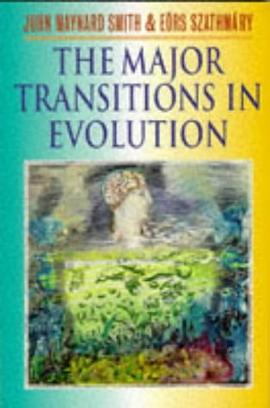
The Major Transitions in Evolution
Douban
John Maynard Smith
/
Eors Szathmary
publishing house:
Oxford University Press, USA
1998
- 1
During evolution, there have been several major changes in the way that genetic information is organized and transmitted from one generation to the next. These transitions include the origin of life itself, the first eukaryotic cells, reproduction by sexual means, the appearance of multicellular plants and animals, the emergence of cooperation and of animal societies, and the unique language ability of humans. This is the first book to discuss all of these major transitions. In discussing such a wide range of topics in one volume, the authors are able to highlight the similarities between different transitions - for example, between the union of replicating molecules to form chromosomes and of cells to form multicellular organisms. The authors also show how an understanding of one transition sheds light on others. A common theme in the book is that entities that could replicate independently before the transition can replicate afterwards only as part of a larger whole. Why, then, does selection between entities at the lower level not disrupt selection at the higher level? In answering this question, the authors offer an explanation for the evolution of cooperation at all levels of complexity. Written in a clear style, and illustrated with many original diagrams, this book can be read with enjoyment by anyone with an undergraduate training in the biological sciences. It will be ideal for advanced discussion groups on evolution. Although the content ranges widely from molecular biology to linguistics and from intragenomic conflict to insect societies, no detailed knowledge of any of these topics is required. Mathematical models are clearly explained, and equations and formulae are kept to a minimum.