AnneCarson
Plainwater
Douban Goodreads
Anne Carson publishing house: Vintage Books 2000 - 3 other title: Plainwater: Essays and Poetry
The poetry and prose collected in Plainwater are a testament to the extraordinary imagination of Anne Carson, a writer described by Michael Ondaatje as "the most exciting poet writing in English today." Succinct and astonishingly beautiful, these pieces stretch the boundaries of language and literary form, while juxtaposing classical and modern traditions. Carson envisions a present-day interview with a seventh-century BC poet, and offers miniature lectures on topics as varied as orchids and Ovid. She imagines the muse of a fifteenth-century painter attending a phenomenology conference in Italy. She constructs verbal photographs of a series of mysterious towns, and takes us on a pilgrimage in pursuit of the elusive and intimate anthropology of water. Blending the rhythm and vivid metaphor of poetry with the discursive nature of the essay, the writings in Plainwater dazzle us with their invention and enlighten us with their erudition.

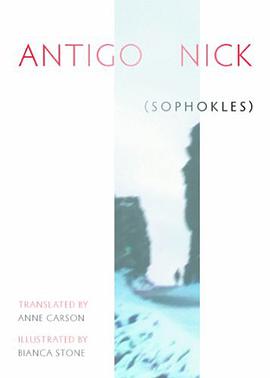
Antigonick
Douban
Sophocles; Stone, Bianca; Carson, Anne 2012 - 5
Antigonick, a "comic book" of Sophocles' tragedy, is one of Carson's strangest works. It dramatises its own eccentricity, evoking a portrait of the author in a state of distraction; the words of the translation are printed in handwriting (Carson's own), almost entirely without punctuation, in tiny capital letters that are both neat and a little frantic. The illustrations (by the artist Bianca Stone) are a surreal assortment of icy landscapes, domestic interiors, gothic houses, unravelling spools of thread, precarious staircases and drowning horses, which are printed on transparent vellum that overlay the text, and which relate only occasionally to what is happening in the play.
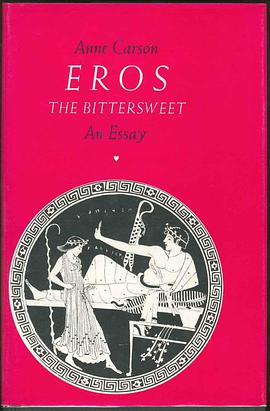
Eros the Bittersweet
Douban
Anne Carson publishing house: Princeton University Press 1986
Published for the Center for Hellenic Studies (Washington DC). A book about love as seen by the ancients, Eros is Anne Carson's exploration of the concept of "eros" in both classical philosophy and literature. Beginning with: "It was Sappho who first called eros 'bittersweet.' No one who has been in love disputes her. What does the word mean?", Carson examines her subject from numerous points of view and styles, transcending the constraints of the scholarly exercise for an evocative and lyrical meditation in the tradition of William Carlos William's Spring and All and William H. Gass's On Being Blue.