poetry
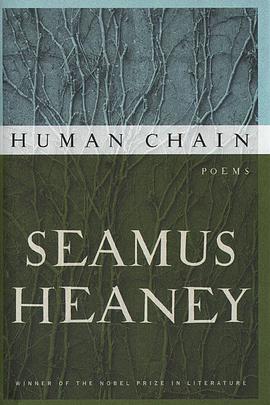
Human Chain
Douban
Seamus Heaney publishing house: Farrar, Straus and Giroux 2010 - 9
Seamus Heaney's new collection elicits continuities and solidarities, between husband and wife, child and parent, then and now, inside an intently remembered present - the stepping stones of the day, the weight and heft of what is passed from hand to hand, lifted and lowered. "Human Chain" also broaches larger questions of transmission, as lifelines to the inherited past. There are newly minted versions of anonymous early Irish lyrics, poems which stand at the crossroads of oral and written, and other 'hermit songs' which weigh equally in their balance the craft of scribe and the poet's early calling as scholar. A remarkable sequence entitled "Route 110" plots the descent into the underworld in the Aeneid against single moments in the arc of a life, from a 1950s adolescence to the birth of the poet's first grandchild. Other poems display a Virgilian pietas for the dead - friends, neighbours and family - which is yet wholly and movingly vernacular. "Human Chain" is Seamus Heaney's twelfth collection of poems.
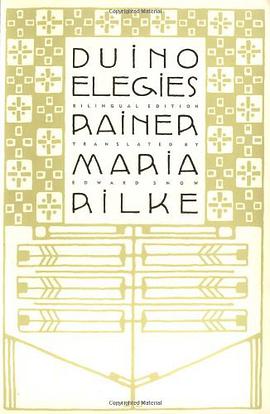
Duino Elegies
Douban
Rilke, Rainer Maria translator: Snow, Edward A. publishing house: Farrar Straus & Giroux 2001 - 3
"Who, if I cried out, would hear me among the angelic""orders? and even if one of them pressed me""suddenly to his heart: I'd be consumed""in that overwhelming existence. For beauty is nothing""but the beginning of terror, which we can just barely endure, ""and we stand in awe of it as it coolly disdains""to destroy us. Every angel is terrifying."-from "The First Elegy" Over the last fifteen years, in his two volumes of "New Poems" as well as in T"he Book of Images" and "Uncollected Poems," Edward Snow has emerged as one of Rainer Maria Rilke's most able English-language interpreters. In his translations, Snow adheres faithfully to the intent of Rilke's German while constructing nuanced, colloquial poems in English. Written in a period of spiritual crisis between 1912 and 1922, the poems that compose the Duino Elegies are the ones most frequently identified with the Rilkean sensibility. With their symbolic landscapes, prophetic proclamations, and unsettling intensity, these complex and haunting poems rank among the outstanding visionary works of the century.