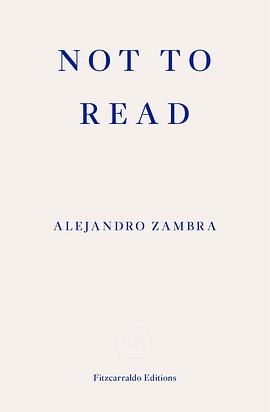
Over the course of the chronicles and literary essays that make up this volume, Alejandro Zambra outlines his own particular theory of reading. Whether it is in the course of a carefully considered commentary on a specific book, or in the digressions born out of a piece on this or that author - from Parra, Levrero and Pavese to Millan, Ribeyro, Tanizaki or Bolano, Natalia Ginzburg and Puig - the simple act of reading dominates these pages, within which the author alternates between forceful and good-humoured rants against cliches and impostures and intimist celebrations of true literary experiences. The book's title is an allusion to the moment when Zambra decided to stop writing a weekly literary column and began instead to experiment, as he explains, with the pleasure of not reading certain books, thus allowing himself the freedom to open himself up to readings not imperative to the daily routine of literary journalism. As in his novels and poems, in NOT TO READ Alejandro Zambra unfurls his characteristic style, which places ambiguity, restraint and uncertainty above everything else, and offer up the suggestion that certain books can touch us in substantial ways. In doing so the outlines of a kind of blurry self-portrait emerge - something like the image of an exemplary writer and reader reflected in a concave mirror, in his library, and surrounded by ghosts and feelings.