时间管理
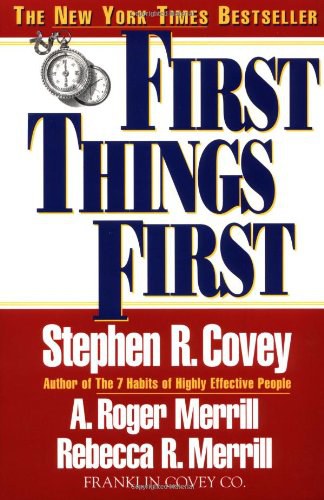
First Things First
Douban
A. Roger Merrill
/
Rebecca R. Merrill
…
publishing house:
Free Press
1996
- 1
Book Description
I'm getting more done in less time, but where are the rich relationships, the inner peace, the balance, the confidence that I'm doing what matters most and doing it well?
Does this nagging question haunt you, even when you feel you are being your most efficient? If so, First Things First can help you understand why so often our first things aren't first. Rather than offering you another clock, First Things First provides you with a compass, because where you're headed is more important than how fast you're going.
Amazon.com
What are the most important things in your life? Do they get as much care, emphasis, and time as you'd like to give them? Far from the traditional "be-more-efficient" time-management book with shortcut techniques, First Things First shows you how to look at your use of time totally differently. Using this book will help you create balance between your personal and professional responsibilities by putting first things first and acting on them. Covey teaches an organizing process that helps you categorize tasks so you focus on what is important, not merely what is urgent. First you divide tasks into these quadrants:
1.Important and Urgent (crises, deadline-driven projects)
2.Important, Not Urgent (preparation, prevention, planning, relationships)
3.Urgent, Not Important (interruptions, many pressing matters)
4.Not Urgent, Not Important (trivia, time wasters)
Most people spend most of their time in quadrants 1 and 3, while quadrant 2 is where quality happens. "Doing more things faster is no substitute for doing the right things," says Covey. He points you toward the real human needs--"to live, to love, to learn, to leave a legacy"--and how to balance your time to achieve a meaningful life, not just get things done.
--Joan Price
From Publishers Weekly
This is the latest time-management book from the author of The 7 Habits of Highly Effective People.
From Library Journal
Covey ( The Seven Habits of Highly Effective People , LJ 3/15/90) and Roger and Rebecca Merrill here create a new paradigm for taking control of busy lives. Unlike the dozens of self-help books that focus on the clock or the way people spend their time, they offer a "principle-centered" approach to time management that emphasizes what "represents our vision, values, principles, mission, conscience, direction--what we feel is important and how we lead our lives." The authors argue that central to our lives are "four needs and capacities--to live, to love, to learn, to leave a legacy." The ideas here are not only clearly explained but are reinforced by scenarios from the authors' lives and self-directed activities for the reader. Introspection and self-reflection play a larger role here than in most time management books. Highly recommended for all types of collections. Previewed in Prepub Alert, LJ 5/15/93.
- Jane M. Kathman, Coll. of St. Benedict Lib., St. Joseph, Minn.
From Booklist
Time management isn't enough, say Covey and his co-authors, Roger and Rebecca Merrill. But it's an effective starting point, so first lay out your life in four quadrants labeled urgent, not urgent, important, and unimportant. That is, a task may have a deadline, but not much importance; or a task may be important, but require preparation and planning. You should stop doing what's unimportant and without urgency. Where the important and the urgent intersect is where you need to expend most of your energies. Assuming that urgency announces itself, the real question is knowing what's important, and Covey and the Merrills draw from a variety of sources to guide you toward determining just that. Much of their argument goes beyond the linear time of time management and centers on quality time; to properly prioritize and spend one's moments happily and productively, one sets goals--or principles--from which all else flows. These goals embody a perfect balance of the mental, the physical, the spiritual, and the social--that is, you need a challenging job, you need to exercise, you need a system of beliefs, and you need someone to love you. Covey, whose The Seven Habits of Highly Effective People has sold 4,000,000 copies, with the aid of the Merrills again offers common sense for those who are working like dogs and, in the bargain, living dogs' lives.
John Mort
Book Dimension :
length: (cm)21 width:(cm)14

超级时间倍增术
Douban
罗里·瓦登
translator:
易伊
publishing house:
广东人民出版社
怎样把时间花费在
能够创造时间的事情上?
同样是出勤8 小时的上班族,为什么有的人能开店、出书、健身三不误,而有的人连看场电影的时间都没有?
同样一天24 小时,为什么我们比扎克伯格、马云的产出少,却跟他们一样忙,甚至比他们还忙?
同样身患拖延症,为什么有的人能“拖得刚刚好”,而有的人却无药可救,关键时刻掉链子?
当我们压力山大、疲倦或者被享乐诱惑时,日程表、任务清单能帮我们把任务一扫光吗?显然不能。
曾经的“时间管理困难症”患者瓦登,从亲身经历中发现,时间管理的关键在于理解“时间不够用”背后的情感原因。
于是,他以情感管理为核心,开发出一套“时间聚焦漏斗”模型,提出5条情感权限,总结出5 条时间倍增策略,让我们不仅能够提高单位时间利用率,更能自主“创造”时间,“倍增”时间,比别人拥有更多“有效”时间。

精力管理
The Power of Full Engagement: managing energy, not time, is the key to high performance and personal renewal Douban
[美] 吉姆·洛尔
/
[美] 托尼·施瓦茨
translator:
高向文
publishing house:
中国青年出版社
2015
- 8
不是时间不够用,而是精力没管好!传统的时间管理模式已经无法满足当下的社会节奏,实现个人质的提升,关键是精力管理。
每一天的时间量是固定不变的,但是我们可用的精力的储备和质量却可以改变。认识到这一事实就会让你拥有颠覆生活方式的力量。
遵循书中的理念和步骤,你的生活会出现如下变化:轻松调动四种精力源:体能、情感、思维、意志;驾驭劳逸结合的生命脉动节奏;和精英运动员一样系统发展自己的能力;建立起高度精确、积极的精力管理习惯。