Python
像计算机科学家一样思考Python (第2版)
Think Python: How to Think Like a Computer Scientist Douban
[美] Allen B. Downey translator: 赵普明 publishing house: 人民邮电出版社 2016 - 7
本书以培养读者以计算机科学家一样的思维方式来理解Python语言编程。贯穿全书的主体是如何思考、设计、开发的方法,而具体的编程语言,只是提供了一个具体场景方便介绍的媒介。 全书共21章,详细介绍Python语言编程的方方面面。本书从基本的编程概念开始讲起,包括语言的语法和语义,而且每个编程概念都有清晰的定义,引领读者循序渐进地学习变量、表达式、语句、函数和数据结构。书中还探讨了如何处理文件和数据库,如何理解对象、方法和面向对象编程,如何使用调试技巧来修正语法错误、运行时错误和语义错误。每一章都配有术语表和练习题,方便读者巩固所学的知识和技巧。此外,每一章都抽出一节来讲解如何调试程序。作者针对每章所专注的语言特性,或者相关的开发问题,总结了调试的方方面面。 本书的第2版与第1版相比,做了很多更新,将编程语言从Python 2升级成Python 3,并修改了很多示例和练习,增加了新的章节,更全面地介绍Python语言。 这是一本实用的学习指南,适合没有Python编程经验的程序员阅读,也适合高中或大学的学生、Python爱好者及需要了解编程基础的人阅读。对于首次接触程序设计的人来说,是一本不可多得的佳作。
Python Data Science Handbook
Douban Goodreads
Jake VanderPlas publishing house: O'Reilly Media 2016 - 6
For many researchers, Python is a first-class tool mainly because of its libraries for storing, manipulating, and gaining insight from data. Several resources exist for individual pieces of this data science stack, but only with the Python Data Science Handbook do you get them all-IPython, NumPy, Pandas, Matplotlib, Scikit-Learn, and other related tools. Working scientists and data crunchers familiar with reading and writing Python code will find this comprehensive desk reference ideal for tackling day-to-day issues: manipulating, transforming, and cleaning data; visualizing different types of data; and using data to build statistical or machine learning models. Quite simply, this is the must-have reference for scientific computing in Python. With this handbook, you'll learn how to use: IPython and Jupyter: provide computational environments for data scientists using Python NumPy: includes the ndarray for efficient storage and manipulation of dense data arrays in Python Pandas: features the DataFrame for efficient storage and manipulation of labeled/columnar data in Python Matplotlib: includes capabilities for a flexible range of data visualizations in Python Scikit-Learn: for efficient and clean Python implementations of the most important and established machine learning algorithms
Scikit-Learn与TensorFlow机器学习实用指南(影印版)
Hands-On Machine Learning with Scikit-Learn &TensorFlow Douban
Aurélien Géron publishing house: 东南大学出版社 2017 - 10
通过具体的例子、很少的理论以及两款成熟的Python框架:Scikit-Learn和TensorFlow,作者Aurélien Géron会帮助你掌握构建智能系统所需要的概念和工具。你将会学习到各种技术,从简单的线性回归及发展到深度神经网络。每章的练习有助于你运用所学到的知识,你只需要有一些编程经验就行了。 探索机器学习,尤其是神经网络 使用Scikit-Learn全程跟踪一个机器学习项目的例子 探索各种训练模型,包括:支持向量机、决策树、随机森林以及集成方法 使用TensorFlow库构建和训练神经网络 深入神经网络架构,包括卷积神经网络、循环神经网络和深度强化学习 学习可用于训练和缩放深度神经网络的技术 运用实际的代码示例,无需了解过多的机器学习理论或算法细节
Fluent Python
Douban Goodreads
Luciano Ramalho publishing house: O'Reilly Media 2015 - 8
Learn how to write idiomatic, effective Python code by leveraging its best features. Python's simplicity quickly lets you become productive with it, but this often means you aren’t using everything the language has to offer. By taking you through Python’s key language features and libraries, this practical book shows you how to make your code shorter, faster, and more readable all at the same time—what experts consider Pythonic. Many programmers who learn Python basics fall into the trap of reinventing the wheel because of past experience in other languages, and try to bend the language to patterns that don't really apply to it. Author Luciano Ramalho, a Python Software Foundation member and Python programmer for 15 years, helps you drop your accent from another language so you can code Python fluently. •Learn practical applications of generators for database processing •Rethink some design patterns in a Python context •Examine attribute descriptors and when to use them: the key to ORMs •Explore Pythonic objects: protocols versus interfaces, abstract base classes and multiple inheritance
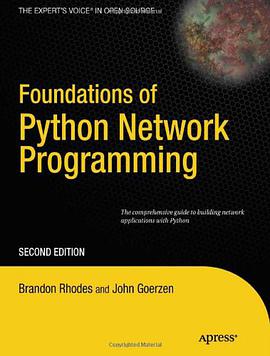
Foundations of Python Network Programming
Douban
John Goerzen / Tim Bower … publishing house: Apress 2010
This second edition of Foundations of Python Network Programming targets Python 2.5 through Python 2.7, the most popular production versions of the language. Python has made great strides since Apress released the first edition of this book back in the days of Python 2.3. The advances required new chapters to be written from the ground up, and others to be extensively revised. You will learn fundamentals like IP, TCP, DNS and SSL by using working Python programs; you will also be able to familiarize yourself with infrastructure components like memcached and message queues. You can also delve into Network server designs, and compare threaded approaches with asynchronous event-based solutions. But the biggest change is this edition's expanded treatment of the web. The HTTP protocol is covered in extensive detail, with each feature accompanied by sample Python code. You can use your HTTP protocol expertise by studying an entire chapter on screen scraping and you can then test lxml and BeautifulSoup against a real-world web site. The chapter on web application programming now covers both the WSGI standard for component interoperability, as well as modern web frameworks like Django. Finally, all of the old favorites from the first edition are back: E-mail protocols like SMTP, POP, and IMAP get full treatment, as does XML-RPC. You can still learn how to code Python network programs using the Telnet and FTP protocols, but you are likely to appreciate the power of more modern alternatives like the paramiko SSH2 library. If you are a Python programmer who needs to learn the network, this is the book that you want by your side. What you'll learn * Understand low level networking * Handle sending and receiving email including composing and decoding emails, SMTP, POP and IMAP * Program the lower levels of web application programming such as FastCGI and WSGI and HTTP itself * Learn how to use memcached and message qeues using Python * Access web services using Python * Master multitasking with threads, forking, and asynchronous communication Who this book is for This book will be of interest to python programmers who need to program networked applications using Python. From web application developers, to systems integrators, to system administrators--this book has everything you need to know. Table of Contents * Introduction to Client/Server Networking * UDP * TCP * Socket Names and DNS * Network Data and Network Errors * TLS and SSL * Server Architecture * Caches, Message Queues, and Map-Reduce * HTTP * Screen Scraping * Web Applications * E-mail Composition and Decoding * SMTP * POP * IMAP * Telnet and SSH * FTP * RPC
Python标准库
The Python Standard Library by Example Douban
Doug Hellmann translator: 刘炽 publishing house: 机械工业出版社华章公司 2012 - 6
本书由资深Python专家亲自执笔,Python语言的核心开发人员作序推荐,权威性毋庸置疑。 对于程序员而言,标准库与语言本身同样重要,它好比一个百宝箱,能为各种常见的任务提供完美的解决方案,所以本书是所有Python程序员都必备的工具书!本书以案例驱动的方式讲解了标准库中一百多个模块的使用方法(如何工作)和工作原理(为什么要这样工作),比标准库的官方文档更容易理解(一个简单的示例比一份手册文档更有帮助),为Python程序员熟练掌握和使用这些模块提供了绝佳指导。 全书一共19章,系统而全面地对Python标准库中的一百多个模块进行了生动的讲解。这些模块主要包括:文本处理工具模块、与数据结构相关的模块、与算法有关的模块、管理日期和时间值的模块、用于数学计算的模块、管理文件系统的模块、用于数据存储与交换的模块、用于数据压缩与归档的模块、用于加密的模块、与进程和线程相关的模块、与网络通信和Email相关的模块、构建模块、支持处理多种自然语言和文化设置的模块、开发工具模块、与运行时特性相关的模块,等等。