政治经济学

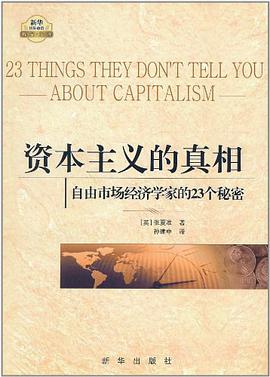
资本主义的真相
Douban
张夏准
translator:
孙建中
publishing house:
新华出版社
2011
- 6
《资本主义的真相:自由市场经济学家的23个秘密》内容简介:如果你想弄明白经济学家们为什么没能预料到经济崩溃(金融危机)的到来,《资本主义的真相(自由市场经济学家的23个秘密)》作者张夏准给出了答案:我们并不了解资本主义的全部。《资本主义的真相(自由市场经济学家的23个秘密)》读来轻松有趣,但有着严肃的目的:自里根时代以来,新自由主义经济学派——自由市场的信徒——长期占据主流地位,《资本主义的真相:自由市场经济学家的23个秘密》将对该学派编造和鼓吹的那些教条背后的假定条件提出质疑。
张夏准是世界上最受尊崇的经济学家之一,他思路清晰、充满智慧,这也是加尔布雷斯和斯蒂格利茨的风格。《资本主义的真相:自由市场经济学家的23个秘密》将揭示全球资本主义制度是如何运作或失灵的。在题为“如何重建世界经济”的最后一章中,作者提供了一种新的视角,那就是如何让资本主义制度发挥人性善的一面,而不是让人们沦为市场的奴隶。

Capitalism, Alone: The Future of the System That Rules the World
Douban Goodreads
Branko Milanovic
publishing house:
Belknap Press
2019
- 9
other title:
Capitalism, Alone
A provocative account of capitalism's rise to global dominance and, as different models of capitalism vie for world leadership, a look into what the future may hold.
We are all capitalists now. For the first time in human history, the globe is dominated by one economic system. In Capitalism, Alone, leading economist Branko Milanovic explains the reasons for this decisive historical shift since the days of feudalism and, later, communism. Surveying the varieties of capitalism, he asks: What are the prospects for a fairer world now that capitalism is the only game in town? His conclusions are sobering, but not fatalistic. Capitalism gets much wrong, but also much right--and it is not going anywhere. Our task is to improve it.
Milanovic argues that capitalism has triumphed because it works. It delivers prosperity and gratifies human desires for autonomy. But it comes with a moral price, pushing us to treat material success as the ultimate goal. And it offers no guarantee of stability. In the West, liberal capitalism creaks under the strains of inequality and capitalist excess. That model now fights for hearts and minds with political capitalism, exemplified by China, which many claim is more efficient, but which is more vulnerable to corruption and, when growth is slow, social unrest. As for the economic problems of the Global South, Milanovic offers a creative, if controversial, plan for large-scale migration. Looking to the future, he dismisses prophets who proclaim some single outcome to be inevitable, whether worldwide prosperity or robot-driven mass unemployment. Capitalism is a risky system. But it is a human system. Our choices, and how clearly we see them, will determine how it serves us.

Varieties of Liberalization and the New Politics of Social Solidarity
DoubanThis book examines contemporary changes in labor market institutions in the United States, Germany, Denmark, Sweden, and the Netherlands, focusing on developments in three arenas - industrial relations, vocational education and training, and labor market policy. While confirming a broad, shared liberalizing trend, it finds that there are in fact distinct varieties of liberalization associated with very different distributive outcomes. Most scholarship equates liberal capitalism with inequality and coordinated capitalism with higher levels of social solidarity. However, this study explains why the institutions of coordinated capitalism and egalitarian capitalism coincided and complemented one another in the "Golden Era" of postwar development in the 1950s and 1960s, and why they no longer do so. Contrary to the conventional wisdom, this study reveals that the successful defense of the institutions traditionally associated with coordinated capitalism has often been a recipe for increased inequality due to declining coverage and dualization. Conversely, it argues that some forms of labor market liberalization are perfectly compatible with continued high levels of social solidarity and indeed may be necessary to sustain it.
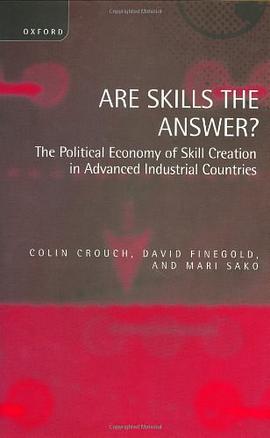
Are Skills the Answer?
Douban
Colin Crouch
/
David Finegold
…
publishing house:
Oxford University Press
1999
- 4
This study of the problems confronting institutions for the creation of occupational skills in seven advanced industrialized countries contributes to two different areas of debate. The first is the study of the diversity of institutional forms taken by modern capitalism, and the difficulties currently surrounding the survival of that diversity. Most discussions of this theme analyse economic institutions and governance in general. The authors of this book are more specific, focusing on the key area of skill creation. The second theme is that of vocational education and training in its own right. While sharing the consensus that the advanced countries must secure competitive advantage in a global economy by developing highly skilled work-forces, the authors draw attention to certain awkward aspects of this approach that are often glossed over in general debate: The employment-generating power of improvements in skill levels is limited: employment policy cannot depend fully on education policies While the acquisition of skills has become a major public need, there is increasing dependence for their provision on individual firms, which can have no responsibility for general needs, with government action being restricted to residual care for the unemployed rather than contributing at the leading edge of advanced skills policy. The authors argue that public agencies must find new ways of working with the business sector, acquiring expertise and authority through such means as supporting skills standards and taking the lead in the certification of employers as trainers. There must also be reconsideration of the former role of public-service employment as a provider of secure if poorly paid employment for low-productivity workers. The countries covered are France, Germany, Italy, Japan, Sweden, the UK and the USA.