职业教育

Varieties of Liberalization and the New Politics of Social Solidarity
DoubanThis book examines contemporary changes in labor market institutions in the United States, Germany, Denmark, Sweden, and the Netherlands, focusing on developments in three arenas - industrial relations, vocational education and training, and labor market policy. While confirming a broad, shared liberalizing trend, it finds that there are in fact distinct varieties of liberalization associated with very different distributive outcomes. Most scholarship equates liberal capitalism with inequality and coordinated capitalism with higher levels of social solidarity. However, this study explains why the institutions of coordinated capitalism and egalitarian capitalism coincided and complemented one another in the "Golden Era" of postwar development in the 1950s and 1960s, and why they no longer do so. Contrary to the conventional wisdom, this study reveals that the successful defense of the institutions traditionally associated with coordinated capitalism has often been a recipe for increased inequality due to declining coverage and dualization. Conversely, it argues that some forms of labor market liberalization are perfectly compatible with continued high levels of social solidarity and indeed may be necessary to sustain it.

Are Skills the Answer?
Douban
Colin Crouch
/
David Finegold
…
publishing house:
Oxford University Press
1999
- 4
This study of the problems confronting institutions for the creation of occupational skills in seven advanced industrialized countries contributes to two different areas of debate. The first is the study of the diversity of institutional forms taken by modern capitalism, and the difficulties currently surrounding the survival of that diversity. Most discussions of this theme analyse economic institutions and governance in general. The authors of this book are more specific, focusing on the key area of skill creation. The second theme is that of vocational education and training in its own right. While sharing the consensus that the advanced countries must secure competitive advantage in a global economy by developing highly skilled work-forces, the authors draw attention to certain awkward aspects of this approach that are often glossed over in general debate: The employment-generating power of improvements in skill levels is limited: employment policy cannot depend fully on education policies While the acquisition of skills has become a major public need, there is increasing dependence for their provision on individual firms, which can have no responsibility for general needs, with government action being restricted to residual care for the unemployed rather than contributing at the leading edge of advanced skills policy. The authors argue that public agencies must find new ways of working with the business sector, acquiring expertise and authority through such means as supporting skills standards and taking the lead in the certification of employers as trainers. There must also be reconsideration of the former role of public-service employment as a provider of secure if poorly paid employment for low-productivity workers. The countries covered are France, Germany, Italy, Japan, Sweden, the UK and the USA.
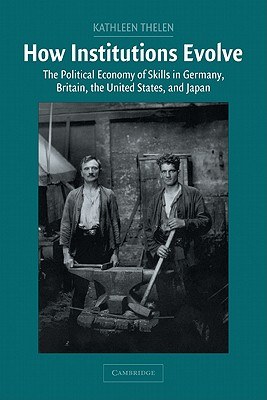
How Institutions Evolve
DoubanKathleen Thelen explains the historical origins of important cross-national differences in four countries (Germany, Britain, the United States and Japan), and also provides a theory of institutional change over time. The latter is considered a frontier issue in institutionalist analysis, of which there are several varieties emerging from economics, political science, and sociology. Thelen's study contributes to the literature on the political economy of the developed democracies that focuses on different institutional arrangements defining distinctive models of capitalism.

The Political Economy of Collective Skill Formation
Douban
Busemeyer, Marius R.; Trampusch, Christine; Busemeyer, Marius R.
2011
- 11
Education, skill formation, and training continue to be important areas of consideration for both public policy and research. This book examines the particular types of vocational training known as collective skill formation systems, whereby the training (often firm-based apprenticeships) is collectively organized by businesses and unions with state support and cooperation in execution, finance, and monitoring. With contributions from leading academics, this book is the first to provide a comprehensive analysis of the varying historical origins of, and recent developments in, vocational training systems, offering in-depth studies on coordinated market economies, namely Germany, Austria, Switzerland, the Netherlands, and Denmark. It also contains comparative chapters that analyse how these countries react to common challenges such as deindustrialization, labour market stratification, academic drift, gender inequalities, and Europeanization. Whereas previous research has focused on the differences between various kinds of skill regimes, this book focuses on explaining institutional variety within the group of collective skill formation systems. The development of skill formation systems is regarded as a dynamic political process, dependent on the outcome of various political struggles regarding such matters as institutional design and transformations during critical junctures in historical development.