资本主义
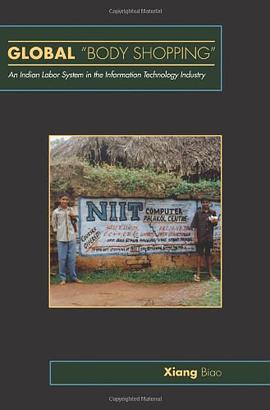
Global "Body Shopping"
Douban Goodreads
★ 8.0 5 ratings
Xiang Biao publishing house: Princeton University Press 2006 - 11
How can America's information technology (IT) industry predict serious labor shortages while at the same time laying off tens of thousands of employees annually? The answer is the industry's flexible labor management system - a flexibility widely regarded as the modus operandi of global capitalism today. "Global "Body Shopping"" explores how flexibility and uncertainty in the IT labor market are constructed and sustained through concrete human actions. Drawing on in-depth field research in southern India and in Australia, and folding an ethnography into a political economy examination, Xiang Biao offers a richly detailed analysis of the India-based global labor management practice known as "body shopping."In this practice, a group of consultants - body shops - in different countries works together to recruit IT workers. Body shops then farm out workers to clients as project-based labor; and upon a project's completion they either place the workers with a different client or "bench" them to await the next placement. Thus, labor is managed globally to serve volatile capital movement. Underpinning this practice are unequal socioeconomic relations on multiple levels. While wealth in the New Economy is created in an increasingly abstract manner, everyday realities - stock markets in New York, benched IT workers in Sydney, dowries in Hyderabad, and women and children in Indian villages - sustain this flexibility.
Capitalism, Alone: The Future of the System That Rules the World
Douban Goodreads
Branko Milanovic publishing house: Belknap Press 2019 - 9 other title: Capitalism, Alone
A provocative account of capitalism's rise to global dominance and, as different models of capitalism vie for world leadership, a look into what the future may hold. We are all capitalists now. For the first time in human history, the globe is dominated by one economic system. In Capitalism, Alone, leading economist Branko Milanovic explains the reasons for this decisive historical shift since the days of feudalism and, later, communism. Surveying the varieties of capitalism, he asks: What are the prospects for a fairer world now that capitalism is the only game in town? His conclusions are sobering, but not fatalistic. Capitalism gets much wrong, but also much right--and it is not going anywhere. Our task is to improve it. Milanovic argues that capitalism has triumphed because it works. It delivers prosperity and gratifies human desires for autonomy. But it comes with a moral price, pushing us to treat material success as the ultimate goal. And it offers no guarantee of stability. In the West, liberal capitalism creaks under the strains of inequality and capitalist excess. That model now fights for hearts and minds with political capitalism, exemplified by China, which many claim is more efficient, but which is more vulnerable to corruption and, when growth is slow, social unrest. As for the economic problems of the Global South, Milanovic offers a creative, if controversial, plan for large-scale migration. Looking to the future, he dismisses prophets who proclaim some single outcome to be inevitable, whether worldwide prosperity or robot-driven mass unemployment. Capitalism is a risky system. But it is a human system. Our choices, and how clearly we see them, will determine how it serves us.
Imagined Futures
Douban
Jens Beckert publishing house: Harvard University Press 2016 - 6
In a capitalist system, consumers, investors, and corporations orient their activities toward a future that contains opportunities and risks. How actors assess uncertainty is a problem that economists have tried to solve through general equilibrium and rational expectations theory. Powerful as these analytical tools are, they underestimate the future’s unknowability by assuming that markets, in the aggregate, correctly forecast what is to come. Jens Beckert adds a new chapter to the theory of capitalism by demonstrating how fictional expectations drive modern economies—or throw them into crisis when the imagined futures fail to materialize. Collectively held images of how the future will unfold are critical because they free economic actors from paralyzing doubt, enabling them to commit resources and coordinate decisions even if those expectations prove inaccurate. Beckert distinguishes fictional expectations from performativity theory, which holds that predictions tend to become self-fulfilling prophecies. Economic forecasts are important not because they produce the futures they envision but because they create the expectations that generate economic activity in the first place. Actors pursue money, investments, innovations, and consumption only if they believe the objects obtained through market exchanges will retain value. We accept money because we believe in its future purchasing power. We accept the risk of capital investments and innovation because we expect profit. And we purchase consumer goods based on dreams of satisfaction. As Imagined Futures shows, those who ignore the role of real uncertainty and fictional expectations in market dynamics misunderstand the nature of capitalism.
Read
Jan. 31, 2021
简言之,就是「真·画大饼原理」。玩笑除外,Bekckert这本是集大成之作:经济学(Shackle),实用主义哲学(杜威),和社会学(欠缺)里关于不确定性的研究置于资本主义动态的视角下。写得很「磅礴」——从Frank Knight,大卫·哈维,布迪厄,到格雷伯,一应俱全。除了理论框架(不是他的原创,但肯定是他非常系统地articulate),四个实证章节也很有启发(货币/债务、投资、创新、消费)。9、10 两章知识哲学方面的企图不敢说我很接受,但有意思。
经济社会学 社会学 时间性 不确定性 资本主义
The Second Industrial Divide
Douban
Michael Piore / Charles Sabel publishing house: Basic Books 1986 - 10
Two MacArthur Prize Fellows argue that to get out of its current economic crisis industry should abandon its attachment to standardized mass production for a system of flexible specialization.
Read
Feb. 19, 2022
相当超前的「修正史学」,核心是重讲了「资本主义大机器生产」的故事,揭示资本主义的多样性(VoC观点在多达程度上继承了他们?)。作者写到了很多的不同领域,但最吸引人的是讲工厂的生产方式(shop-floor regime),法国德国意大利日本,各个都不一样,美式的大流水线生产征服全世界只是一个myth。既不是新古典经济学,也不是马克思主义,更偏历史一点。很有启发。
资本主义 德国 意大利 法国 全球化
Farewell to the Working Class
Douban
Andre Gorz publishing house: Pluto Press 1987 - 1
Andre Gorz argues that changes in the role of the work and labour process in the closing decades of the twenthieth century have, once and for all, weakened the power of skilled industrial workers. Their place has been taken, says Gorz, by social movements such as the women's movement and the green movement, and all those who refuse to accept the work ethic so fundamental to early capitalist societies. Provocative and heretical, Farewell To the Working Class is a classic study of labour and unemployment in the post-industrial world.