
高等教育

On Course
Douban
James M. Lang
publishing house:
Harvard University Press
2010
- 5
You go into teaching with high hopes: to inspire students, to motivate them to learn, to help them love your subject. Then you find yourself facing a crowd of expectant faces on the first day of the first semester, and you think 'Now what do I do?' Practical and lively, "On Course" is full of experience-tested, research-based advice for graduate students and new teaching faculty. It provides a range of innovative and traditional strategies that work well without requiring extensive preparation or long grading sessions when you're trying to meet your own demanding research and service requirements. What do you put on the syllabus? How do you balance lectures with group assignments or discussions - and how do you get a dialogue going when the students won't participate? What grading system is fairest and most efficient for your class? Should you post lecture notes on a website? How do you prevent cheating, and what do you do if it occurs? How can you help the student with serious personal problems without becoming overly involved? And what do you do about the student who won't turn off his cell phone? Packed with anecdotes and concrete suggestions, this book will keep both inexperienced and veteran teachers on course as they navigate the calms and storms of classroom life.

The Power of Privilege
Douban
Joseph Soares
publishing house:
Stanford University Press
2007
- 4
It is widely assumed that admission to elite U.S. universities is based solely on academic merit—the best and brightest are admitted to Harvard, Yale, and their peer institutions as determined by test scores and GPA, and not by lineage or family income. But does reality support those expectations? Or are admissions governed by a logic that rewards socioeconomic status while disguising it as personal merit?
The Power of Privilege examines the nexus between social class and admissions at America's top colleges from the vantage point of Yale University, a key actor in the history of higher education. It is a documented history of the institutional gatekeepers, confident of the validity of socially biased measures of merit, seeking to select tomorrow's leadership class from among their economically privileged clientele. Acceptance in prestigious colleges still remains beyond the reach of most students except those from high-income professional families. Ultimately, the author suggests reforms that would move America's top schools toward becoming genuine academic meritocracies.

學術人
Homo Academicvs Google Books Douban
皮耶.布赫迪厄(Pierre Bourdieu)
translator:
李沅洳 譯
/
林錚 審閱
publishing house:
時報文化
2019
- 12
other title:
學術人
一本「要燒掉的書」?
一本震驚法國學界的書!
社會學家布赫迪厄(Pierre Bourdieu)嚴謹而銳利的自我審視,
具體分析出身背景與人脈資源對於學術地位的影響。
《學術人》(Homo Academicvs)是已故法國知名社會學者--皮耶.布赫迪厄(Pierre Bourdieu)在一九八四年出版的暢銷著作,震動當時的法國學界,在他寫作這本書之前,並沒有人勇於自我挑戰,具體檢視學界,也就是學者自身所處場域。
布赫迪厄透過分析醫學院、法學院、文學院以及自然科學學院四大學術領域,其組成成員的社會背景及他們在人脈網絡中的角色,他們的實際活動情況與所能取得的權力地位,進而直剖法國高等教育長久以來的問題。藉由檢視法國數十年來的高等教育問題,看出一九六八年五月的高等教育危機如何發生,及其後學界如何變化。
布赫迪厄在書中所談的問題,雖然時空背景與今不同,但其中人的出身與隱形資源造就將來社會位置的差異,以及人們對於醫學院、法學院、文學院以及自然科學學院四大領域所能帶來的身份地位象徵,這類的問題直到今日仍非常相似,也使《學術人》於今仍具有高度參考性,不僅是一本重要的社會學研究著作,更是理解當代社會階級問題與高等教育僵化情況不能錯過的重要著作。
The Formation of Scholars
Douban
Walker, George E./ Golde, Chris M./ Jones, Laura/ Bueschel, Andrea Conklin/ Hutchings, Pat
2008
- 1
This groundbreaking book explores the current state of doctoral education in the United States and offers a plan for increasing the effectiveness of doctoral education. Programs must grapple with questions of purpose. The authors examine practices and elements of doctoral programs and show how they can be made more powerful by relying on principles of progressive development, integration, and collaboration. They challenge the traditional apprenticeship model and offer an alternative in which students learn while apprenticing with several faculty members. The authors persuasively argue that creating intellectual community is essential for high-quality graduate education in every department. Knowledge-centered, multigenerational communities foster the development of new ideas and encourage intellectual risk taking.
Doctoral Education and the Faculty of the Future
Douban
Ehrenberg, Ronald G. (EDT)/ Kuh, Charlotte V. (EDT)
2008

The Diverted Dream
Douban
Steven Brint
/
Jerome Karabel
publishing house:
Oxford University Press, USA
1991
- 2
In the twentieth century, Americans have increasingly looked to the schools--and, in particular, to the nation's colleges and universities--as guardians of the cherished national ideal of equality of opportunity. With the best jobs increasingly monopolized by those with higher education, the opportunity to attend college has become an integral part of the American dream of upward mobility. The two-year college--which now enrolls more than four million students in over 900 institutions--is a central expression of this dream, and its invention at the turn of the century constituted one of the great innovations in the history of American education. By offering students of limited means the opportunity to start higher education at home and to later transfer to a four-year institution, the two-year school provided a major new pathway to a college diploma--and to the nation's growing professional and managerial classes. But in the past two decades, the community college has undergone a profound change, shifting its emphasis from liberal-arts transfer courses to terminal vocational programs. Drawing on developments nationwide as well as in the specific case of Massachusetts, Steven Brint and Jerome Karabel offer a history of community colleges in America, explaining why this shift has occurred after years of student resistance and examining its implications for upward mobility. As the authors argue in this exhaustively researched and pioneering study, the junior college has always faced the contradictory task of extending a college education to the hitherto excluded, while diverting the majority of them from the nation's four-year colleges and universities. Very early on, two-year college administrators perceived vocational training for "semi-professional" work as their and their students' most secure long-term niche in the educational hierarchy. With two thirds of all community college students enrolled in vocational programs, the authors contend that the dream of education as a route to upward mobility, as well as the ideal of equal educational opportunity for all, are seriously threatened. With the growing public debate about the state of American higher education and with more than half of all first-time degree-credit students now enrolled in community colleges, a full-scale, historically grounded examination of their place in American life is long overdue. This landmark study provides such an examination, and in so doing, casts critical light on what is distinctive not only about American education, but American society itself.

The Price of Admission
Douban
Daniel Golden
publishing house:
Broadway Books
2007
- 9
Every spring thousands of middle-class and lower-income high-school seniors learn that they have been rejected by America’s most exclusive colleges. What they may never learn is how many candidates like themselves have been passed over in favor of wealthy white students with lesser credentials—children of alumni, big donors, or celebrities.
In this explosive book, the Pulitzer Prize–winning reporter Daniel Golden argues that America, the so-called land of opportunity, is rapidly becoming an aristocracy in which America’s richest families receive special access to elite higher education—enabling them to give their children even more of a head start. Based on two years of investigative reporting and hundreds of interviews with students, parents, school administrators, and admissions personnel—some of whom risked their jobs to speak to the author— The Price of Admission exposes the corrupt admissions practices that favor the wealthy, the powerful, and the famous.
In The Price of Admission , Golden names names, along with grades and test scores. He reveals how the sons of former vice president Al Gore, one-time Hollywood power broker Michael Ovitz, and Senate Majority Leader Bill Frist leapt ahead of more deserving applicants at Harvard, Brown, and Princeton. He explores favoritism at the Ivy Leagues, Duke, the University of Virginia, and Notre Dame, among other institutions. He reveals that colleges hold Asian American students to a higher standard than whites; comply with Title IX by giving scholarships to rich women in “patrician sports” like horseback riding, squash, and crew; and repay congressmen for favors by admitting their children. He also reveals that Harvard maintains a “Z-list” for well-connected but underqualified students, who are quietly admitted on the condition that they wait a year to enroll.
The Price of Admission explodes the myth of an American meritocracy—the belief that no matter what your background, if you are smart and diligent enough, you will have access to the nation’s most elite universities. It is must reading not only for parents and students with a personal stake in college admissions, but also for those disturbed by the growing divide between ordinary and privileged Americans.
From the Hardcover edition.

Degrees of Control
Douban
David K. Brown
publishing house:
Teachers College, Columbia University
1949

An Elusive Science
Douban
Ellen Condliffe Lagemann
publishing house:
University Of Chicago Press
2002
- 5
Since its beginnings at the start of the 20th century, educational scholarship has been a marginal field, criticized by public policy makers and relegated to the fringes of academe. An Elusive Science explains why, providing a critical history of the traditions, conflicts, and institutions that have shaped the study of education over the past century.
The Institution of Science and the Science of Institutions
Douban
Marcel Herbst
publishing house:
Springer
2014
The present anthology, edited by Marcel Herbst, is partially based on a conference, held in 2009, to reflect on the legacy of Ben-David, and contains a selection of substantially revised papers, plus four contributions specifically written for this volume. The book focuses on three major lines of Ben-David’s research, namely “Center and Periphery” (Part I), “Role and Ethos” (Part II), and “Organization and Growth” (Part III). In addition, comprehensive introductory (“Prologue”) and concluding chapters (“Epilogue”, Part IV) by Marcel Herbst are provided. The volume addresses the following disciplines: higher education, history and sociology of science, philosophy of science, history of medicine, public administration, policy studies, Jewish studies, and economics. The anthology is one of two new publications on Joseph Ben-David after the special Minerva edition Vol. 25, Numbers 1–2, March 1987, and Gad Freudenthal’s collection of Ben-David’s writings [1991]. The text can be used in graduate studies, it addresses higher education professionals or public officials, and serves as a gateway to researchers in the field of higher education, science studies, or policy sciences.

College Admissions for the 21st Century
Douban
Sternberg, Robert J.
publishing house:
Harvard University Press
2010
- 10
SATs, ACTs, GPAs. Everyone knows that these scores can't tell a college everything that's important about an applicant. But what else should admissions officers look for, and how can they know it when they see it? In "College Admissions for the 21st Century", a leading researcher on intelligence and creativity offers a bold and practical approach to college admissions testing. Standardized tests are measures of memory and analytical skills. But the ever-changing global society beyond a college campus needs more than just those qualities, argues Robert Sternberg. Tomorrow's leaders and citizens also need creativity, practicality, and wisdom. How can the potential for those complex qualities be measured? One answer is 'Kaleidoscope', a new initiative in undergraduate admissions, first used at Tufts University. Its open-ended questions for applicants, and the means used to score the answers, gives applicants and admissions officers the chance to go beyond standardized tests. Does it work? As Sternberg describes in detail, Kaleidoscope measures predicted first-year academic success, over and above SATs and high school GPAs, and predicted first-year extracurricular activities, leadership, and active citizenship as well. And every year that Kaleidoscope measures were used, the entering class' average SATs and high school GPAs went up too. What worked at Tufts can work elsewhere. New kinds of assessments, like Kaleidoscope, can liberate many colleges and students from the narrowness of standardized tests and inspire new approaches to teaching for new kinds of talented, motivated citizens of the world.
The University and the Global Knowledge Society
Douban
David John Frank
/
John W. Meyer
publishing house:
The University of Princton Press
2020
- 5
The university is experiencing an unprecedented level of success today, as more universities in more countries educate more students in more fields. At the same time, the university has become central to a knowledge society based on the belief that everyone can, through higher education, access universal truths and apply them in the name of progress. This book traces the university’s rise over the past hundred years to become the cultural linchpin of contemporary society, revealing how the so-called ivory tower has become profoundly interlinked with almost every area of human endeavor.
David John Frank and John Meyer describe how, as the university expanded, student and faculty bodies became larger, more diverse, and more empowered to turn knowledge into action. Their contributions to society underscored the public importance of scholarship, and as the cultural authority of universities grew they increased the scope of their research and teaching interests. As a result, the university has become the bedrock of today’s information-based society, an institution that is now implicated in the solution to every conceivable problem.
But, as Frank and Meyer also show, the conditions that helped spur the university’s recent ascendance are not immutable: eruptions of nationalism, authoritarianism, and illiberalism undercut the university’s universalistic and rationalistic premises, and may threaten the centrality of the university itself.

How College Affects Students
Douban
Ernest T. Pascarella
/
Patrick T. Terenzini
publishing house:
Jossey-Bass
2005
- 2
This is the long-awaited second volume of Pascarella and Terenzini's 1991 award-winning review of the research on the impacts of college on students. The authors review their earlier findings and then synthesize what has been learned since 1990 about college's influences on students’ learning. The book also discusses the implications of the findings for research, practice, and public policy. This authoritative and comprehensive analysis of the literature on college-impact is required reading for anyone interested in higher education practice, policy, and promise¾faculty, administrators, researchers, policy analysts, and decision-makers at every level.

The Case against Education
Google Books Douban
Bryan Caplan
publishing house:
Princeton University Press
2018
- 1
Despite being immensely popular--and immensely lucrative—education is grossly overrated. In this explosive book, Bryan Caplan argues that the primary function of education is not to enhance students' skill but to certify their intelligence, work ethic, and conformity—in other words, to signal the qualities of a good employee. Learn why students hunt for easy As and casually forget most of what they learn after the final exam, why decades of growing access to education have not resulted in better jobs for the average worker but instead in runaway credential inflation, how employers reward workers for costly schooling they rarely if ever use, and why cutting education spending is the best remedy.
Caplan draws on the latest social science to show how the labor market values grades over knowledge, and why the more education your rivals have, the more you need to impress employers. He explains why graduation is our society's top conformity signal, and why even the most useless degrees can certify employability. He advocates two major policy responses. The first is educational austerity. Government needs to sharply cut education funding to curb this wasteful rat race. The second is more vocational education, because practical skills are more socially valuable than teaching students how to outshine their peers.
Romantic notions about education being "good for the soul" must yield to careful research and common sense — The Case against Education points the way. (less)

Allies and Rivals
Douban
Emily Levine
publishing house:
University of Chicago Press
2021
- 9
During the nineteenth century, nearly ten thousand Americans traveled to Germany to study in universities renowned for their research and teaching. By the mid-twentieth century, American institutions led the world. How did America become the center of excellence in higher education? And what does that story reveal about who will lead in the twenty-first century?
Allies and Rivals is the first history of the ascent of American higher education seen through the lens of German-American exchange. In a series of compelling portraits of such leaders as Wilhelm von Humboldt, Martha Carey Thomas, and W. E. B. Du Bois, Emily J. Levine shows how academic innovators on both sides of the Atlantic competed and collaborated to shape the research university. Even as nations sought world dominance through scholarship, universities retained values apart from politics and economics. Open borders enabled Americans to unite the English college and German PhD to create the modern research university, a hybrid now replicated the world over.
In a captivating narrative spanning one hundred years, Levine upends notions of the university as a timeless ideal, restoring the contemporary university to its rightful place in history. In so doing she reveals that innovation in the twentieth century was rooted in international cooperation—a crucial lesson that bears remembering today.

The Diversity Bargain
Douban
Natasha K. Warikoo
publishing house:
University Of Chicago Press
2016
- 11
We’ve heard plenty from politicians and experts on affirmative action and higher education, about how universities should intervene—if at all—to ensure a diverse but deserving student population. But what about those for whom these issues matter the most? In this book, Natasha K. Warikoo deeply explores how students themselves think about merit and race at a uniquely pivotal moment: after they have just won the most competitive game of their lives and gained admittance to one of the world’s top universities.
What Warikoo uncovers—talking with both white students and students of color at Harvard, Brown, and Oxford—is absolutely illuminating; and some of it is positively shocking. As she shows, many elite white students understand the value of diversity abstractly, but they ignore the real problems that racial inequality causes and that diversity programs are meant to solve. They stand in fear of being labeled a racist, but they are quick to call foul should a diversity program appear at all to hamper their own chances for advancement. The most troubling result of this ambivalence is what she calls the “diversity bargain,” in which white students reluctantly agree with affirmative action as long as it benefits them by providing a diverse learning environment—racial diversity, in this way, is a commodity, a selling point on a brochure. And as Warikoo shows, universities play a big part in creating these situations. The way they talk about race on campus and the kinds of diversity programs they offer have a huge impact on student attitudes, shaping them either toward ambivalence or, in better cases, toward more productive and considerate understandings of racial difference.
Ultimately, this book demonstrates just how slippery the notions of race, merit, and privilege can be. In doing so, it asks important questions not just about college admissions but what the elite students who have succeeded at it—who will be the world’s future leaders—will do with the social inequalities of the wider world.

Seeing the World
Douban
Mitchell L. Stevens
/
Cynthia Miller-Idriss
…
publishing house:
Princeton University Press
2018
- 2
An in-depth look at why American universities continue to favor U.S.-focused social science research despite efforts to make scholarship more cosmopolitan
U.S. research universities have long endeavored to be cosmopolitan places, yet the disciplines of economics, political science, and sociology have remained stubbornly parochial. Despite decades of government and philanthropic investment in international scholarship, the most prestigious academic departments still favor research and expertise on the United States. Why? Seeing the World answers this question by examining university research centers that focus on the Middle East and related regional area studies.
Drawing on candid interviews with scores of top scholars and university leaders to understand how international inquiry is perceived and valued inside the academy, Seeing the World explains how intense competition for tenure-line appointments encourages faculty to pursue “American” projects that are most likely to garner professional advancement. At the same time, constrained by tight budgets at home, university leaders eagerly court patrons and clients worldwide but have a hard time getting departmental faculty to join the program. Together these dynamics shape how scholarship about the rest of the world evolves.
At once a work-and-occupations study of scholarly disciplines, an essay on the formal organization of knowledge, and an inquiry into the fate of area studies, Seeing the World is a must-read for anyone who cares about the future of knowledge in a global era.
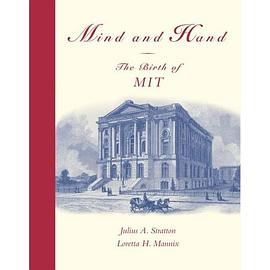
Mind and Hand
Douban
Julius A. Stratton
/
Loretta H. Mannix
publishing house:
The MIT Press
2005
- 5