常读常新,需要反复琢磨
Book · Review
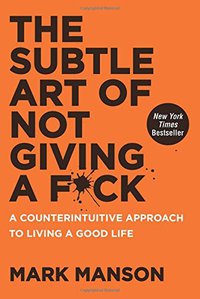
The Subtle Art of Not Giving a F*ck部分摘录:
The Subtle Art of Not Giving a F*ck Mark Manson Often the only difference between a problem being painful or being powerful is a sense that we chose it, and that we are responsible for it. If you’re miserable in your current situation, chances are it’s because you feel like some part of it is outside your control—that there’s a problem you have no ability to solve, a problem that was somehow thrust upon you without your choosing. When we feel that we’re choosing our problems, we feel empowered. When we feel that our problems are being forced upon us against our will, we feel victimized and miserable. Freedom grants the opportunity for greater meaning, but by itself there is nothing necessarily meaningful about it. Ultimately, the only way to achieve meaning and a sense of importance in one’s life is through a rejection of alternatives, a narrowing of freedom, a choice of commitment to one place, one belief, or (gulp) one person. He spent the whole time feeling like a fake and a fraud. Improvement at anything is based on thousands of tiny failures, and the magnitude of your success is based on how many times you’ve failed at something. If someone is better than you at something, then it’s likely because she has failed at it more than you have. But that’s not it. Sure, rejection hurts. Failure sucks. But there are particular certainties that we hold on to—certainties that we’re afraid to question or let go of, values that have given our lives meaning over the years. That woman doesn’t get out there and date because she would be forced to confront her beliefs about her own desirability. That man doesn’t ask for the promotion because he would have to confront his beliefs about what his skills are actually worth. It’s easier to sit in a painful certainty that nobody would find you attractive, that nobody appreciates your talents, than to actually test those beliefs and find out for sure. Beliefs of this sort—that I’m not attractive enough, so why bother; or that my boss is an asshole, so why bother—are designed to give us moderate comfort now by mortgaging greater happiness and success later on. They’re terrible long-term strategies, yet we cling to them because we assume we’re right, because we assume we already know what’s supposed to happen.
Certainty is the enemy of growth. Nothing is for certain until it has already happened—and even then, it’s still debatable. That’s why accepting the inevitable imperfections of our values is necessary for any growth to take place. If you think about a young child trying to learn to walk, that child will fall down and hurt itself hundreds of times. But at no point does that child ever stop and think, “Oh, I guess walking just isn’t for me. I’m not good at it.” Avoiding failure is something we learn at some later point in life. I’m sure a lot of it comes from our education system, which judges rigorously based on performance and punishes those who don’t do well. Another large share of it comes from overbearing or critical parents who don’t let their kids screw up on their own often enough, and instead punish them for trying anything new or not preordained. And then we have all the mass media that constantly expose us to stellar success after success, while not showing us the thousands of hours of dull practice and tedium that were required to achieve that success. At some point, most of us reach a place where we’re afraid to fail, where we instinctively avoid failure and stick only to what is placed in front of us or only what we’re already good at.
It was sitting on my mom’s couch that summer, staring into the so-called abyss, seeing the endless and incomprehensible nothingness where Josh’s friendship used to be, when I came to the startling realization that if there really is no reason to do anything, then there is also no reason to not do anything; that in the face of the inevitability of death, there is no reason to ever give in to one’s fear or embarrassment or shame, since it’s all just a bunch of nothing anyway; and that by spending the majority of my short life avoiding what was painful and uncomfortable, I had essentially been avoiding being alive at all. The punch line? William James went on to become the father of American psychology. His work has been translated into a bazillion languages, and he’s regarded as one of the most influential intellectuals/philosophers/psychologists of his generation. He would go on to teach at Harvard and would tour much of the United States and Europe giving lectures. He would marry and have five children (one of whom, Henry, would become a famous biographer and win a Pulitzer Prize). James would later refer to his little experiment as his “rebirth,” and would credit it with everything that he later accomplished in his life. There is a simple realization from which all personal improvement and growth emerges. This is the realization that we, individually, are responsible for everything in our lives, no matter the external circumstances. We don’t always control what happens to us. But we always control how we interpret what happens to us, as well as how we respond. We can be truly successful only at something we’re willing to fail at. If we’re unwilling to fail, then we’re unwilling to succeed. Whether we consciously recognize it or not, we are always responsible for our experiences. It’s impossible not to be. Choosing to not consciously interpret events in our lives is still an interpretation of the events of our lives. Choosing to not respond to the events in our lives is still a response to the events in our lives. Even if you get run over by a clown car and pissed on by a busload of schoolchildren, it’s still your responsibility to interpret the meaning of the event and choose a response. Whether we like it or not, we are always taking an active role in what’s occurring to and within us. We are always interpreting the meaning of every moment and every occurrence. We are always choosing the values by which we live and the metrics by which we measure everything that happens to us. Often the same event can be good or bad, depending on the metric we choose to use. The point is, we are always choosing, whether we recognize it or not. Always. Whether we like it or not, we are always taking an active role in what’s occurring to and within us. We are always interpreting the meaning of every moment and every occurrence. We are always choosing the values by which we live and the metrics by which we measure everything that happens to us. Often the same event can be good or bad, depending on the metric we choose to use. The point is this: we all must give a fuck about something, in order to value something. And to value something, we must reject what is not that something. To value X, we must reject non-X. That rejection is an inherent and necessary part of maintaining our values, and therefore our identity. We are defined by what we choose to reject. And if we reject nothing (perhaps in fear of being rejected by something ourselves), we essentially have no identity at all. The desire to avoid rejection at all costs, to avoid confrontation and conflict, the desire to attempt to accept everything equally and to make everything cohere and harmonize, is a deep and subtle form of entitlement. Entitled people, because they feel as though they deserve to feel great all the time, avoid rejecting anything because doing so might make them or someone else feel bad. And because they refuse to reject anything, they live a valueless, pleasure-driven, and self-absorbed life. Honesty is a natural human craving. But part of having honesty in our lives is becoming comfortable with saying and hearing the word “no.” In this way, rejection actually makes our relationships better and our emotional lives healthier. The second layer of the self-awareness onion is an ability to ask why we feel certain emotions. But there’s another, even deeper level of the self-awareness onion. And that one is full of fucking tears. The third level is our personal values: Why do I consider this to be success/failure? How am I choosing to measure myself? By what standard am I judging myself and everyone around me? Here’s one way to think about the distinction between the two concepts. Fault is past tense. Responsibility is present tense. Fault results from choices that have already been made. Nobody else is ever responsible for your situation but you. Many people may be to blame for your unhappiness, but nobody is ever responsible for your unhappiness but you. This is because you always get to choose how you see things, how you react to things, how you value things. You always get to choose the metric by which to measure your experiences. He didn’t mean for the play to be a glorification of love. In fact, he meant it to be the opposite: a big flashing neon sign blinking KEEP OUT, with police tape around it saying DO NOT CROSS. These are VCR questions. From the outside, the answer is simple: just shut up and do it. I was miserable for months afterward. That was to be expected. But I also held her responsible for my misery. Which, take it from me, didn’t get me very far. It just made the misery worse. See, I couldn’t control her. No matter how many times I called her, or screamed at her, or begged her to take me back, or made surprise visits to her place, or did other creepy and irrational ex-boyfriend things, I could never control her emotions or her actions. Ultimately, while she was to blame for how I felt, she was never responsible for how I felt. I was. At some point, after enough tears and alcohol, my thinking began to shift and I began to understand that although she had done something horrible to me and she could be blamed for that, it was now my own responsibility to make myself happy again. She was never going to pop up and fix things for me. I had to fix them for myself. When I took that approach, a few things happened. VCR questions are funny because the answer appears difficult to anyone who has them and appears easy to anyone who does not. And five years later, our absolutely, swear-to-god, swear-on-my-mother’s-grave, truer-than-true story is at most 50 percent true. In fact, in my experience, the more uncomfortable the answer, the more likely it is to be true. Take a moment and think of something that’s really bugging you. Now ask yourself why it bugs you. Chances are the answer will involve a failure of some sort. Then take that failure and ask why it seems “true” to you. What if that failure wasn’t really a failure? What if you’ve been looking at it the wrong way? A recent example from my own life: “It bugs me that my brother doesn’t return my texts or emails.” Why? “Because it feels like he doesn’t give a shit about me.” Why does this seem true? “Because if he wanted to have a relationship with me, he would take ten seconds out of his day to interact with me.” Why does his lack of relationship with you feel like a failure? Healthy love is based on two people acknowledging and addressing their own problems with each other’s support. The difference between a healthy and an unhealthy relationship comes down to two things: 1) how well each person in the relationship accepts responsibility, and 2) the willingness of each person to both reject and be rejected by their partner. Anywhere there is an unhealthy or toxic relationship, there will be a poor and porous sense of responsibility on both sides, and there will be an inability to give and/or receive rejection. Wherever there is a healthy and loving relationship, there will be clear boundaries between the two people and their values, and there will be an open avenue of giving and receiving rejection when necessary. By “boundaries” I mean the delineation between two people’s responsibilities for their own problems. People in a healthy relationship with strong boundaries will take responsibility for their own values and problems and not take responsibility for their partner’s values and problems. Many people, when they feel some form of pain or anger or sadness, drop everything and attend to numbing out whatever they’re feeling. Their goal is to get back to “feeling good” again as quickly as possible, even if that means substances or deluding themselves or returning to their shitty values. Learn to sustain the pain you’ve chosen. When you choose a new value, you are choosing to introduce a new form of pain into your life. Relish it. Savor it. Welcome it with open arms. Then act despite it. I won’t lie: this is going to feel impossibly hard at first. But you can start simple. You’re going to feel as though you don’t know what to do. But we’ve discussed this: you don’t know anything. Even when you think you do, you really don’t know what the fuck you’re doing. So really, what is there to lose? Life is about not knowing and then doing something anyway. All of life is like this. It never changes. I won’t lie: this is going to feel impossibly hard at first. But you can start simple. You’re going to feel as though you don’t know what to do. But we’ve discussed this: you don’t know anything. Even when you think you do, you really don’t know what the fuck you’re doing. So really, what is there to lose? Life is about not knowing and then doing something anyway. We get to control what our problems mean based on how we choose to think about them, the standard by which we choose to measure them. Everything comes with an inherent sacrifice—whatever makes us feel good will also inevitably make us feel bad. What we gain is also what we lose. What creates our positive experiences will define our negative experiences. Packwood’s advice started beckoning me from the recesses of my mind. I heard it like a mantra: Don’t just sit there. Do something. The answers will follow. In the course of applying Mr. Packwood’s advice, I learned a powerful lesson about motivation. It took about eight years for this lesson to sink in, but what I discovered, over those long, grueling months of bombed product launches, laughable advice columns, uncomfortable nights on friends’ couches, overdrawn bank accounts, and hundreds of thousands of words written (most of them unread), was perhaps the most important thing I’ve ever learned in my life: Action isn’t just the effect of motivation; it’s also the cause of it. Most of us commit to action only if we feel a certain level of motivation. And we feel motivation only when we feel enough emotional inspiration. We assume that these steps occur in a sort of chain reaction, like this: Action isn’t just the effect of motivation; it’s also the cause of it. People can’t solve your problems for you. And they shouldn’t try, because that won’t make you happy. “The fear of death follows from the fear of life. A man who lives fully is prepared to die at any time.” The victim, if he really loved the saver, would say, “Look, this is my problem; you don’t have to fix it for me. Just support me while I fix it myself.” That would actually be a demonstration of love: taking responsibility for your own problems and not holding your partner responsible for them. They say that a butterfly flapping its wings in Africa can cause a hurricane in Florida; well, what hurricanes will you leave in your wake? And as such, it must be the compass by which we orient all of our other values and decisions. It is the correct answer to all of the questions we should ask but never do. The only way to be comfortable with death is to understand and see yourself as something bigger than yourself; to choose values that stretch beyond serving yourself, that are simple and immediate and controllable and tolerant of the chaotic world around you. This is the basic root of all happiness. Whether you’re listening to Aristotle or the psychologists at Harvard or Jesus Christ or the goddamn Beatles, they all say that happiness comes from the same thing: caring about something greater than yourself, believing that you are a contributing component in some much larger entity, that your life is but a mere side process of some great unintelligible production. This feeling is what people go to church for; it’s what they fight in wars for; it’s what they raise families and save pensions and build bridges and invent cell phones for: this fleeting sense of being part of something greater and more unknowable than themselves. tarot cards. That’s often all that’s necessary to get the snowball rolling, the action needed to inspire the motivation to keep going. Whether you’re listening to Aristotle or the psychologists at Harvard or Jesus Christ or the goddamn Beatles, they all say that happiness comes from the same thing: caring about something greater than yourself, believing that you are a contributing component in some much larger entity, that your life is but a mere side process of some great unintelligible production. Acts of love are valid only if they’re performed without conditions or expectations. So here’s a litmus test: ask yourself, “If I refused, how would the relationship change?” Similarly, ask, “If my partner refused something I wanted, how would the relationship change?” But the truth is far less interesting than any of these explanations. The truth is, I thought I wanted something, but it turns out I didn’t. End of story. And life doesn’t work that way. Who you are is defined by what you’re willing to struggle for. People who enjoy the struggles of a gym are the ones who run triathlons and have chiseled abs and can bench-press a small house. People who enjoy long workweeks and the politics of the corporate ladder are the ones who fly to the top of it. People who enjoy the stresses and uncertainties of the starving artist lifestyle are ultimately the ones who live it and make it. This is not about willpower or grit. This is not another admonishment of “no pain, no gain.” This is the most simple and basic component of life: our struggles determine our successes. Our problems birth our happiness, along with slightly better, slightly upgraded problems. See: it’s a never-ending upward spiral. And if you think at any point you’re allowed to stop climbing, I’m afraid you’re missing the point. Because the joy is in the climb itself. See: it’s a never-ending upward spiral. And if you think at any point you’re allowed to stop climbing, I’m afraid you’re missing the point. Because the joy is in the climb itself. Fame and glory would have been nice, sure—but he decided that what he already had was more important: a big and loving family, a stable marriage, a simple life. He even still got to play drums, touring Europe and recording albums well into the 2000s. So what was really lost? Just a lot of attention and adulation, whereas what was gained meant so much more to him. These stories suggest that some values and metrics are better than others. Some lead to good problems that are easily and regularly solved. Others lead to bad problems that are not easily and regularly solved.
Shitty Values There are a handful of common values that create really poor problems for people—problems that can hardly be solved. So let’s go over some of them quickly: 1.Pleasure. Pleasure is great, but it’s a horrible value to prioritize your life around. Ask any drug addict how his pursuit of pleasure turned out. Ask an adulterer who shattered her family and lost her children whether pleasure ultimately made her happy. Josh’s death taught me much more than I initially realized. Yes, it helped me to seize the day, to take responsibility for my choices, and to pursue my dreams with less shame and inhibition. But these were side effects of a deeper, more primary lesson. And the primary lesson was this: there is nothing to be afraid of. Ever. And reminding myself of my own death repeatedly over the years—whether it be through meditation, through reading philosophy, or through doing crazy shit like standing on a cliff in South Africa—is the only thing that has helped me hold this realization front and center in my mind. This acceptance of my death, this understanding of my own fragility, has made everything easier—untangling my addictions, identifying and confronting my own entitlement, accepting responsibility for my own problems—suffering through my fears and uncertainties, accepting my failures and embracing rejections—it has all been made lighter by the thought of my own death. Ask a man who almost ate himself to death how pleasure helped him solve his problems. Pleasure is a false god. Research shows that people who focus their energy on superficial pleasures end up more anxious, more emotionally unstable, and more depressed. Pleasure is the most superficial form of life satisfaction and therefore the easiest to obtain and the easiest to lose. And yet, pleasure is what’s marketed to us, twenty-four/seven. It’s what we fixate on. It’s what we use to numb and distract ourselves. But pleasure, while necessary in life (in certain doses), isn’t, by itself, sufficient. Pleasure is not the cause of happiness; rather, it is the effect. If you get the other stuff right (the other values and metrics), then pleasure will naturally occur as a by-product. Pleasure is a false god. Research shows that people who focus their energy on superficial pleasures end up more anxious, more emotionally unstable, and more depressed. Pleasure is the most superficial form of life satisfaction and therefore the easiest to obtain and the easiest to lose. It’s the backwards law again: the more you try to be certain about something, the more uncertain and insecure you will feel. When people measure themselves not by their behavior, but by the status symbols they’re able to collect, then not only are they shallow, but they’re probably assholes as well. 3.Always Being Right.Our brains are inefficient machines. We consistently make poor assumptions, misjudge probabilities, misremember facts, give in to cognitive biases, and make decisions based on our emotional whims. As humans, we’re wrong pretty much constantly, so if your metric for life success is to be right—well, you’re going to have a difficult time rationalizing all of the bullshit to yourself. The fact is, people who base their self-worth on being right about everything prevent themselves from learning from their mistakes. They lack the ability to take on new perspectives and empathize with others. They close themselves off to new and important information. Our brains are inefficient machines. We consistently make poor assumptions, misjudge probabilities, misremember facts, give in to cognitive biases, and make decisions based on our emotional whims. As humans, we’re wrong pretty much constantly, so if your metric for life success is to be right—well, you’re going to have a difficult time rationalizing all of the bullshit to yourself. Uncertainty is the root of all progress and all growth. As the old adage goes, the man who believes he knows everything learns nothing. We cannot learn anything without first not knowing something. The more we admit we do not know, the more opportunities we gain to learn. Our values are imperfect and incomplete, and to assume that they are perfect and complete is to put us in a dangerously dogmatic mindset that breeds entitlement and avoids responsibility. The only way to solve our problems is to first admit that our actions and beliefs up to this point have been wrong and are not working. This openness to being wrong must exist for any real change or growth to take place. Before we can look at our values and prioritizations and change them into better, healthier ones, we must first become uncertain of our current values. We must intellectually strip them away, see their faults and biases, see how they don’t fit in with much of the rest of the world, to stare our own ignorance in the face and concede, because our own ignorance is greater than us all. Uncertainty is the root of all progress and all growth. As the old adage goes, the man who believes he knows everything learns nothing. We cannot learn anything without first not knowing something. The more we admit we do not know, the more opportunities we gain to learn. Manson’s Law of Avoidance Chances are you’ve heard some form of Parkinson’s law: “Work expands so as to fill up the time available for its completion.” You’ve also undoubtedly heard of Murphy’s law: “Whatever can go wrong will go wrong.” Well, next time you’re at a swanky cocktail party and you want to impress somebody, try dropping Manson’s law of avoidance on them: The more something threatens your identity, the more you will avoid it. That means the more something threatens to change how you view yourself, how successful/unsuccessful you believe yourself to be, how well you see yourself living up to your values, the more you will avoid ever getting around to doing it. When trust is destroyed, it can be rebuilt only if the following two steps happen: 1) the trust-breaker admits the true values that caused the breach and owns up to them, and 2) the trust-breaker builds a solid track record of improved behavior over time. You avoid telling your friend that you don’t want to see him anymore because ending the friendship would conflict with your identity as a nice, forgiving person. Yet they are some of the most meaningful moments and joyous things we’ll ever do. They involve pain, struggle, even anger and despair—yet once they’re accomplished, we look back and get all misty-eyed telling our grandkids about them. As Freud once said, “One day, in retrospect, the years of struggle will strike you as the most beautiful.” This is why these values—pleasure, material success, always being right, staying positive—are poor ideals for a person’s life. Some of the greatest moments of one’s life are not pleasant, not successful, not known, and not positive. The point is to nail down some good values and metrics, and pleasure and success will naturally emerge as a result. These things are side effects of good values. By themselves, they are empty highs. Defining Good and Bad Values Good values are 1) reality-based, 2) socially constructive, and 3) immediate and controllable. Years passed and he never did give up his “real job.” Why? Because despite dreaming about making a living through his art, the real potential of becoming An Artist Nobody Likes was far, far scarier than remaining An Artist Nobody’s Heard Of. At least he was comfortable with and used to being An Artist Nobody’s Heard Of. At least he was comfortable with and used to being An Artist Nobody’s Heard Of. I had another friend who was a party guy, always going out drinking and chasing girls. After years of living the “high life,” he found himself terribly lonely, depressed, and unhealthy. He wanted to give up his party lifestyle. He spoke with a fierce jealousy of those of us who were in relationships and more “settled down” than he was. Yet he never changed. For years he went on, empty night after empty night, bottle after bottle. Always some excuse. Always some reason he couldn’t slow down. Giving up that lifestyle threatened his identity too much. The Party Guy was all he knew how to be. To give that up would be like committing psychological hara-kiri. We all have values for ourselves. We protect these values. We try to live up to them and we justify them and maintain them. Even if we don’t mean to, that’s how our brain is wired. As noted before, we’re unfairly biased toward what we already know, what we believe to be certain. Bad values are 1) superstitious, 2) socially destructive, and 3) not immediate or controllable. Honesty is a good value because it’s something you have complete control over, it reflects reality, and it benefits others (even if it’s sometimes unpleasant). Popularity, on the other hand, is a bad value. If that’s your value, and if your metric is being the most popular guy/girl at the dance party, much of what happens will be out of your control: you don’t know who else will be at the event, and you probably won’t know who half those people are. Second, the value/metric isn’t based on reality: you may feel popular or unpopular, when in fact you have no fucking clue what anybody else really thinks about you. (Side Note: As a rule, people who are terrified of what others think about them are actually terrified of all the shitty things they think about themselves being reflected back at them.) Some examples of good, healthy values: honesty, innovation, vulnerability, standing up for oneself, standing up for others, self-respect, curiosity, charity, humility, creativity. Side Note: As a rule, people who are terrified of what others think about them are actually terrified of all the shitty things they think about themselves being reflected back at them. If I believe I’m a nice guy, I’ll avoid situations that could potentially contradict that belief. If I believe I’m an awesome cook, I’ll seek out opportunities to prove that to myself over and over again. The belief always takes precedence. Until we change how we view ourselves, what we believe we are and are not, we cannot overcome our avoidance and anxiety. We cannot change. In this way, “knowing yourself” or “finding yourself” can be dangerous. It can cement you into a strict role and saddle you with unnecessary expectations. It can close you off to inner potential and outer opportunities. I say don’t find yourself. I say never know who you are. Because that’s what keeps you striving and discovering. And it forces you to remain humble in your judgments and accepting of the differences in others. Kill Yourself Buddhism argues that your idea of who “you” are is an arbitrary mental construction and that you should let go of the idea that “you” exist at all; that the arbitrary metrics by which you define yourself actually trap you, and thus you’re better off letting go of everything. I say don’t find yourself. I say never know who you are. Because that’s what keeps you striving and discovering. And it forces you to remain humble in your judgments and accepting of the differences in others. When the insurance adjuster admits to himself, “You know, maybe there’s nothing unique or special about my dreams or my job,” then he’s free to give that screenplay an honest go and see what happens. I have both some good news and some bad news for you: there is little that is unique or special about your problems. That’s why letting go is so liberating. There’s a kind of self-absorption that comes with fear based on an irrational certainty. When you assume that your plane is the one that’s going to crash, or that your project idea is the stupid one everyone is going to laugh at, or that you’re the one everyone is going to choose to mock or ignore, you’re implicitly telling yourself, “I’m the exception; I’m unlike everybody else; I’m different and special.” This is narcissism, pure and simple. You feel as though your problems deserve to be treated differently, that your problems have some unique math to them that doesn’t obey the laws of the physical universe. I have both some good news and some bad news for you: there is little that is unique or special about your problems. That’s why letting go is so liberating. In this way, the rejection of alternatives liberates us—rejection of what does not align with our most important values, with our chosen metrics, rejection of the constant pursuit of breadth without depth. Yes, breadth of experience is likely necessary and desirable when you’re young—after all, you have to go out there and discover what seems worth investing yourself in. But depth is where the gold is buried. And you have to stay committed to something and go deep to dig it up. That’s true in relationships, in a career, in building a great lifestyle—in everything. Yes, breadth of experience is likely necessary and desirable when you’re young—after all, you have to go out there and discover what seems worth investing yourself in. But depth is where the gold is buried. And you have to stay committed to something and go deep to dig it up. That’s true in relationships, in a career, in building a great lifestyle—in everything. Like a junkie giving up the needle, you’re going to go through withdrawal when you start giving these things up. But you’ll come out the other side so much better. How to Be a Little Less Certain of Yourself Questioning ourselves and doubting our own thoughts and beliefs is one of the hardest skills to develop. But it can be done. Here are some questions that will help you breed a little more uncertainty in your life. Question #1: What if I’m wrong? A friend of mine recently got engaged to be married. The guy who proposed to her is pretty solid. He doesn’t drink. He doesn’t hit her or mistreat her. He’s friendly and has a good job. But since the engagement, my friend’s brother has been admonishing her nonstop about her immature life choices, warning her that she’s going to hurt herself with this guy, that she’s making a mistake, that she’s being irresponsible. The second is uncertainty: the acknowledgement of your own ignorance and the cultivation of constant doubt in your own beliefs. The next is failure: the willingness to discover your own flaws and mistakes so that they may be improved upon. The fourth is rejection: the ability to both say and hear no, thus clearly defining what you will and will not accept in your life. The final value is the contemplation of one’s own mortality; this one is crucial, because paying vigilant attention to one’s own death is perhaps the only thing capable of helping us keep all our other values in proper perspective. I try to live with few rules, but one that I’ve adopted over the years is this: if it’s down to me being screwed up, or everybody else being screwed up, it is far, far, far more likely that I’m the one who’s screwed up. I have learned this from experience. I have been the asshole acting out based on my own insecurities and flawed certainties more times than I can count. It’s not pretty. That’s not to say there aren’t certain ways in which most people are screwed up. And that’s not to say that there aren’t times when you’ll be more right than most other people. That’s simply reality: if it feels like it’s you versus the world, chances are it’s really just you versus yourself.