a review of 猎人之夜

Movie · Review
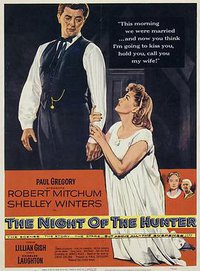
The Night of the Hunter (1955)ok, first and foremost this is eerie as all heck and mitchum is truly deranged and terrifying. this came across like a parable about the oppression of children and women in patriarchal, christian society (although i don't think those are the exact themes the writers sought to portray). the style of storytelling and accompanying imagery worked quite well imo. i also think i need to watch this on a better-quality screen. i know there's so much depth in the dark ranges that didn't come through on my screen. i think the film is interesting when placed in the context of its time. a film adapted in the early fifties from a novel written in the early fifties, inspired by events that transpired in the early thirties. still, i'm wrestling a little with this one. there's definitely a lot here that's compelling. there's also a lot that leaves me confused about what the film is actually saying (literally, the plot is somewhat confusing towards the end, and thematically it seems to even contradict itself at times). i think some of the contradiction i sense is the product of how much society has changed in the last seventy years, and i think also some of the thematic contradictions are the result of grubb, agee, and laughton truly not understanding power dynamics and oppression within a patriarchal (and puritanical) society like america. one of the most interesting aspects of the writing is actually how much remains the same today as it was seventy years ago. the historical context that this film exists within drives home some of the themes almost as well as the writing itself does. the movie earns four stars based on the cinematography, mitchum's acting, and, honestly, vibes. it's creepy as hell. it's scary. i do not want to be anywhere in the world of this movie where preacher powell exists. and yet, thousands of preacher powells exist all around us, no matter where we live (in america at least). i want to explore the oft-referenced themes of "good vs. evil", "the innocence of children", and "the dangers of religious zealotry". i think it's fair to interpret these as main themes, though i think the main theme is more accurately the oppressive nature of both patriarchy and american christianity. one of the most glaring missed opportunities in the writing is that the writers present preacher powell as a unique abomination. a monster who is misappropriating christianity for his own benefit. however, among those who have held power within american christianity for the last several hundred years, personalities like pastor powell's are much closer to the default and the norm than they are to an outlier. it certainly would be a bit much to expect a film written in the early fifties to be adept at calling this out, and nevertheless it's a discrepancy i thought weakened the film. (it's possible the lynch mob narrative at the end is in fact trying to comment on this, but the way that minor plot point is developed and presented is too confusing to hold any weight for me.) the theme of good vs. evil feels more accurate to label as the struggle of oppressed people (children and women in the context of this film) to survive their oppressors. until the children in the film run away we do not witness a single instance where their autonomy is respected. the children are marginalized and belittled by almost every adult around them, and it gets worse the more preacher powell manipulates his way into their lives. the story almost could have worked equally well if preacher powell was simply emotionally abusive, rather than murderous. the fact he's a murder isn't really the point. the point is that he will stop at nothing to manipulate and control and remove agency from those around him (especially women and children). murder just so happens to be a powerful way to portray removing someone's agency. (the story is also loosely based on true events.) one of the most interesting glitches in how the writers present "good" is in the character of rachel cooper. she is in the story seemingly to represent a foil against the "evil" of preacher powell. notably, her first interaction with the harper children is threatening. while her intentions are to act as a "savior" to these young children (and i'm sure this depiction actually makes sense against the backdrop of the poverty of the time), she literally threatens them with a switch and forces them to come live with her. so, we see in even the most benevolent character in the film, still a willingness to remove agency from children. don't get me wrong, i'm sure almost nobody in the early fifties was aware how oppressive parenting practices of the time were, it just feels worth noting. the case could be made that once she's adopted the children (and youths) into her home they are treated quite well and seem to have freedom to explore and make mistakes. still, she serves as an interesting case study on the pitfalls of saviorism. we witness well-intentioned people all around us accidentally replicate the systems of power they seek to protect people from, especially when they haven't done their own internal work to unlearn the systems of power. in this case, rachel seeks to protect the children from (a caricaturized version of) patriarchy, yet she hasn't acknowledged and healed from the ways she herself wields patriarchy. this is visible in how often she makes disparaging comments about women. on the dangers of religious zealotry and the appropriation of religion for selfish or evil purposes, i think the film is notably less clear. this is maybe a personal hang-up with religion, but i don't find the foil for malevolent religious figures to be benevolent religious figures (as it is in this film). those things are two sides of the same coin. i feel like the foil for malevolent religious zealots must come from outside of the hierarchical, patriarchal world of christianity. but hey, to each their own. the film to me would have been more interesting if the person who ultimately came to the aid of the children was not themself religious. but hey, a lot of this is actually commentary on the source material, as the film is famously intentional about portraying the source material as grubb intended. it's creepy. it's almost whimsical? it's kind of an epic? i'll likely watch it again, and i'm open to the possibility it could earn a higher rating in the future.