Masao Adachi — Producer (3)

Movie

1963 (1963) IMDb TMDB Douban
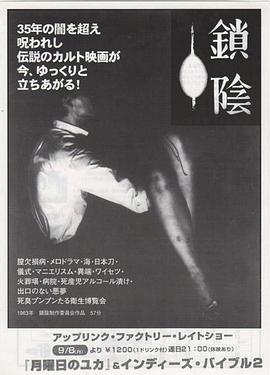
鎖陰
director: Masao Adachi actor: 竹田ひろし / 木村京子 …
other title: 锁阴 / 鎖陰 …
Sa-in (Blocked Vagina) 1963. Directed by Masao Adachi with some students of Nihon University (Nihon University Film Study Club) Blocked Vagina represents the blocked situation following the demonstrations against the AMPO in 1960. There was a happening during the projection of this movie Sa-in no Go (The Ceremony of the Blocked Vagina) with fight against the police. The film was stole during that fight. Pou Pou / Pu Pu (1959) by Motoharu Jonouchi. Surrealist movie by Motoharu Jonouchi a friend of Masao Adachi from Nichidai, Nihon University.
Movie

Gingakei (1967) IMDb TMDB Douban
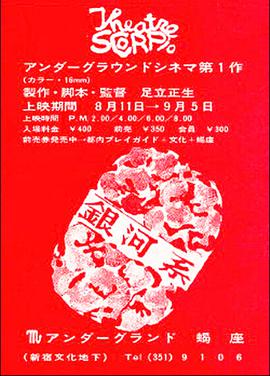
銀河系
director: Masao Adachi actor: Akira Hanagami / 竹邑類 …
other title: 银河系 / 銀河系 …
A car wreck on a beach road. While the passengers gather round the broken engine the driver, a young man meets his doppelganger on the beach. He beats and strangles him to death. A hospital. The young man walks down a flight of stairs passing a group of beautiful nurses and is hit by a crutch, thrown by his doppelganger who’d been waiting for him at the top of the staircase. Again he beats him to death with the crutch disposing of the corpse in the nearby toilet room. Leaving the toilet the young man is again confronted with his living doppelganger and collapses. A car. The young man now drives through Tokyo’s outskirts accompanied by a beautiful woman who tries to hug and kiss him. Desperately he tries to escape from her leaping through the windshield of the driving car now flying high above the highways landing on a table on the rooftop of a building trying to hide from the woman, who somehow managed to follow him through the air…
Sounds crazy? It’s the synopsis of the first 10 minutes of Adachi’s independently produced experiment in classical surrealism, a dreamlike Möbius-strip of a film, which was the formal opening film at the famous underground theatre Zasori-za located in the basement of Shinjuku Bunka, the headquaters of ATG and the Tokyo underground movements of the 60’s. The original print was sepia-tinted, hence the distorted colour of the stills.

Movie

A.K.A. Serial Killer (1969) WikiData IMDb TMDB Douban
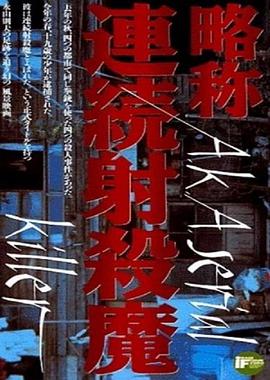
略称・連続射殺魔
★ 7.5 (6 ratings) director: 足立正生 actor: Masao Adachi
other title: 略称:连环射杀魔 / 略称・連続射殺魔 …
A horrifying series of murders, committed by a teenaged killer in 1968, prompted a group of filmmakers to chart his path, capturing the things he might have seen before committing his crimes. Their result is this provocative, rarely-screened meditation on geography and society.
In 1969, Adachi, who had already made a number of important films, led a group of people, who were all in the vanguard of filmmaking in Japan, in making a film called “AKA. Serial Killer.” The camera eye mostly shows various landscapes across Japan, following the itinerary of a young informal worker, Norio Nagayama, who ended up committing a series of shootings in these places. Then a relatively known film director made a narrative film about Nagayama’s miserable upbringing and tried to make a statement about the social inequality that was supposed to have been responsible for his crime (The film is “Naked Nineteen -Hadaka no Jyuukyuu-sai-” directed by Kaneto Shindo, 1970). Meanwhile this group decided to pursue a totally different approach, which, precisely speaking, is neither a story film nor documentary. It is an attempt to see exactly what Nagayama saw along his itinerary looking for a better job, a better place, which never existed. The resulting film shows a series of terrains that have been transformed to the effect of losing genius loci or the singularities of place and became a series of postcard-like landscapes. This was the most straightforward critique of capital’s “real subsumption,” namely, the overall commodification of the everyday, which corresponds to the critique of “spectacle” by Guy Debord (The key word used in the debate provoked by the film was fukei in Japanese, which is commonly translated as “landscape.” As opposed to that, the music critic Yuzo Sakuramoto suggested to use “spectacle.”).
足立正生 Masao Adachi
男,生于1939年5月13日,福冈
他为大岛渚和若松孝二写下了不少杰出的剧本。
当他还是大学生的时候,他来到了若松的制片公司,要求加入,若松说:欢迎,我会好好折磨你的。足立写剧本很快,两天一个。后来若松回忆起来,说当时的确对他很狠,甚至说:如果下雨,就是你的错。
1971年,足立加入日本赤军,成为领袖之一,后来转战中东,1997年2月15日被黎巴嫩警方逮捕。2000年3月18日被黎巴嫩政府送回日本,在成田机场,足立被日本警方逮捕。